Apps vs Notebooks: Which Wins for Habit Tracking?
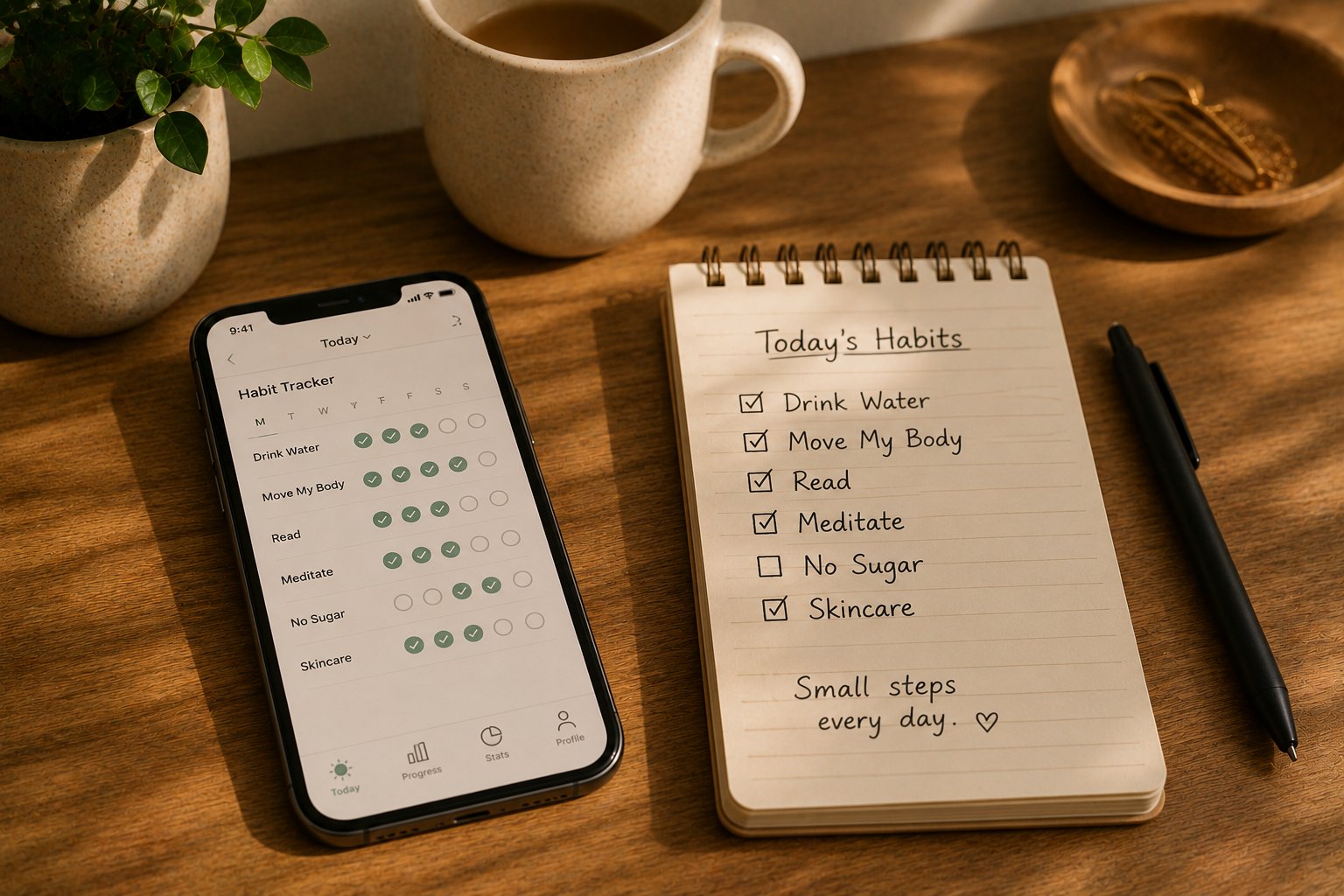
Yes, this post lives on a habit-tracker company's blog, and yes, it will eventually recommend a habit tracker. The honest answer is still messier than "apps for everything." A bullet journal beats an app for certain habits and certain people, and the reverse holds just as often. What actually decides it is what you want to learn from the tracking, because paper and pixels surface very different things. The sections below cover where each side wins, plus the hybrid setup that people who have tracked habits for years tend to land on.
What you're actually deciding between
Search results frame this as a religion war between minimalists and tech bros. Underneath the framing, both methods do the same job. You mark whether the habit happened today, patterns pile up over time, and there's a small ritual in ticking a day done. Where they genuinely differ is in friction, retrieval, and reflection, and those three variables matter more than the medium itself.
Friction is how much energy each log costs you. Paper carries a tiny constant overhead: dig out the notebook and a pen, flip to the right page. Logging in an app is a single tap, though the phone brings its own tax in the form of whatever notifications are waiting on the lock screen. With one habit, the paper overhead is nothing. Multiply it by seven habits and it starts to add up fast.
Retrieval covers how easily you can look back. This month's spread in a notebook is right there under your thumb; January of last year means digging through a drawer of old books. An app pulls up years of data in about a second. If your habit's value emerges from quarterly or yearly patterns, that speed dominates the decision. When all you ever need is the current month, it barely registers.
Then there's reflection, the depth of what you write about the habit. Margins, notes, and sketches invite longer entries on paper, while most apps cap you at a yes/no or a 1-5 rating. Habits where the WHY matters as much as the WHETHER give paper an edge. When you just need the count, an app does the job.
Where notebooks win
Gratitude journaling, weekly review, monthly goal-setting, morning pages, decision journals: reflective habits with a low daily count live or die by what gets written, not by whether a box got checked. Paper invites a longer, more thoughtful entry where an app tends to compress the same moment into a single tap. Any habit where the entry itself is the payoff belongs in a notebook.
Tracking exactly one habit, daily writing say, doesn't need software at all. Open the notebook, mark today, close it. An app is overkill for a single line.
The biggest hidden cost of app tracking shows up for anyone already fighting their phone for attention: the log lives inside the same device as everything engineered to eat an evening. Open the phone at 10pm to tick one box, and Instagram is sitting right there; 25 minutes later it's a stranger renovating a van. The paper version of that same log costs 30 seconds and exposes you to nothing else. Some genuinely disciplined trackers refuse to log anything on a screen after dinner for exactly this reason. Shaky phone discipline is reason enough to pick paper on its own.
Some people draw their trackers, and the drawing itself is half the ritual for creative or visually-expressed habits. Nothing digital replicates that. Sitting down on a Sunday night to design next week's spread is a small act of commitment in itself, and bullet journals were built around exactly that moment.
Where apps win
The friction math reverses fast once multiple habits enter the picture. Two habits fit fine in a notebook, but by seven there's a full page of small grids to fill in every single day and dread before the look-back even starts. Apps handle 7-15 habits about as easily as 1, and they surface the cross-habit patterns, which habits move together, which days run cold, that a notebook holds inside its pages without ever showing anyone.
Water five times a day. Steps all day. Supplements three times a day. High-frequency habits outrun what a notebook can keep up with. Apps handle continuous data natively and plug straight into Apple Health or Google Fit, which paper simply can't do.
Figuring out how sleep tracked across all of last year, or what Sundays tend to look like, or exactly where habits historically fall apart, needs months or years of clean data pulled up instantly. That's long-term pattern detection, and apps win it by orders of magnitude. The data technically exists in a stack of old notebooks too, somewhere across a dozen of them, and nobody is ever flipping through twelve notebooks hunting for a pattern.
Vitamins. Hydration. A 3pm stretch break. Whatever the habit, if it only fires when a reminder taps a shoulder at a specific time, apps are built for this and paper structurally isn't; notifications exist on one side of this comparison and not the other. Habit chains can eventually replace the reminder, but only once the chain is already installed. In the first 21 days, the app's push notification is doing real work.
A lost notebook takes six months of data down with it. A lost phone doesn't, since the data was already waiting in the cloud before the replacement even arrived. For anyone who genuinely cares about long-term retention, backup and recovery alone settle this category.
The hybrid setup most consistent trackers actually use
Talk to anyone who's held a habit-tracking practice for 5+ years and they'll usually describe a hybrid: an app doing the daily binary tracking across several habits, and a notebook holding the weekly or monthly review where the actual reflection happens. Each tool ends up covering the other's blind spot.
In practice it looks like 6-10 habits tracked daily in HabitIt (or whatever app), each one a single tap. Then on Sunday morning the notebook comes out for a 200-word weekly review with the app's data open as the prompt - what went well, what didn't, what to adjust next week. The app supplies the raw material, and the notebook is where it turns into something worth reading back a year later.
Forcing everything into one place tends to end with nothing happening in either. An app's reflection field is too cramped for a real entry, a notebook is too slow for logging 7 daily habits, and the setup collapses at whichever end you overloaded. Splitting the jobs is what works.
A practical test to pick
The choice comes down to three things.
1. Habit count. One or two: paper. Three to five: either works. Six or more: app.
2. Reminder dependence. Vitamins and hydration need a nudge, so app. Workouts and sleep fire on their own, so either.
3. Whether the entry itself carries the value. Journaling and gratitude: paper. A binary done-or-didn't: app.
Two or three answers pointing the same way settle it. A split points at the hybrid setup above. The whole decision should take about 90 seconds, and if you're still chewing on it after five minutes, you're overthinking the tool and undershipping the habit.
Running it
Whichever you choose, give it 30 days minimum before judging. The first week is awkward either way - in an app you're still dialing in reminders, on paper you're still fiddling with the layout - and both stabilize after week two. Week one is setup noise.
Every habit tracker app vs notebook comparison lands in the same place eventually: it depends on the habit. Pick based on the three answers above, run the system for 30 days, and adjust based on what worked. The streaks vs calendars post covers the next decision down (once you've picked a medium, which tracking UI to use), and the journaling habit post covers the paper side in depth.
Common failures
The classic one is switching methods every two weeks. The app feels limiting, so you move to a notebook; the notebook feels slow, so you move back, and no system ever runs long enough to prove anything about itself. Thirty days minimum before you're allowed to switch.
Money causes a quieter version of the same failure. The $40 aesthetic bullet journals are beautiful and intimidating, and plenty of them die at page three because ruining a $40 book feels like a crime. A $5 composition notebook removes that pressure for the first three months, and by then you'll know whether you're someone who'd ever use the upgrade. Very few are.
On the app side, the equivalent is chasing the trendy tool every quarter - Notion this month, whatever launched loudest the next. Every switch resets your data and your habits along with it. Give one app 6 months, and only move if you can name the specific feature gap driving you out.
Some people also turn the choice into identity, declaring themselves a paper person or a tech person and using the label to stop asking what actually serves the habit. Pick for the habit and let the self-image catch up.
Underneath all of these sits tracking with no plan. A daily box with nothing behind it is a feedback loop wired to nothing; by week two there's nothing to feed back on, so you quit. Build the plan first, pick the tracker second.
Beyond the choice
A lot of the energy that goes into the paper-or-app question would do more good pointed at the habit itself and the plan behind it. The tool is a small fraction of the outcome; the plan is most of it.
If you've tried both and neither stuck, the tool probably wasn't the problem. The structure was - no anchor, no specific trigger, no plan underneath. A good medium amplifies a good plan and does nothing for a missing one. Get the plan right and either side of this comparison will carry it for 30 days.
HabitIt is, obviously, an app. We still lose users to bullet journals constantly, and we're okay with that, because what we care about is whether the habit holds. If paper is what makes it hold, that's the right call for you. In practice, plenty of people land on the hybrid setup described above anyway. Whichever side you start on, run it long enough to know.
Try a digital habit tracker today
Free 3-day trial of all features. After that the free tier covers the basic plan. No subscription required.


Get the Hybrid Tracking Template
Drop your email and we'll send a printable plan you can fill in and track. Occasional updates (max 1 per 2 weeks).
Success! Now check your email to confirm your subscription.
We respect your privacy. Unsubscribe at any time.