How to Drink More Water: A 30-Day Hydration Plan
You know you should drink more water. You keep buying bottles, filling them once, and forgetting. By 6pm you've had two coffees and half a glass at lunch and your headache is back. The problem isn't that you don't care about hydration. It's that "drink more water" isn't a habit. It's a wish. Here's the 30-day plan that turns it into a habit so quiet you stop noticing you're doing it. An AI habit tracker with an automatic daily plan ramps the cups for you so you don't have to keep doing the math.
The pattern you already know
Monday morning you read another article about hydration. You buy the bottle. You fill it. You drink it once. You put it down on the desk. You forget. By Friday it's a decorative object.
Two weeks later you do it again. Different bottle. Same outcome. You wonder, briefly, if you just don't have the willpower for water. You do not. Willpower has very little to do with it. The reason "drink more water" doesn't stick is that it's not a habit yet. It's a vague intention attached to no specific moment, no specific quantity, and no feedback loop telling you whether today went well.
This is the 30-day plan for anyone who keeps meaning to drink more water and never quite does. The four rules. The slow ramp. The few specific failure modes that kill it for almost everyone.
Why most "I'm going to drink more water" attempts die in week 2
Three reasons, in the order they kill the habit most often:
"8 cups a day" is the cultural default everyone's heard, and for someone starting from 3, it's more than double overnight. Targeting 8 on day one from a 3-cup baseline plays out the same way almost every time: 4 cups in by 2pm, a bladder that feels like a punishment, and a fight already lost before anyone realized they were in one. What works on day one is current baseline plus one. Not eight. Plus one.
Most habits start easy because a trigger already exists: teeth get brushed because someone just woke up, lunch happens because it's noon. Water has no native cue at all, and thirst itself is a lagging indicator, arriving well after the body is already running low. A water habit needs a manufactured cue, and only the ones anchored to existing rituals hold at all: morning coffee, lunch, the walk to a desk. "Drink water during the day" as a plan gets forgotten, every time, because it was never actually anchored to anything.
A streak, a finished page, a mile logged: most habits that survive give back something visible. Water's reward is close to invisible, just "slightly less terrible than yesterday," which doesn't fire much of anything. Chasing that feeling doesn't fix it. Tracking the count does, since the visible number ends up doing the work the feeling never could.
The 30-Day Plan
This plan assumes a starting point somewhere in the 3-5 cup range; CDC survey data puts the US adult average for plain water, not counting coffee, tea, or other drinks, at roughly 4-5 cups a day, and plenty of people sit well below that. If you're already higher, slide your week-1 target up to match. The principle holds: add one cup per week, anchor each new cup to an existing daily ritual, and stop the climb once your body tells you you're full.
Put a glass of water next to your coffee maker or by the kettle. Drink it before the coffee. Not while. Not after. Before. The cue is already there. You stand in the kitchen for two minutes every morning anyway. Use that. By day 7 the cup will feel automatic. If it doesn't, you skipped a day and didn't notice. That's fine. Tomorrow you do it again.
Keep your coffee, your soda, whatever. The whole game in week one is one cup, one anchor. People who try to overhaul their entire fluid intake on day one are the ones who give up by day five and Google "is it bad to drink no water." You're not them.
A glass of water at the start of lunch. Whatever lunch looks like, whether it's a desk salad or a sandwich on a Tuesday. The act of sitting down is the cue. Doing it before you eat (instead of during) means you actually drink the whole glass, because once food is in front of you the water gets ignored.
Get a bottle or glass that stays on your desk all day. Refilled twice (morning, lunch). Visible water gets drunk. Bottles in the fridge do not. This is the most boring sentence in the post and also the highest-impact one. Look up from your screen, see the water, take a sip. That's the whole technology.
The third anchor is the one that's specific to your life. If you have a 3pm meeting block, anchor it to the walk into the conference room. If you pick kids up at 4, fill the bottle in the car. If you work out at 6, the pre-workout cup. Pick the one ritual you do daily that you haven't already used. The point is repetition at a fixed moment, not the moment itself.
Around day 18 most people report that their skin feels different, their afternoon energy is more even, and they're not getting the 4pm headache they used to dismiss as a coffee crash. This is the dopamine kick the habit needed. It's late but it lands.
Do not try to go from 7 to 12 because you're "doing well." That's the move that breaks the habit. The new baseline is somewhere between 6 and 9 cups for almost everyone and you'll know which end of that range works because your body will tell you. Bladder constantly full means too much. Headaches and dark urine mean too little. Boring, comfortable, no thoughts about hydration means you found it.
Have one weekend during week 4 where you do not track at all. Just live. If by Sunday night you've still hit roughly your target without checking, the habit is locked in. If you've drifted back to 3 cups, the anchors aren't sticky enough yet. Go back to tracking for two more weeks and the anchors will deepen.
The Four Rules That Make It Stick
A "cup" is whatever vessel happens to sit on the desk; it doesn't have to be exactly 8 ounces. Counting cups instead of ounces or milliliters removes the exact friction that makes most water apps annoying to use. A 12oz glass, 8 of them, is already more than enough. Pick the vessel once and count from there.
This is habit stacking applied directly to water: coffee, lunch, kids' pickup, workout, bedtime, whatever already happens daily without a second thought. Anchoring every cup to an existing ritual is what makes the cue reliable. Clock-based cues ("9am, 11am, 1pm") fail almost every time, because nobody actually checks the clock. They check whether coffee is already in hand.
Hydration is an environment-design problem wearing a discipline-problem costume. A visible bottle beats willpower every time: one sitting in the line of sight gets drunk passively, one buried in a bag doesn't. Working across different rooms during the day just means buying two bottles, which is cheaper than failing at this habit a third time.
"8 cups a day" is a generic cultural baseline, not a medical standard. Body weight, climate, sweat rate, coffee intake (which counts toward hydration despite the old myth otherwise), and how much produce gets eaten all shift the real number up or down. A 110-pound desk worker in a humid city needs less than a 220-pound construction worker in Arizona. Don't chase 8 if the body's actual answer is 6. Week 4 is where that real number gets found, and the plan is a ramp toward it, not a fixed target to hit forever.
Running the day-by-day habit plan with an app (not a piece of paper)
You can absolutely run this with tally marks on a sticky note. People did. The failure mode of the sticky note version is that on day 6 you forget to put the note up and you've broken the visible feedback loop that's holding the habit together. An app does that part automatically and lets you tap a single button when you finish a cup, which matters because if logging takes more than two seconds you'll stop logging.
Three small things to look for in whatever you use. First, can you log a cup in one tap from your home screen widget without opening the app? If not, you'll skip logs. Second, does the daily target adjust automatically when you set a longer-term hydration goal? If you have to manually edit the target each week, you won't. Third, does it shrug off a missed day instead of resetting your streak to zero? Because you will miss a day, and apps that punish that by demanding you start over from one are how this habit dies a second time.
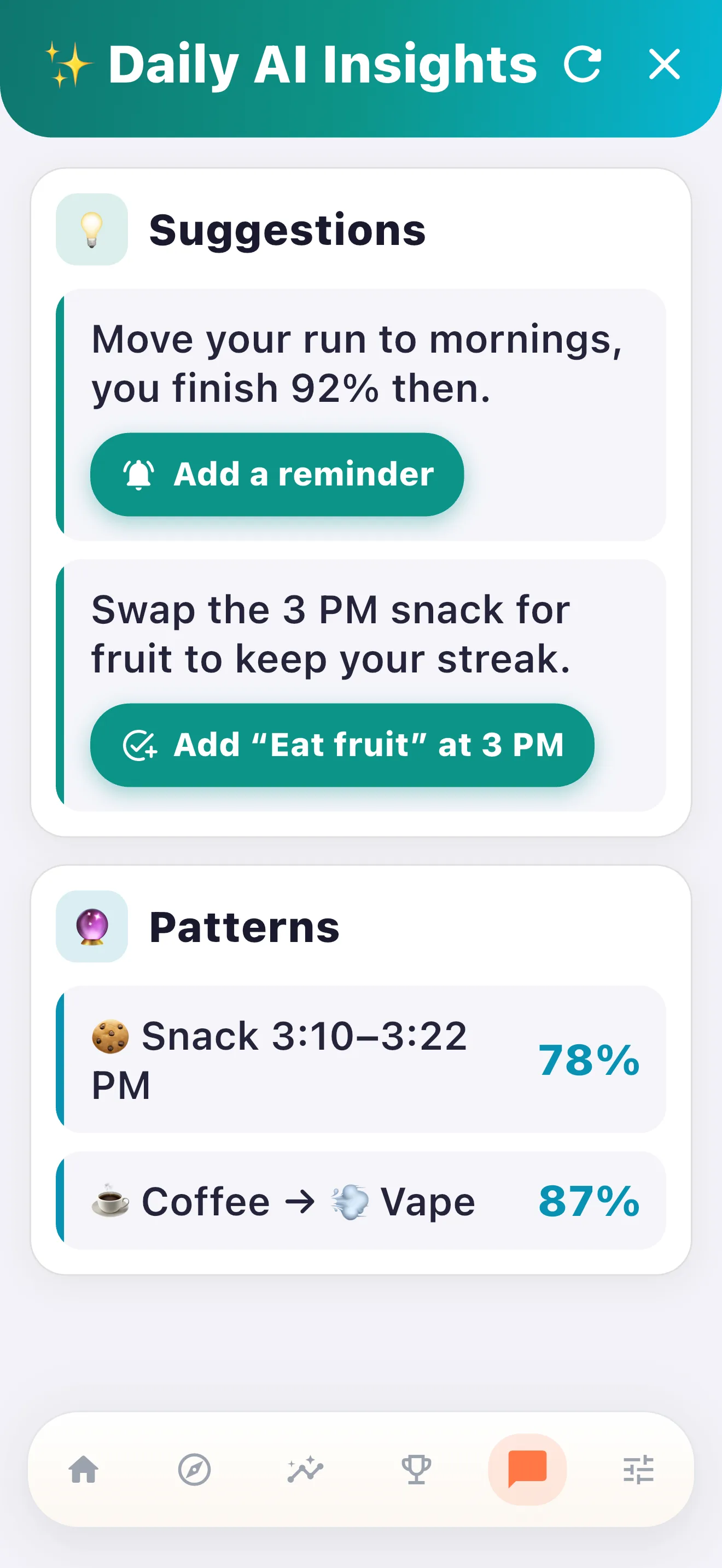
If you've been looking for a water tracker app that does the daily target math for you instead of just being a glorified tally counter, or a hydration tracker app that anchors your cups to existing routines via habit chains, or a drink more water app that scales the daily goal up gradually instead of forcing 8 cups on day one, HabitIt's "more" journey was designed for exactly this shape of habit. You set the start number (current baseline) and the end number (your target), and it builds the weekly ramp. The home screen widget logs a cup in one tap. The journey resets gracefully when you miss a day. The cost tracking side counts how many bottled drinks you're not buying, which becomes its own small reward by week three.
The Five Ways This Habit Still Dies
Thirst is a delayed signal, already trailing well behind the body's actual state by the time it registers, which is exactly why "I'll just drink when I'm thirsty" quietly kills this habit. The whole plan exists to drink on a schedule, anchored to rituals, so thirst never has to be the trigger in the first place. Abandon the anchors for "I'll listen to my body" and the habit tends to be gone within ten days. Listening to the body is a week-4 privilege, earned once the habit's locked in, not a day-one strategy.
Forty dollars on a smart bottle that lights up on a schedule solves nothing, because the fancy bottle was never the problem or the solution. The bottle that actually works is the cheap one already sitting on the desk. Treating a fancy purchase as the "starting point" of the habit is a delay tactic dressed up as preparation. The habit starts with the glass in the kitchen tomorrow morning, not whenever a package arrives.
Three cups by 6pm becomes an attempt to chug the rest of the day's target right before bed, and that sprint wrecks sleep with bathroom trips while teaching the body a pattern that isn't useful at all. Three cups is just the day that happened. A cup with dinner, no attempt to erase the deficit by 10pm, and tomorrow the anchors pick the slack back up.
Lemon or cucumber in the glass is harmless. Electrolyte powders, sweetened enhancers, flavored sparkling drinks, or coconut water counted as "hydration" undermine the actual point, which is building a relationship with plain water specifically. Flavored water creep tends to fade on its own by week three as the plain version stops needing help. Still exclusively drinking flavored water on day 30 means the habit that got built isn't the one that was intended.
Coffee and tea genuinely do contribute to daily fluid totals. But the "coffee counts" loophole undercuts a habit that's specifically about drinking water as a deliberate act. Let coffee count, and the whole thing drifts back to "I drink water sometimes," which dissolves fast. Water gets tracked separately regardless of overall hydration, because marking the cup is the actual mechanism locking the routine in.
Beyond 30 days
Around day 35 you notice you haven't thought about hydration in a few days. The morning cup happens before you're awake. The lunch cup happens before you've sat down. The afternoon anchor fires automatically. You're not "trying" anymore. This is what a locked-in habit feels like: invisible, frictionless, and a little bit boring.
The interesting part is what gets unlocked next. Once water is automatic, the same anchor framework can stack onto something else. A morning glass of water can become "morning glass of water plus two minutes of stretching." A lunchtime glass can become "lunch water plus a five minute walk." This is the chain effect, and it's how a single boring habit becomes the scaffolding for everything else. If you're curious about that next step, the habit chains post goes into the structure of stacking new behaviors onto established ones.
For now: just get the water cup happening every morning before coffee. That's day one. The rest of the 30-day arc follows from that single agreement.
Build your 30-day water plan today
Free 3-day trial of all features. After that, the free tier covers a basic hydration journey. No subscription required.


Get the Free Hydration Plan
Drop your email and we'll send a printable plan you can fill in and track. Occasional updates (max 1 per 2 weeks).
Success! Now check your email to confirm your subscription.
We respect your privacy. Unsubscribe at any time.
Let the app ramp it for you with a drink more water habit tracking plan that adds one anchored cup a week.