How to Be Sober Curious: A 30-Day Alcohol Reset
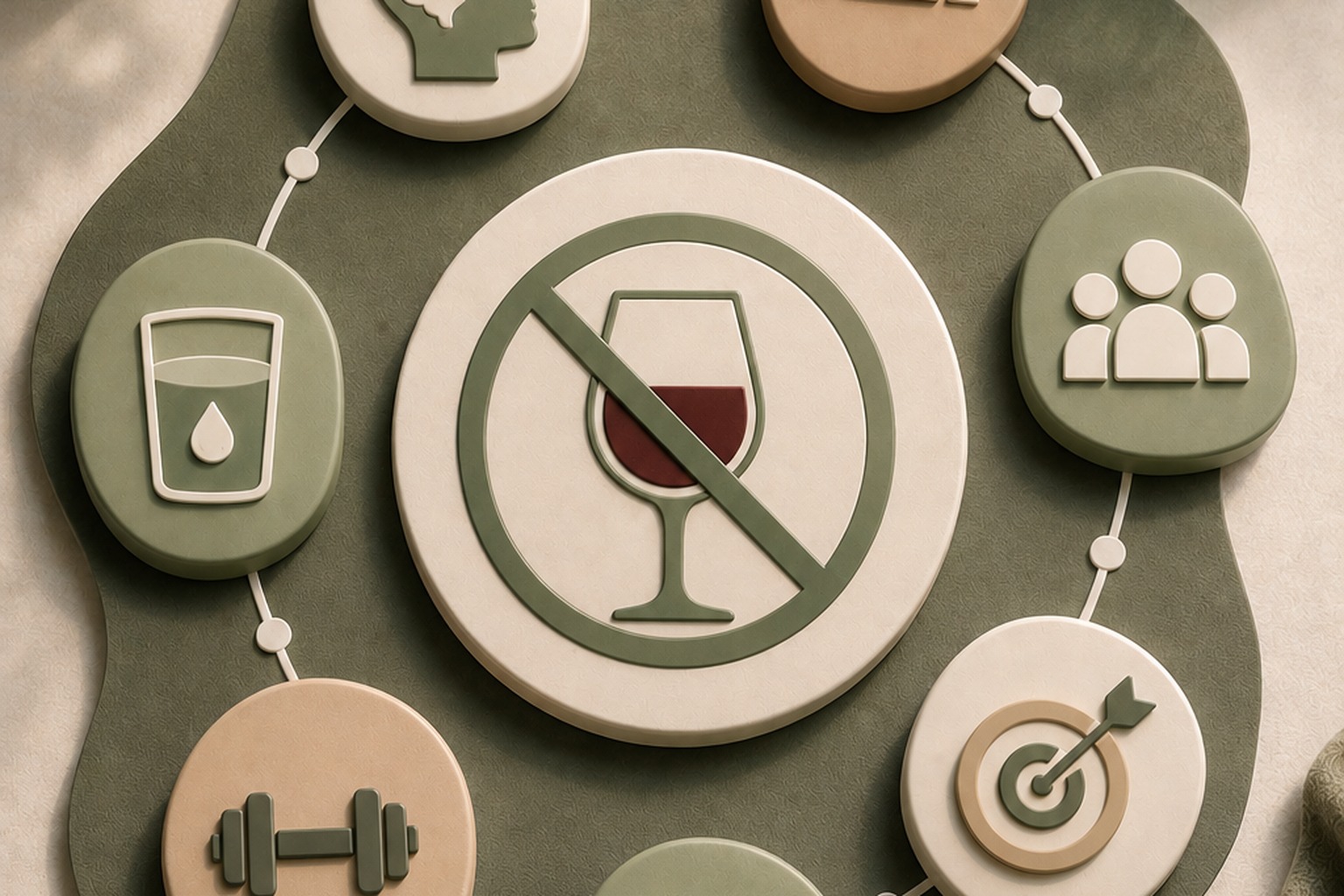
Sober curious means taking alcohol out for 30 days to see what happens, without deciding in advance that anything is wrong with you. Nobody is asking you to count days forever or pick a label. Sleep, anxiety, social energy, skin, focus - all of it shifts when alcohol leaves the picture, and hardly anyone knows their own baseline because there's been a drink somewhere in every week since college. This plan treats the month as data collection. What you do with the data afterward is your call.
The pattern you already know
Wine at dinner on Tuesday. Beer at the game on Saturday. Cocktail at the work event because everyone else has one. None of it feels like a "drinking problem." It feels like just what you do in those contexts - the glass that shows up automatically, the round you order because not ordering feels like a statement you didn't mean to make.
The sober curious question is quieter than "do I have a problem with alcohol." It's closer to: how much of my drinking would I choose, if I were actually choosing? That's a hard thing to answer from inside the routine, which is the whole reason for the 30 days. You're buying data you can't get any other way. Sleep with no alcohol in the picture. Baseline anxiety without the Friday wine. A Sunday where 10am feels like the middle of the morning and not the painful start of it.
Calling it an experiment does real work here. A month spent just not drinking is a month built entirely around absence, and absence gets heavy by week two. A month spent watching what your sleep does without alcohol has an actual job attached to it. Same zero drinks either way. One version runs on willpower alone. The other runs on curiosity, and curiosity holds up a lot better at a wedding.
Here's the part that tends to catch people off guard: the craving itself is usually manageable. What's awkward is everyone else. Someone hands you a beer, you wave it off, and suddenly there's a small conversation happening about you. Get a two-sentence answer ready before day one - something about running a 30-day experiment, mostly curious what it does to your sleep. Say the word experiment and people start asking about the experiment instead of about you.
Why most attempts fail
A few things sink most attempts. Framing is the first, and it sounds soft until you've actually lived with it for a month. Treat the month as deprivation, and every dinner out quietly becomes a dinner without wine. By day 12 there's a birthday, and the only thing left holding the line is stubbornness - which loses to champagne more often than people expect. A question you actually want answered, like what happens to your sleep or where your anxiety sits without a drink in the evening, gives day 12 something sturdier to run on.
The second is walking into social situations without a script. The plan rarely dies at home on a Tuesday. It dies at a bar, in the two seconds between "what are you having" and whatever comes out of your mouth. So decide before you walk in. Sparkling water with lime, tonic and bitters, whichever mocktail the venue does. The specific drink barely matters, as long as you never have to choose it in real time with people watching.
The third is finishing the month with no plan for day 31. Go in with "I'll see how I feel" and the old pattern comes back on its own - nothing marks the ending, so nothing changes. Make day 31 an appointment: open the log, read four weeks of sleep and anxiety numbers, and decide what drinking looks like from there. A month built toward a decision runs completely differently than one spent just counting down to a release date.
The plan
The current count matters because day 31 is a comparison point. The replacement order matters because you'll need it within days. The one or two people matter because some social contexts are much harder than others and having even one person who knows what you're doing is a meaningful buffer. You don't need to announce it broadly - just enough to have cover in the situations where drinking is the obvious default.
This is what you're here for. Fair warning on sleep specifically: the first few nights can sometimes get worse before they get better, with vivid dreams or a rougher night than usual. That's alcohol's grip on REM sleep loosening, and it's a known, well-documented pattern.[1] Real improvement tends to show up around one to two weeks in, easy to miss night-by-night but clear once you look at the weekly average. Energy tends to follow behind that. Anxiety moves on its own schedule entirely - some people feel it ease by week two, others don't notice a shift until the final week, and either one is normal. A flat anxiety line for three weeks isn't the experiment failing. Write the numbers down every morning regardless. Memory at day 30 is useless - "I think I felt better" isn't a data point.
Weeks 1 and 2 are mostly home territory. Week 3 is where you find out how the plan holds in the real world. Does the replacement drink order work in practice? Is the social pressure as hard as you expected? With the answer ready, it's usually a non-event. "Doing a 30-day experiment" gets a curious follow-up question about half the time and a shrug the rest. Nobody has ever staged an intervention over a glass of sparkling water.
Look at your sleep trend across four weeks, your energy trend, your anxiety trend. Note which social situations were genuinely difficult and which ones you barely thought about. Four weeks in, you're not guessing anymore. Maybe you keep going. Maybe alcohol comes back on your terms - weekends only, or only at things actually worth toasting. Maybe the sleep numbers alone convince you to extend the experiment another month. Any of these is a fine answer as long as it comes out of the log and not out of momentum.
The four rules
1. Log the data every morning. Sleep, energy, anxiety - three numbers, thirty seconds a day. Skip the log and day 30 arrives with a vague feeling and nothing to back it up. Keep it, and you've got an actual sleep score climbing from 5.2 to 7.8 by week three. A lot of people doing this month with real data end up genuinely surprised by how much the sleep numbers move. Everyone's heard that alcohol messes with sleep. Few people have actually seen their own number change because of it.
2. Have the drink order ready. Pick one - sparkling water with lime works fine, and so does tonic and bitters. What matters is that you've already decided before you walk in the door. Having that answer ready takes half a second to order and removes the "what do I get" decision from every social situation for the next 30 days. Decision fatigue is real, and cutting out one friction point right at the moment of highest social pressure is worth more than it sounds.
3. Tell people only when necessary. Nobody at the table needs a reason from you, and "not drinking tonight" covers nearly every situation. There's usually one person who digs anyway. Give that person the experiment - they'll want to know what you're measuring, whether it's working, what your sleep looks like now, and suddenly you're having a much better conversation. Avoid framing it as quitting or as a health scare, because both of those invite advice.
4. Day 31 is a decision point. The 30 days are data collection. What you do with that data happens deliberately on day 31, with four weeks of actual information sitting in front of you. Knowing that going in changes how the whole month feels. It stops being a waiting period until you can drink again and becomes a stretch of active measurement building toward one real decision. That shift alone is the difference between the month feeling purposeful and feeling like a grind.
Running the plan with HabitIt
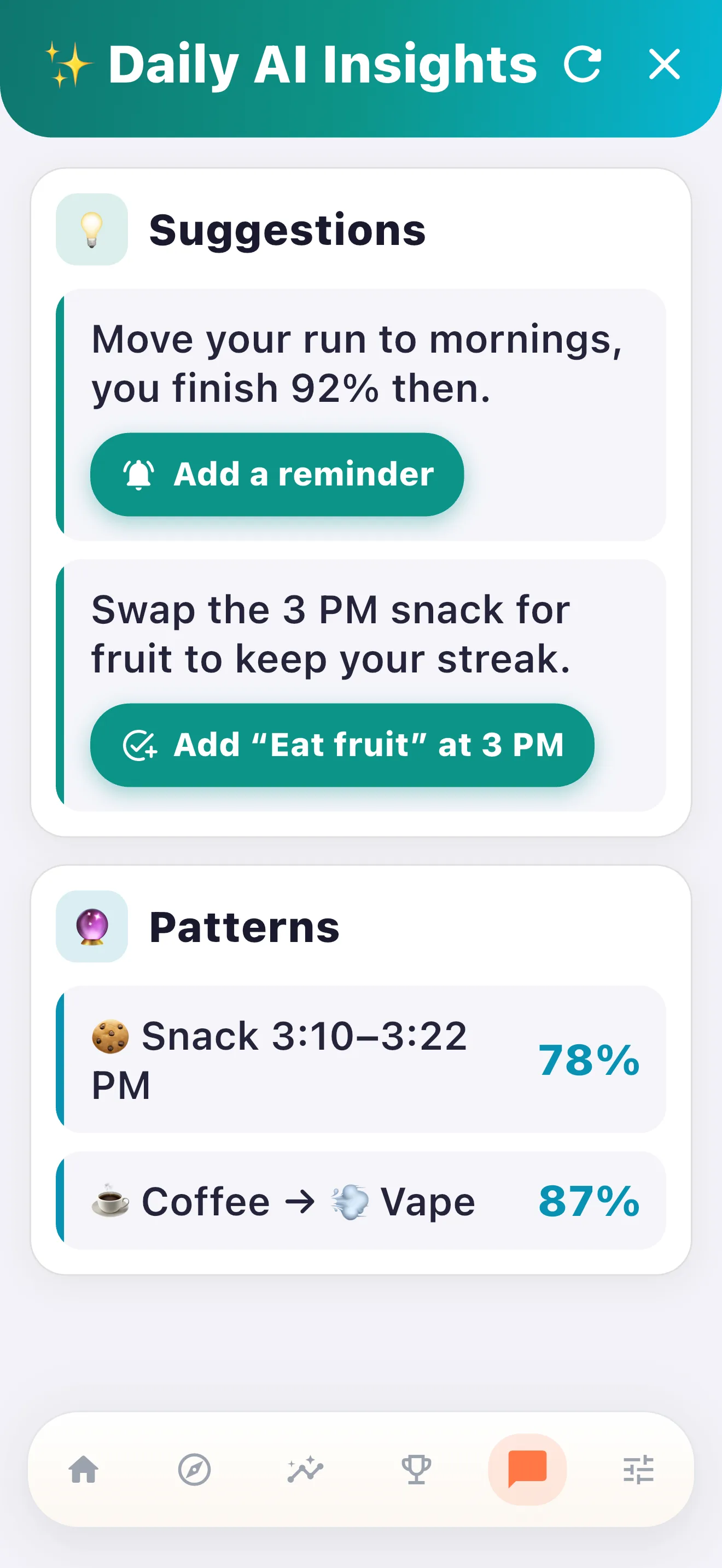
The cleanest way to track a sober curious month is to log drinks as a countable habit with a target of zero. One tap at the end of each day - if you hit zero, you log zero. If you had a drink, you log the actual number. No judgment, no streak reset, just data. The total across the week is visible, which matters because most people's mental model of how much they drink is off from the actual logged number by more than they expect.
The notes field is where the morning numbers live - sleep, energy, anxiety, thirty seconds while the coffee brews. By the end you've got a month of entries in one place and the trend line does most of the arguing for you. That's the document day 31 gets decided from.
The 30-day plan structure holds the experiment even when social pressure hits. You're not deciding each week whether to continue - the plan runs to day 30 and then you make a deliberate call. That structure is most useful in week 3, when the novelty has worn off and social situations get more complex.
The tracker really does two jobs. It logs the drink count, so you're working from actual numbers, not memory. And it holds the morning data, so week four has something real to look back on. Day 31 is only worth deciding anything at if you've got four weeks of data behind it. That's the whole point of running it this way: a month that produces a specific, measurable output.
Common failures
Grading the month pass/fail. "Can I go 30 days without drinking" turns every evening into a quiz, and one rough Friday starts to look like proof the whole thing is falling apart. In an experiment there's no failing Friday. A slip is a data point - what triggered it, who you were with, what time it hit. Log it and keep going. The hard days usually tell you more about your drinking than the easy ones do.
Not having a replacement drink order ready. It keeps coming up in this post because it genuinely is where months end. If the order isn't settled before you're standing at the bar, the decision happens in public, under pressure, half a second after someone asked. Settle it at home. Boring answers work fine.
Skipping the daily log. Skip the morning numbers and day 30 arrives with nothing but a vague sense that things were maybe better - and a vague feeling rarely wins an argument against an old habit, while a sleep average that actually climbed from 5 to 7.5 over four weeks usually does. Thirty seconds each morning is the entire cost of showing up to day 31 with real evidence instead of a hunch.
Not deciding in advance what day 31 looks like. The month needs an ending that's an actual event: log open, numbers read, choice made. Leave it open and the ending gets decided for you, usually by the first invitation that shows up in week five. The choice itself can be small - weekends only, another 30 days, whatever the numbers support.
Beyond 30 days
Run the month properly and the log tends to tell a familiar story, the same shape described above but stretched further out - the numbers just keep moving in that direction past day 30. The bigger surprise for most people is the social side. The situations that looked terrifying from day one turn out to be the thing you stopped thinking about somewhere around week three. Usually the dread costs more than the party ever did.
By day 31, people generally land in one of a few places. Some decide to drink less going forward, with an actual framework attached this time - weekends only, or a weekly limit. Some keep drinking about the same amount, but with real awareness of the tradeoff now, where before it was just autopilot. Some just keep going another month. All of those are fine outcomes. The experiment was never trying to produce one specific answer. It was trying to produce a choice you actually made, not a default you drifted back into.
What makes the sober curious frame different from a quit-drinking approach or an AA framework is that it carries no identity requirement. No label, no confession, no group required. You ran an experiment, you own the results, and you decide what they mean. A lot of people find that a much easier door to walk through than anything that sounds like quitting. If you want to think through the longer-term relationship with alcohol, the three-number method is a solid next step for exactly that.
Citations
- Colrain, I.M., Nicholas, C.L. & Baker, F.C., "Alcohol and the Sleeping Brain," Handbook of Clinical Neurology, vol. 125 (2014), pp. 415-431. Read the source ↗
Build your 30-day sober curious plan today
Free 3-day trial of all features. After that the free tier covers the basic plan. No subscription required.

Get the Free 30-Day Sober Curious Data Log
Drop your email and we'll send a printable plan you can fill in and track. Occasional updates (max 1 per 2 weeks).
Success! Now check your email to confirm your subscription.
We respect your privacy. Unsubscribe at any time.