Cold Turkey vs Taper: Which Actually Works for Quitting?
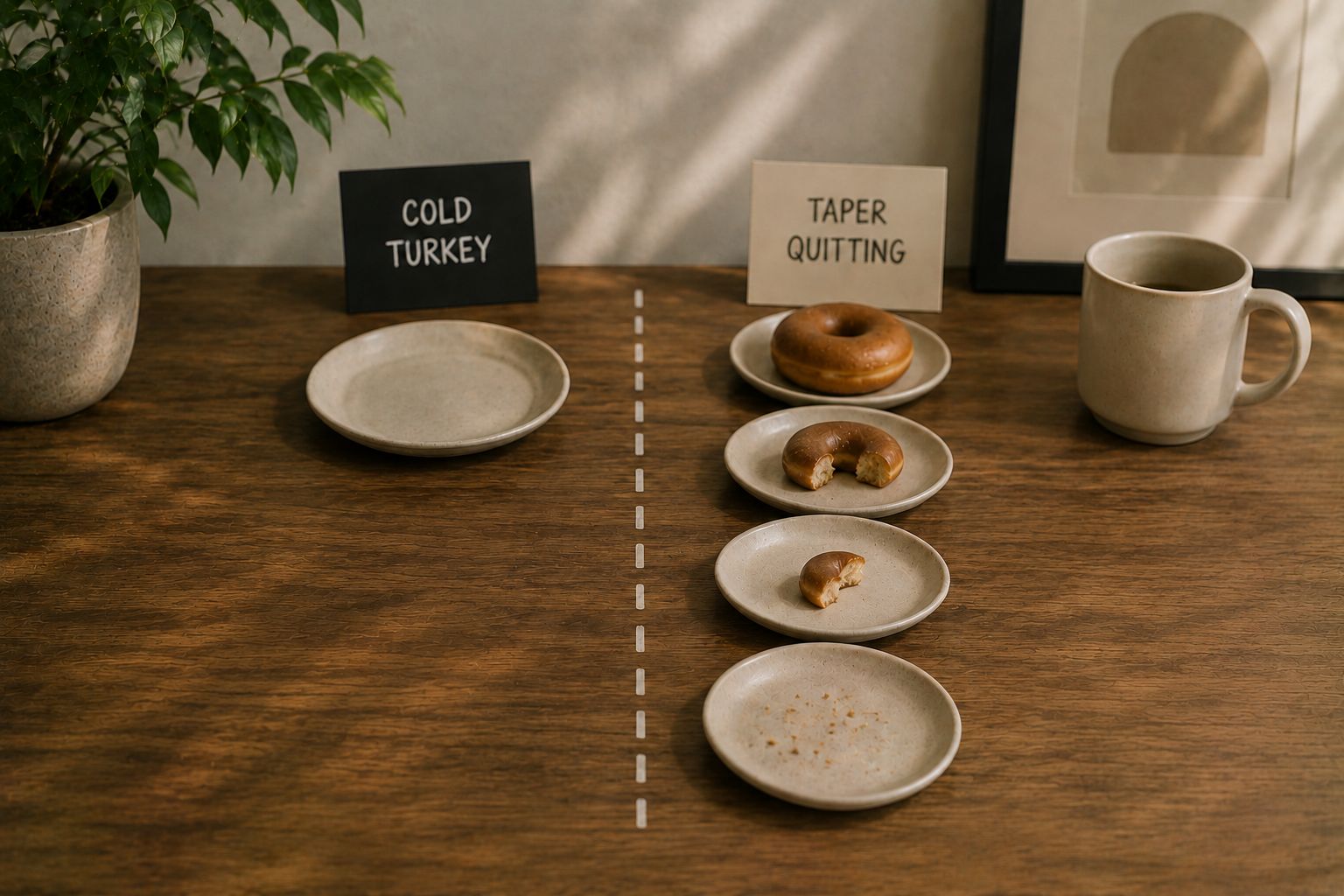
Roughly 3-8% of people who quit a substance completely unaided, no plan, no support, are still off it 12 months later. Structured approaches land well above that, often in the 15-35% range. That gap is real and well-documented. What's less clean is the specific question in this post's title: head-to-head, whether a structured taper beats a well-supported cold-turkey quit is genuinely contested in the clinical literature. This post covers what the research shows, when each approach is the right call anyway, and the hybrid most real clinical protocols land on. It applies the same way to nicotine, alcohol, caffeine, sugar, screen time, and basically any habit where willpower alone has been the default plan. An AI habit tracker that auto-builds the day-by-day plan removes the willpower question entirely.
The quick answer
For most substances and most people, structured beats unaided by a wide margin, and taper is usually the easiest way to get that structure in place. Cold turkey wins outright in two specific cases: when the substance has a hard medical reason to stop immediately, and when the person quitting has a track record of cold-turkey wins and treats them as identity (rare, real). For everything else, including the average person trying to quit smoking, vaping, alcohol, or caffeine, taper is the higher-probability move, though it isn't a proven multiplier over a well-supported cold-turkey attempt done with real preparation behind it. The hybrid (taper plus a structured cold-turkey end) is what most clinical protocols actually use. For smokers specifically, the ten best non-cold-turkey approaches breaks down clinical 12-month abstinence rates for each individual method.
What each approach actually is
Cold turkey is the all-at-once stop. You pick a date, you do the thing one last time, and from the next morning the substance is at zero. The success path is white-knuckling through the worst of withdrawal in the first one to two weeks, then re-stabilizing at the new baseline. The failure path is breaking inside that window because the body's adjustment + the empty ritual slot + life stress all stack on the same week.
Taper is the step-down. You measure your current daily intake, you set a quit date some weeks out, and you reduce by a defined amount each week until you reach zero. The body and the ritual adjust gradually rather than all at once, which spreads the difficulty over weeks instead of front-loading it. The success path is that any single day's reduction is small enough not to break you. The failure path is the taper being too slow, which lets the habit keep its momentum, or too aggressive, which is just cold turkey in disguise.
Both approaches have variants. Cold turkey has the "rip the bandaid" version and the "structured-replacement" version (cold turkey on the substance plus an active replacement habit). Taper has the linear version (drop 20% per week), the milestone version (cut in half, hold, cut in half again), and the percentage-of-the-previous-week version (each week is 75% of the last). The data below is on the broad categories; the specific variant inside each matters less than getting the category right.
What the data says about success rates
The most-cited numbers for nicotine put unaided, totally-alone cold-turkey quitting around 3-5% 12-month abstinence (Hughes and colleagues' widely-cited estimate), versus 15-35% for quit attempts that use structured support of some kind, whether that's nicotine replacement therapy, a prescribed medication, or a planned taper. That gap is real and it's large. What it isn't is clean evidence that gradual reduction specifically beats an abrupt quit: head-to-head trials on that narrower question are genuinely mixed, and a 2019 Cochrane review of gradual-versus-abrupt cessation found the two performed about the same. For alcohol, the same unaided-versus-supported gap shows up; for caffeine, tapering is unusually easy regardless because the half-life is short and the withdrawal is well-understood and mild by comparison. The percentages move depending on the study and how "success" is defined, but the honest takeaway holds: having a plan of any kind beats having none by a wide margin. Which specific kind of plan matters much less than whether one exists at all.
Why? Three reasons that overlap. The first is body chemistry: stopping suddenly produces the strongest withdrawal symptoms, which makes the first two weeks the hardest in the whole quit. Taper spreads that adjustment across the whole timeline so no single week is unbearable. The second is the ritual slot: cold turkey leaves an enormous unstructured time block where the substance used to live, and an empty slot at the time of day you used to use is exactly when relapse happens. Taper keeps the slot occupied by progressively smaller doses, so by the time you reach zero the slot has already been refilled by other behaviors. The third is identity: people who taper successfully start identifying as someone who is gradually changing, which holds through slips. People who cold-turkey identify as someone who quit, which means any slip is identity-breaking and triggers a full relapse.
The cold-turkey success stories you hear about exist (the 5%), but they have heavy selection bias: people who didn't make it don't write about it. For every dramatic Reddit thread about quitting cold-turkey-from-day-one, there are 15 quiet posts months later about failing again. Don't optimize for the dramatic version of the story; optimize for the version that holds at month 12.
When cold turkey actually is the right call
Three situations where cold turkey wins:
A doctor who said stop now yesterday, for a heart event, a pregnancy, a medication interaction, changes the whole calculation. Medical necessity flips the risk profile entirely: the higher failure rate of cold turkey still beats the days of continued use a taper would otherwise require.
Some people genuinely do well with a binary identity-shift, and if that's a real pattern rather than a hopeful one, it's worth trusting. Anyone who's cold-turkey-quit other substances before and had it hold for years already knows their own shape here; the 5% average doesn't apply evenly to everyone, and some people really do sit outside it. The honest test isn't whether something got quit once for a few weeks. It's whether it held past 12 months without a relapse.
Minimal physical withdrawal is the third case: caffeine at a low daily amount, sugar outside binge patterns, a mild screen-time habit. None of these carry a real chemistry component, so cold turkey never triggers the body-rebellion response that nicotine or alcohol does. It's really just a decision to do something or not, and cold turkey handles that decision fine.
If you don't fit one of those three buckets, taper is the higher-probability move.
When taper wins (which is most cases)
Taper is the default-correct choice when: (1) the substance has any real chemistry component, (2) you have a daily ritual built around it, or (3) you've tried cold turkey on this substance before and slipped within the first month. All three apply to most people quitting nicotine, alcohol over a few drinks a day, daily cannabis, or heavy daily caffeine. The pattern is the same: a body that's adjusted to a daily dose plus a ritual that occupies a specific time of day equals an attempt that needs more than willpower to survive week two.
This is the case for nicotine taper, which is well-documented in the quit vaping post and the quit smoking taper. The math is the same for both: drop 20-30% per week until you hit zero, hold each step for at least 5 days, run a replacement ritual into the missing slot from day one. The caffeine taper works the same way over 30 days. Same shape applies to sugar, alcohol, and weed with the obvious substance-specific adjustments. Smokeless tobacco is a notable exception: dip and chew deliver nicotine over a 20–30 minute hold rather than a 5–7 minute cigarette, so the per-session dose and the oral fixation component both need their own taper structure, covered in the 6-week chewing tobacco taper plan.
The hybrid that beats both
The approach used in most real clinical settings isn't pure taper or pure cold turkey. It's a structured taper that ends in a hard zero on a chosen date, with the last week being the smallest dose held the longest. This combines the body-chemistry benefits of taper (gradual reduction prevents the worst withdrawal) with the identity-clarity of cold turkey (you have a specific quit date you crossed). The path looks like: week 1, drop 25%. Week 2, drop another 25%. Week 3, hold at 25% of original. Week 4, day 1 is your quit day. From there: zero, with replacement ritual already in place.
The reason the hybrid outperforms pure taper slightly is that pure taper without a defined end can drift; you keep telling yourself you'll go to zero next week, but you sit at the low dose indefinitely. The defined quit date inside a taper plan removes that drift. The reason it outperforms pure cold turkey by a lot is the obvious one: by quit-day, your body has done most of its adjustment already, so the actual cold-turkey moment is much smaller than starting cold turkey from full use.
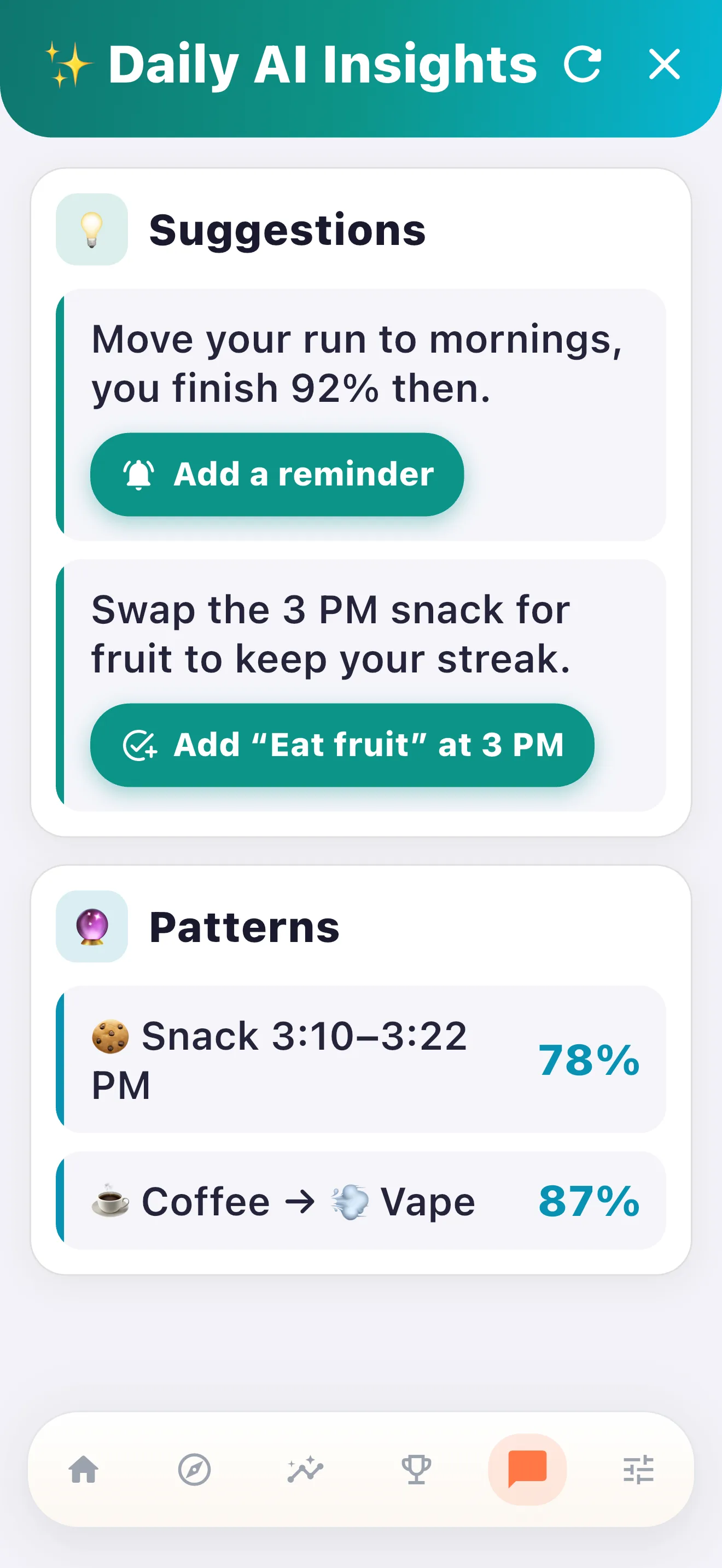
HabitIt was built around this exact shape. It's an AI habit tracker with automatic daily plans: you set the start amount, the quit date, and the curve, and the app does the math. Daily targets step down. The last week holds at a low dose. The morning of the quit date, the target is zero, and the replacement ritual has already been running for three weeks. Pattern detection in the app surfaces which day-of-week slip-ups cluster on, so you can shore up that day specifically. That's the shape that holds.
How to choose for your specific habit
Run this checklist. If you check 2 or 3 of these boxes, taper. If you check 0, cold turkey might be fine.
Daily use for more than three months means the ritual has already set, which alone points toward taper. Physical withdrawal is the second question: nicotine, alcohol, heavy caffeine, heavy weed, and opiates all carry it; sugar outside binge patterns, light social media, and occasional shopping mostly don't. And the third question matters more than either: has this specific substance been cold-turkeyed before, and did it end in a slip? If so, that's the strongest signal of all, since repeating the same failed approach without changing anything is the single most common quit-failure pattern there is.
Most people quitting nicotine, alcohol, caffeine, or daily weed check all three boxes. Most people cutting out sugar binges or quitting social media check one. The boxes you check decide the approach. The pattern, by the way, is identical to the day-4 wall reasoning: if you've failed at the same kind of quit multiple times, the problem is the approach, not your willpower.
Common failures of each approach
By far the most common cold-turkey failure: stopping with no plan for the evenings. The evening shows up, there's nothing to do at the exact time the substance used to fill, and it refills that slot again on day 4 or 5. Even on cold turkey, the replacement ritual still needs a plan.
A taper that's too slow fails just as often, just more quietly. Eight weeks of cutting 5% a week doesn't work, because the habit keeps its momentum and nothing ever forces a real decision point. Steep enough to feel week over week, 20-30% a week, is the sweet spot for most substances.
Drift is the other taper failure: no defined quit date means months spent at "two cigarettes a day" with no end in sight. Set a real zero day. The whole point of tapering is making that day survivable, not avoiding it forever.
Both approaches share one more failure, maybe the biggest one: treating a slip as total failure. A slip mid-taper doesn't mean restarting at full dose; the curve just continues from wherever things actually are. A slip on cold turkey doesn't require waiting for "next Monday" either; the next minute works fine. The all-or-nothing reset is what kills both approaches, far more than the slip itself ever does.
Beyond the choice
The cold-turkey-vs-taper question is worth asking, but it's not the biggest predictor of quit success. That predictor is whether a replacement ritual is installed by day one, and whether a slip gets tolerated instead of triggering a full restart from scratch. People who pick the "right" approach but skip those two things still fail at high rates. People who pick the harder approach but nail those two things still beat the average. Method matters less than most people assume; the ritual and the slip-handling carry most of the actual weight.
So: taper is the practical default for most quits, mainly because it's the easier way to get real structure in place, not because it's a proven scientific upgrade over a well-supported abrupt quit. The hybrid above is the version most clinical protocols land on. But what matters more than the curve shape is whether your evening from day one has something else in it, and whether you can survive a Tuesday slip without throwing the next three weeks out. Get those two right and the curve almost picks itself. For behavioral quits where there's no chemical taper at all (the substance is the app), the same logic applies but the bottleneck shifts to environment design - see the sports betting self-exclusion plan for what that looks like in practice. And for alcohol specifically, if your goal is moderation rather than cold-turkey abstinence, the 6 best drink-less apps are scored against the same taper-versus-streak frame.
Build your taper plan today
Free 3-day trial of all features. After that the free tier covers the basic taper. No subscription required.


Get the Free Quitting Plan
Drop your email and we'll send a printable plan you can fill in and track. Occasional updates (max 1 per 2 weeks).
Success! Now check your email to confirm your subscription.
We respect your privacy. Unsubscribe at any time.