How to Build Habits Without Motivation

Motivation is a feeling. It shows up when things are going well and you're rested and the habit is still new enough to be interesting. Then it vanishes on some gray Tuesday in February when you're tired and nothing about the thing you're supposed to do sounds appealing. The habits that stick are built as systems, small enough and attached firmly enough to existing behavior that they fire before the motivation question ever gets asked. This post is about that design.
Why motivation fails as a system
Motivation is real. The problem is that it's variable by nature, and you cannot build a system on a variable input you don't control. Your motivation level on any given morning is downstream of how you slept, what you ate, what's stressing you out, whether it's Monday or Thursday, and roughly a hundred other things you have no direct say over. A habit that requires motivation to execute works on the good days and dies on the bad ones, and every month contains bad ones.
BJ Fogg's behavior model captures this cleanly: behavior happens when motivation, ability, and a prompt converge at the same moment.[1] Motivation is one of the three, and the least reliable one. A lot of the early motivation is really just novelty - the first few days feel fresh because the habit is new, and that freshness is the kind of thing that fades on its own timeline, whether or not you did anything wrong. By week two or three you're down in the valley, and the habits that die there tend to be the ones that were quietly depending on the freshness to keep them running.
The classic trap is deciding to start once you feel more motivated. That day has a way of never arriving. There's always a stressful project wrapping up, or a rough stretch of sleep, or a holiday coming - waiting for motivation is the most available excuse there is. The habits that survive get started at whatever motivation level exists that day, because they're designed to run at motivation zero. The day-4 wall is exactly this: the point where motivation drops and the habit design has to carry the weight.
Motivation genuinely does have a use, to be fair, and it's covered further down. First, the part that actually holds a habit together day to day.
What actually works instead of motivation
Four mechanisms run reliably without motivation, and they all work for the same underlying reason. Each one shrinks the decision down to almost nothing at the exact moment the habit needs to fire. Motivation only gets recruited when friction is high and a decision is still live. Take away the friction and the decision both, and there's nothing left for motivation to do.
Habit anchoring. You attach the new behavior to something you already do, so the old behavior becomes the cue. Floss right after brushing your teeth, since brushing already happens every morning without a shred of willpower involved. The new behavior rides in on the old one's back. Remembering to floss stops being the job - the job is remembering what comes after brushing, and brushing is already automatic.
Minimum viable behavior. Start so small that skipping feels stranger than doing it. This one gets its own section below.
Environmental design. Put the running shoes by the door. Move the floss onto the sink where the toothbrush lives. Each change takes about five minutes once, and the friction it removes just keeps not being there, indefinitely, even though motivational content tends to skip right past this for being boring.
Identity framing. Somebody who reads and somebody trying to read a bit more react to a skipped Tuesday in almost opposite ways. On paper the gap looks small - a word or two. In practice, the first person shrugs and picks the book back up Wednesday, because a missed day is just a data point when reading is already part of who they are. The second person treats the same missed Tuesday as evidence against themselves, because every miss becomes a small referendum on whether they're even the kind of person who can do this. The identity shift post covers this in detail.
The minimum viable habit
The minimum viable habit deserves its own section because it's the piece everyone nods along with and then fails to actually implement. Meditating for 30 minutes takes motivation, since you have to want to sit still for half an hour. Doing one push-up asks almost nothing of you at all. Those are two completely different thresholds.
The point of the minimum is surviving the hard days. Most days you'll do more than one rep anyway - once you're on the floor a second one tends to happen, then a fifth, and the session turns real without you really deciding it should. But on the day everything's working against you, the single rep is the one that matters. It's what keeps the chain from breaking, and tomorrow you get the full version back.
This is adjacent to James Clear's "never miss twice" rule.[2] A well-designed minimum makes even the first miss unlikely, because almost no excuse clears a bar set that low. Set the bar under every excuse you can imagine yourself reaching for at 10pm on a bad day.
The more specific the minimum, the better. A vague intention to meditate more isn't a minimum viable behavior. Naming an exact chair and an exact 60 seconds is. Tie that moment to something that already happens daily - right after you close your laptop for the night works fine - and the specificity removes the decision entirely. There's no choosing whether to meditate on a given evening anymore. You close the laptop, you sit down, and the deciding already happened weeks earlier, back when deciding was still cheap.
Environmental design is the real work
Building a habit looks like it should be mental work - willpower, resolve, that kind of thing. What it actually takes is quieter and dumber than that: moving objects around a room. A poster will tell you to dig deep. Moving the object still gets the result.
Take a reading habit. Put the book on the pillow, and it becomes the thing your hand finds the moment you get into bed.
A morning workout mostly falls apart on assembly, and effort has surprisingly little to do with it. Which shirt, where the socks went, whether anything's actually clean - solve all of that the night before and getting dressed in the morning turns into a two-minute passive action nobody has to think about.
Water is even simpler. A glass in the cabinet means remembering to want water and then getting up to go find it. A full glass already sitting next to the keyboard just asks to be picked up. Fill it when you sit down in the morning and it tends to get drunk without any real decision involved.
And for a morning routine generally, moving the phone charger outside the bedroom matters more than it sounds like it should. A phone within arm's reach of the bed becomes the first action of the day no matter what you intended the night before. Charge it in the kitchen instead, and there's a real window between waking up and reaching for it - room for whatever you're actually trying to build.
None of these moves are the habit itself. They're the setup that makes the habit automatic, and each one takes five to fifteen minutes once while the payoff keeps compounding for as long as the objects stay put.
When motivation is actually useful
Motivation has a real job. It's just a smaller job than the daily-fuel role it usually gets assigned. There are three places in the habit lifecycle where it earns its keep.
First, picking the habit. You need to care about the outcome enough to bother setting up the system, and motivation is what makes you decide this thing is worth doing in the first place. A habit built purely on a should tends to quietly fade before it ever really starts.
Second, the early stretch - roughly the first couple of weeks, in our experience, before the environment's been optimized and the anchor isn't fully automatic yet. Friction is genuinely high here because everything's still new. Motivation carries real weight in this window. Use it while it's around.
Third, getting back up after a longer gap - more than a few days off, where the chain's broken and the environment's drifted back toward the old default. Restarting after a week or two away does take a real push. Once that push gets the system moving again, the anchors can take back over.
Outside those three moments, motivation isn't really doing anything for you. Expecting it to also show up every single morning is where the design goes wrong.
Common mistakes
You feel motivated on a Sunday night and decide Monday is when you'll finally start. By Tuesday morning the feeling is gone, and so is the plan, because the plan was never actually built - just a decision waiting for a mood to show back up. Start Monday at whatever level the mood happens to be, low included.
Size trips people up almost as often. A 45-minute workout takes a real push most days; a 5-minute stretch barely registers as effort at all. That gap is exactly why the stretch is the smarter place to start, even on the days you'd genuinely rather do the full 45. Five minutes, built up slowly, tends to survive a bad week. Forty-five minutes, attempted cold, tends to snap during the first one.
Notifications make a tempting cue and a genuinely poor one. Within a matter of days the brain starts filing them as background noise, the same mechanism behind why people stop consciously seeing banner ads after enough exposure to them.[3] An anchor behavior sidesteps that entirely, since brushing your teeth happens every morning whether or not you glanced at a notification first. Alerts work fine as a short-term crutch during the first couple of weeks. Past that, the habit needs to live on a behavior instead.
And then there's the plan written at the level of who you want to be, rather than what you'll actually do. "Become a morning person" gives you nothing to physically do at 6:45am. Opening the curtains the second the alarm goes off gives you exactly one thing, and it either happened or it didn't - which is the part that makes a habit trackable and recoverable once it slips.
The bottom line
Pick the smallest possible version of the habit, the version that still runs on a day when you'd rather do anything else. Anchor it to something you already do so the cue fires without being asked to. Then rearrange the physical space around it so showing up takes less effort than skipping does. None of this is complicated. It's just rarely done on purpose.
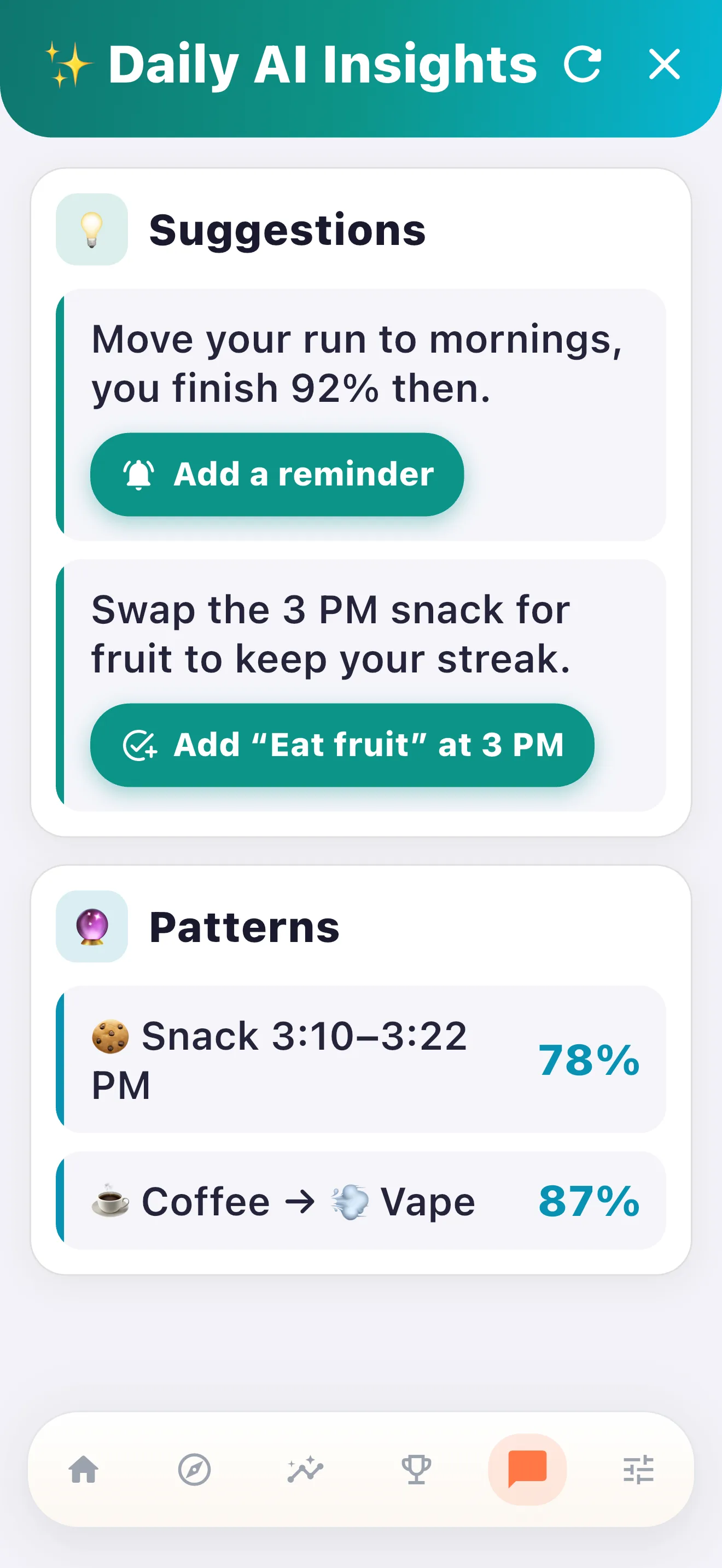
A log helps with the last piece most people skip: noticing where the design is actually leaking. HabitIt is built as an AI habit tracker for exactly this - it doesn't just record whether you showed up, its pattern detection picks up which specific mornings or triggers your slips cluster around, so the fix is a real adjustment to the anchor or the environment instead of a vague resolution to try harder.
Most habit advice centers on motivation because motivation makes for a better paragraph than a checklist does. A moved charger or a relocated pair of shoes never reads as inspiring on the page. It's just the one that actually moves behavior once you're standing in the room with it.
A lot of people searching for how to build habits without motivation are hoping for some trick they haven't heard yet. There usually isn't one. It's decided the night before, once, and then it just runs.
Citations
- Fogg, B.J., "A Behavior Model for Persuasive Design," Proceedings of the 4th International Conference on Persuasive Technology (2009); expanded in Tiny Habits: The Small Changes That Change Everything (2019). Read the source ↗
- Clear, James, Atomic Habits: An Easy & Proven Way to Build Good Habits & Break Bad Ones, Avery (2018). Read the source ↗
- Benway, J.P. & Lane, D.M., "Banner Blindness: Web Searchers Often Miss 'Obvious' Links," Internetworking, 1(3) (1998). Read the source ↗
Build a habit that runs without motivation
Free 3-day trial of all features. After that the free tier covers basic habit tracking. No subscription required.


Get the Free Habit Design Checklist
Drop your email and we'll send a printable plan you can fill in and track. Occasional updates (max 1 per 2 weeks).
Success! Now check your email to confirm your subscription.
We respect your privacy. Unsubscribe at any time.