Why You Keep Quitting Habits on Day 4 (And How to Build Past It)

Days 1 through 3, you're a hero. You opened the app. You logged the streak. You felt the dopamine of a fresh start. Day 4 you forgot. Day 5 you told yourself you'd "restart Monday." By day 8 the app is uninstalled and you've added another failed habit to the pile. This is not a willpower problem. It is the most predictable failure pattern in behavior change, it happens to almost everyone, and it has a name: the day-4 wall. Here's what's actually going on biologically, why most apps make it worse, and the five moves that get you past it. An AI habit tracker with pattern detection is the difference between knowing the day-4 wall exists and seeing it coming three days out.
The pattern you already know
Monday: you announce to yourself (and maybe a friend) that this week is different. You're cutting caffeine. Quitting the vape. Reading every day. Going to the gym. You open the tracker app, set the goal, log day one. The app is satisfying. The dopamine of starting is real.
Tuesday: you do it again, maybe slightly less enthusiastically. Wednesday: it takes a small act of effort but you log it. Thursday morning: you forget. Thursday night: you remember, you feel guilty, you tell yourself you'll start fresh Friday. Friday: you don't. By Sunday the app shows an angry red gap in the streak and you don't want to open it. By the next Monday it's uninstalled and you have a new mental data point that habits "don't work for you."
You are not weak. You are not undisciplined. This pattern is so consistent across populations, habit types, and tracker apps that it has its own behavior-science term. The day-4 wall (sometimes called the "novelty cliff") shows up in studies on smoking cessation, exercise adherence, language learning, sobriety, and dietary change. Around day 3 to day 5, a specific biological window opens where the brain decides whether the new behavior is paying off enough to keep up. If the answer leans no, the habit dies that week. The good news: knowing this is what's happening lets you design around it. The bad news: almost no habit tracker is designed with the day-4 wall in mind, which is why so many people end up where you are.
What's actually happening on day 4
Three biological things converge in the day-3-to-day-5 window, and all three pull in the direction of quitting.
The novelty dopamine drops. Days 1-3 of any new habit produce a real dopamine spike from the novelty alone. You're doing a thing you weren't doing before. The brain treats new patterns as potentially rewarding and over-allocates attention to them. By day 4 the novelty signal has decayed because the behavior is no longer new, but the long-term reward (better sleep, less anxiety, lower bills, etc.) hasn't kicked in yet. So you're in a window where the new habit costs you effort but produces no felt reward. The brain reads this gap and starts looking for an exit.
Identity formation lags behavior. A 2010 study by Phillippa Lally and colleagues at University College London famously found that habits take a median of 66 days to become automatic, with a wide range (18 to 254 days). The "21 days to form a habit" claim that everyone repeats has been wrong since the 1960s. The relevant number for the day-4 wall is much earlier: it takes about two weeks of consistent behavior before the new identity starts to feel real. Before then, the practice still feels like "I am trying to do X" rather than "I am someone who does X." That gap between behavior and identity is the most fragile window in any habit's life. The identity shift is the practical work that closes it.
The first real obstacle shows up. Days 1-3 are usually a quiet stretch where life cooperates. By day 4, the first real obstacle has shown up: a late work meeting, a sick kid, a hangover, a travel day, a low-energy morning. The first time the habit collides with normal life is the test that almost every new attempt fails. Not because the obstacle is uniquely hard but because the habit hasn't been practiced under load yet. You don't know what missing a day means. You don't have a recovery move. So the obstacle becomes a full quit instead of a one-day skip.
These three things stack on the same calendar day for most people, which is why day 4 isn't arbitrary. The dopamine drop, the identity lag, and the first real obstacle all hit in the same 48-hour window.
Why most habit trackers make day 4 worse
The dominant pattern in habit-tracking apps is the streak counter, popularized by Duolingo and copied by every habit tracker since. The streak is a single integer that represents how many consecutive days you've completed the habit. Miss a day, the streak resets to zero. The streak is designed to leverage loss aversion: you don't want to lose the number you've built.
The streak counter works beautifully for habits that are already established. It's almost perfectly designed to kill habits that aren't. The detailed science — intermittent reinforcement, loss aversion, catastrophic-miss psychology — is in why streaks are a trap.
Here's why. The day-4 wall produces missed days for biological reasons we just covered. A streak-reset model interprets that missed day as a moral failure: you broke the chain, start over. The user opens the app, sees the zero, feels shame, and closes the app. The next day they don't open it because the shame is still there. Within a week the habit is gone. The streak's loss-aversion mechanism punishes the user at the exact moment they need encouragement to keep going. It's like a fitness coach who only shows up to tell you you've failed.
The other common pattern, the "perfect day" requirement, has the same problem. Some apps require all of a day's habits to be completed for the day to count. A user with five habits who hits four of them gets a red "incomplete" day. The app is teaching the user that anything less than perfect is failure, which is the exact opposite of what habit science says works.
The fix is structural, not motivational. Build the app to expect missed days, recover gracefully, and treat showing up as the win.
Five moves that get you past day 4
1. Make day 4 deliberately smaller than days 1-3. If you start at 30 push-ups, drop to 10 on day 4. If you start at 10 pages, drop to 3. The point is to engineer a near-zero-effort day right at the wall, so the streak survives even when the energy doesn't. This is the principle behind the 60-second meditation start and the 10-minute home workout floor. The smaller the floor on the hard day, the higher the survival rate of the whole habit.
2. Plan the recovery before the slip happens. Sit down on day 1 and write a single sentence: "If I miss a day, tomorrow I do half the normal dose." That's it. The work happens in advance, when you're calm, so the recovery doesn't depend on willpower at the moment of the slip. People who write the recovery rule before day 1 have a roughly 2x completion rate at day 30 compared to people who don't, across multiple studies of behavior change.
3. Anchor to an existing trigger, not a clock. "I'll meditate at 8am" requires you to remember it's 8am, which requires willpower you don't have on day 4. "After I pour my morning coffee, I sit for 60 seconds" runs off the coffee trigger you're already firing daily. The anchored version survives forgetfulness and low energy because the trigger does the remembering. Habit chains are the structured version of this, and they're the single highest-impact technique in beginner habit design.
4. Track effort, not outcome. "Did I sit down for the session?" is a yes/no you can answer regardless of how the session went. "Did I have a good meditation?" is a question that invites you to judge yourself and find yourself lacking. Logging the act of showing up is what builds the identity ("I am someone who meditates daily") even when the individual sessions are messy. Stop grading the sessions. Grade the showing up.
5. Pick a tracker that doesn't punish missed days. This sounds obvious and it's the structural change that matters most. A habit tracker that doesn't reset streak when you miss a day, that rebuilds tomorrow's plan instead of demanding restart-from-zero, and that treats day 4 as a normal part of habit formation rather than a moral failure is doing 80% of the design work for you. Read the app's "what happens when I miss a day" before installing. If the answer is "your streak resets," uninstall and find a different one.
What day 4 actually feels like in specific habits
The day-4 wall isn't abstract. It has a specific signature in every habit type, and recognizing it as it shows up is half the battle.
Caffeine quit: Day 3-4 is when the receptor-rebound headache peaks. You'll be tempted to "just have one cup to take the edge off." Almost every cold-turkey caffeine quit dies in this window. The 30-day caffeine taper deliberately avoids the day-4 wall by keeping a smaller daily dose through the headache window instead of going to zero.
Sugar cut: Day 3-7 is the dopamine cliff. Your baseline dopamine hasn't recalibrated to the lower sugar input yet, so you feel flat, irritable, and craving. Most "no sugar" attempts collapse here. The 30-day sugar reduction plan avoids it by tapering grams rather than eliminating overnight.
Quit smoking or vaping: Day 3-5 is the peak nicotine withdrawal window. Cold turkey works for fewer than 10% of smokers, which is part of the broader pattern of why cold turkey loses to tapering across substances. Tapering off cigarettes or off vapes both deliberately ride through the day-4 wall with reduced doses. See the cigarette taper plan or the vaping taper for the pharmacology.
Home workouts: Day 4 is delayed-onset muscle soreness peak. You're sore from days 1-3, you don't want to do today's session, you skip. The 10-minute-floor workout plan keeps the day-4 dose small enough that even sore muscles can move through it.
Meditation: Day 4 is when the novelty wears off and the sit feels long. People who started at 10 minutes quit here. People who started at 60 seconds barely notice the wall. See how to meditate when you can't sit still for the 60-second-start framework.
Reading habit: Day 4 is when you forget the book at the office or leave it on a plane. The recovery move is the 1-page rule: when you don't have the book, read a single page of anything (phone article, kindle sample, even a takeout menu) and log the session. The streak survives, the identity holds. See how to start a daily reading habit.
Water habit: Day 4 is when the novelty of the new bottle wears off and you forget to fill it. The fix is the visible-bottle rule. See how to drink more water for the anchor-by-anchor ramp that survives this wall.
Nail biting: Day 4 is when the awareness phase feels pointless ("I'm just counting, not stopping, this is silly") and most people quit the protocol. The recovery move is to trust the count and finish the two-week audit before doing anything else. See how to stop biting your nails for the full habit reversal sequence.
Impulse spending: Day 4 of a no-spend reset is when the first real stress trigger hits and a $30 purchase looks like the cheapest dopamine available. The recovery move is the 72-hour rule plus a non-buying response. See how to stop impulse spending for the cash-only reset framework.
Notice the pattern: every existing successful framework on this blog is structured to bypass the day-4 wall, not push through it. That's not coincidence. Almost every habit that breaks fails at this same wall, so almost every habit that succeeds works around it.
Running the AI habit tracker plan with an app
You can build past day 4 with a paper streak counter. People do. The failure mode of paper is that on day 4 you can't see how close you are to the next milestone, you can't see the cumulative time invested, and you can't see what the recovery rule was that you wrote down two weeks ago. Paper doesn't help on the hard day, which is the only day that matters.
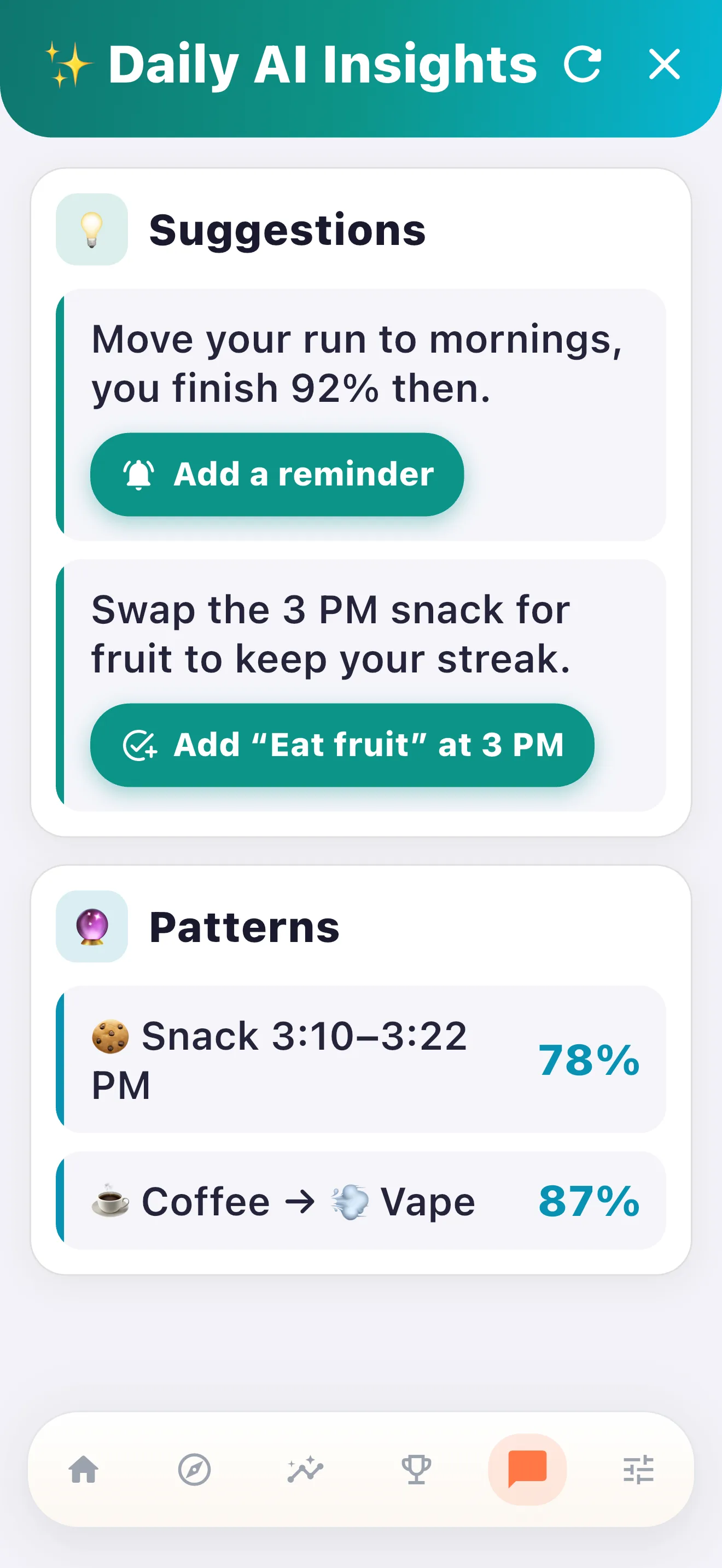
Three things to look for in whatever app you choose. One, does the app shrug off a missed day instead of resetting the streak? Two, does it let you log a "smaller dose" version on hard days so you can keep the chain alive at low effort? Three, does it show you your recovery rule (the one you wrote on day 1) when you miss a day, instead of just a red zero? Almost no app does all three.
If you've been searching for a habit tracker that doesn't reset streak when you miss a day, an app to help stick to habits past the early-week wall, or a habit motivation tracker that treats showing up as the win rather than perfect execution, HabitIt's journey system was built around exactly this problem. The journey rebuilds tomorrow's target when you miss today's, so the plan adjusts to your reality instead of demanding you adjust to it. The streak counts unbroken progress without penalizing the slip. You set a recovery rule once at journey start and the app surfaces it at the moment you need it. If the day-4 wall already broke your habit and you're a few weeks past it, the restart-after-falling-off protocol is the four-step version of getting back to running without the all-or-nothing reset.
Beyond day 4
Once you've moved past day 4, the next walls are around day 14, day 30, and day 66. They are progressively smaller and easier to handle, but they exist. Day 14 is where the identity formation starts to lock in. Day 30 is where the behavior becomes mostly automatic. Day 66 is the median Lally figure, where most habits become fully automatic for most people. The fact that there are subsequent walls doesn't mean the habit will keep failing. It means each wall you build past makes the next one smaller. If you want to understand the actual research behind why these timelines are what they are — including why the 21-day claim has been wrong for decades — how long it actually takes to form a habit covers the full picture.
The real prize isn't the streak. The streak is just a leading indicator. The prize is identity: the point at which "I am trying to meditate" becomes "I am someone who meditates." That shift usually happens between day 14 and day 30 for most habits. Replacement habits are part of why this works: filling the function of the old behavior with a new one is what makes the identity shift stick instead of just being a streak you defend.
For now: write your day-4 recovery rule. One sentence. "If I miss a day, tomorrow I do half." Tape it somewhere you'll see it. That's the whole agreement.
Build past day 4 today
Free 3-day trial of all features. After that the free tier covers basic journeys. No subscription required.


Get the Free Day-4 Survival Plan
Drop your email and we'll send a printable plan you can fill in and track. Occasional updates (max 1 per 2 weeks).
Success! Now check your email to confirm your subscription.
We respect your privacy. Unsubscribe at any time.
The fix that survives day 4 is structure, not willpower: a habit tracking plan that hands you tomorrow's target and shrugs off the missed day.