How to Meditate When You Can't Sit Still
You downloaded Headspace. Sat down day one for 10 minutes. Made it 90 seconds before opening Instagram to "check one thing." Day two you didn't open the app. By Thursday you'd uninstalled it and made a mental note that meditation isn't for you, when the real culprit was a starting dose built for people who already meditate. Beginners need a different number entirely - the progression below starts at 60 seconds and moves by feel, not by calendar. An AI habit tracker with pattern detection makes the calendar-vs-feel call for you by surfacing the days you actually held the seat.
The pattern you already know
You read one article about how meditation lowers cortisol and you've been meaning to try. Maybe a friend swears by Headspace. Maybe your therapist suggested it. So you download an app, pick a "beginner" track, hit start. Five minutes in your back hurts, your foot is asleep, you're thinking about an email, and the calm voice telling you to "return to the breath" makes you want to throw your phone. You finish the session feeling worse than you started. You don't open the app tomorrow.
Calibration did that, not restlessness. The "start with 10 minutes" default that almost every meditation app uses was designed by people who have been meditating for years and forgot what the first week actually feels like. For a beginner, 10 minutes is the wrong unit - the equivalent of a couch-to-5K plan that opens with "go run 5K and see how you feel." Failing to sit through it says nothing about whether someone can meditate; it says the starting dose was wrong.
The fix is unglamorous. Start at 60 seconds. Hold there until 60 seconds feels easy. Move to 2 minutes. Hold. Then 5. Then 10. The graduation is by feel, not by calendar. Some people stay at 60 seconds for a week. Some stay at 2 minutes for a month. The clock is irrelevant; the consistency is everything. Most people who can't sit still right now will hit 10 minutes inside two months if they let the progression happen at the speed their nervous system actually moves. This is the same starting-too-small principle that breaks the procrastination habit loop: shrink the task below the threshold your brain rejects, do that, and let the size grow back when the resistance fades.
The Progression That Works
This isn't a 30-day plan because meditation doesn't graduate on a calendar. Some people move through these stages in days, some take months, and the rule is the same either way: hold the current stage until it feels easy, then move up. "Easy" means finishing the session without watching the timer and without feeling relieved when it ends.
Set a 60-second timer, sit somewhere consistent, close your eyes or soften your gaze, and notice you're breathing. Don't try to clear your mind - nobody can, and chasing blankness is how most people quit before day three. When the timer ends, get up. Most people find this almost insultingly easy on day one, which is the point: easy is what makes it repeatable. Hold here until 60 seconds feels boring, usually somewhere between a week and three.
Same chair, same time, same setup - just a longer timer. If the mind wanders, notice it and return to the breath; that's the whole instruction, no new technique required. Move on once 2 minutes stops feeling like a finish line and starts feeling like a natural settling point.
Around minute 3, almost everyone hits a restlessness wall - a leg itches, the back complains, an unanswered text surfaces out of nowhere. This is the exact wall that a 10-minute default crashes beginners into on day one, except by Stage 3 the first two stages have already built enough foundation to walk through it instead of bailing. Notice the restlessness, label it, let it sit there uncomfortably, and finish the session anyway. Do this for a week and the wall stops being a wall; it becomes a normal, boring part of minute three. Almost everyone who quits meditation quits somewhere in this stage. Almost everyone who gets through it keeps the practice for years. If there's one idea worth taking from this entire guide, it's this: the wall is supposed to happen, it isn't a sign you're bad at this, and walking through it a handful of times is the entire trick.
10 minutes a day is the dose most long-term meditators settle into, and the handful of studies that have tested duration head-to-head haven't found a meaningful gap between 10 and 20 minutes daily. The jump that matters is 0 to 10, not 10 to 20 - so stay here unless a specific goal genuinely needs longer sits.
The One Rule That Actually Matters
Same time, same place, every single day. This is the single highest-leverage decision in the entire practice, and it only needs to be made once. Morning works for most people because the day hasn't loaded yet; right after coffee works because the trigger is already firing on autopilot; before bed works for some, though it activates rather than settles others. Whichever anchor gets picked, the goal is to stop re-deciding it every day. Habit chains apply directly here - linking meditation to something already happening automatically is what makes it survive busy weeks. Everything below is secondary to getting this one decision right.
Three smaller things help once the anchor is solid: change only one variable at a time when moving between stages, rather than also switching apps or adding a cushion the same week a minute gets added; default to a plain timer over guided audio while the habit is still fragile, since a dependency on a voice becomes a single point of failure; and put the phone in another room - within arm's reach, most people check it inside 90 seconds, which is the same reason cutting doomscrolling comes down to moving the device rather than gritting through the urge.
Running the AI habit tracker plan with an app
You can do this with a pencil-and-paper tally and a kitchen timer - people have for thousands of years. The failure mode of the analog version shows up around day 12, when you forget to tick the box, then day 15, when you can't remember whether yesterday's session was 60 seconds or 2 minutes, and by day 20 the tracking has dissolved into "I think I meditated most days this month." The data fades, and the progression stalls with it. An app keeps the streak visible and the stage transitions obvious, which matters more than it sounds like it should.
What actually matters in whatever you use: logging a session in one tap, since anything slower gets skipped; tracking time per sit rather than a plain yes/no checkbox, since the progression is the whole point; and shrugging off a missed day instead of burning the streak over it, because a missed day will happen, and trackers that punish it are how a fragile new habit gets buried under the shame of a broken counter.
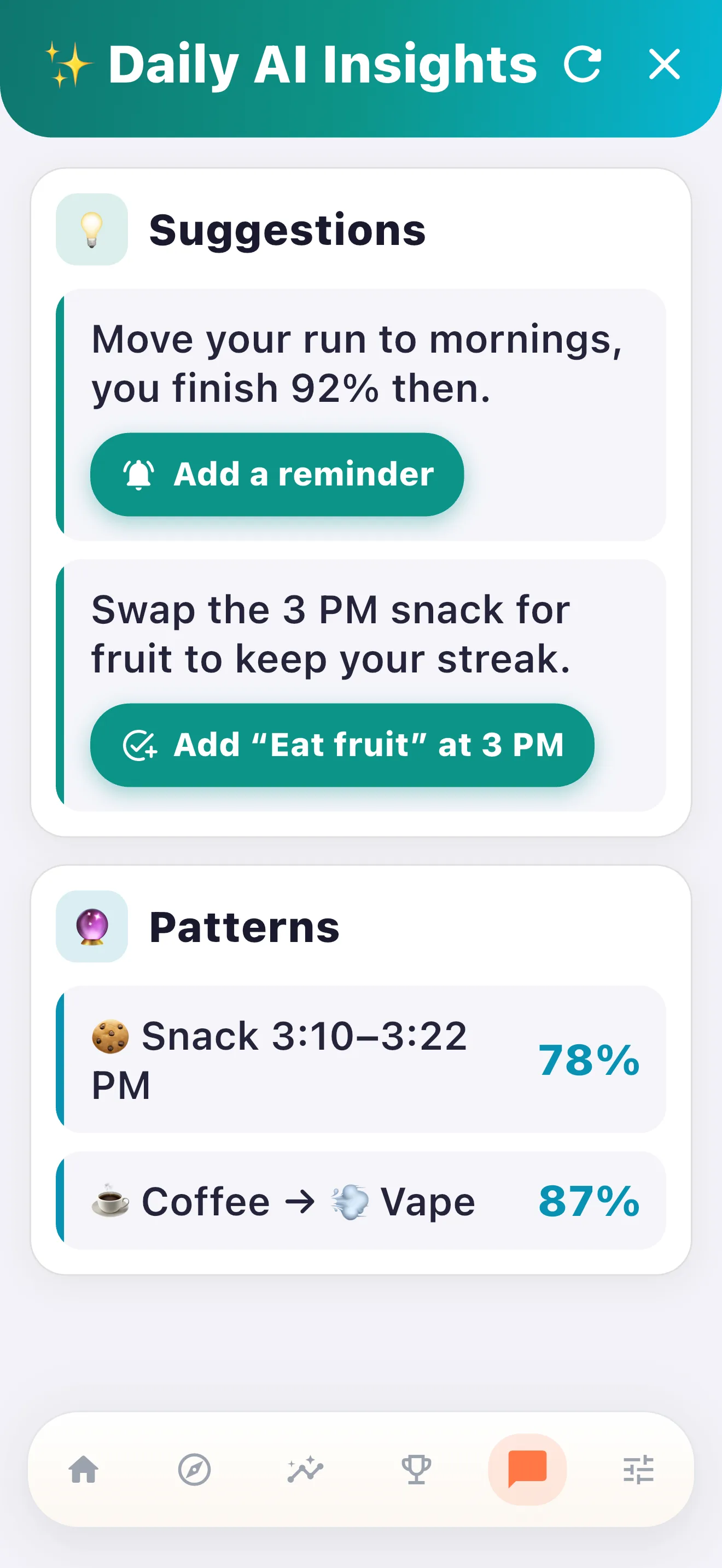
If you've been searching for a meditation app for beginners that doesn't immediately push you to 10-minute sessions on day one, a meditation streak tracker that lets you log 60-second sits as legitimate practice, or just a daily meditation tracker that scales with you instead of demanding the full dose, HabitIt's "start" journey was built for exactly this kind of slow ramp. You set the start number (60 seconds), the end number (10 minutes), and the app generates the weekly progression. The widget logs a session in one tap from your home screen. When you miss a day, the journey rebuilds tomorrow instead of resetting the streak. That's the difference between a tracker and a habit-formation tool.
The Failure Mode That Actually Kills It
Grading each sit quietly ends more meditation habits than anything else on this list. "That one was good." "That one was awful, I couldn't focus for a single breath." Neither label matters, and treating them as if they do is the mistake. Showing up is the only variable the habit actually tracks - a distracted minute counts exactly the same as a blissed-out one - and the grading itself is just another thought that's supposed to be noticed and released like any other. Most people who quit aren't quitting the sitting. They're quitting the scorecard they invented for it.
Everything else is smaller by comparison. Waiting for ideal conditions - guaranteed silence, the right cushion, the right mood - assumes conditions have to arrive before the habit can start, when it's the other way around: a noisy kitchen table earns the same 60 seconds as a quiet temple. "Too busy today" rarely survives scrutiny once the session is only 60 seconds long; on the days that are genuinely that packed, shrinking to two slow breaths keeps the streak alive without lying about how busy the day was. Reading about meditation instead of doing it - articles, podcasts, 200-book wishlists - is a real trap but a quiet one, since none of it is the practice no matter how useful it is. Buying gear before doing any sitting - cushions, retreats, courses, candles - mostly functions as a delay tactic dressed up as commitment; a chair already in the house and a phone timer is the entire real setup, and the gear can wait a year.
Beyond the Four Stages
Once you've held Stage 4 for a couple of months, the question of "should I do more?" usually answers itself. Some people drift up to 20 minutes naturally. Some never feel the pull and stay at 10 forever. Both are fine. Dose-response research on meditation is thin - only a handful of studies have actually tested duration head-to-head - but what exists doesn't show session length past 20 minutes buying much for most non-monastic outcomes, so don't feel pressure toward marathon sessions just because someone on a podcast does.
What does compound is the years, not the minutes. A daily 10-minute practice held for a decade is a fundamentally different thing than 10 minutes tried for a month; the effect is cumulative, not session-by-session. The interesting part isn't any single sit, it's the compounding of treating 10 minutes a day as non-negotiable for long enough that it stops being a decision. Stacking meditation onto an earlier wake time is a common move once both habits are stable, because the morning has more available pre-load minutes than any other part of the day. The other pairing people fall into is jotting a line or two after the timer stops, which is the gentlest on-ramp into building a journaling habit - same chair, same minute, no new trigger to remember. A third pairing that works for the same reason: closing the session with one specific thing you noticed today, written in a sentence. The meditation surfaces it; the gratitude entry keeps it.
For now: 60 seconds. One chair. One timer. Tomorrow morning. That's the whole agreement.
Build your meditation habit today
Free 3-day trial of all features. After that the free tier covers the basic journey. No subscription required.


Get the Free Beginner Meditation Plan
Drop your email and we'll send a printable plan you can fill in and track. Occasional updates (max 1 per 2 weeks).
Success! Now check your email to confirm your subscription.
We respect your privacy. Unsubscribe at any time.
Want it scheduled for you? Try a meditation habit tracking plan that starts at 60 seconds and grows as you're ready.