How to Practice Daily Gratitude Without It Feeling Fake
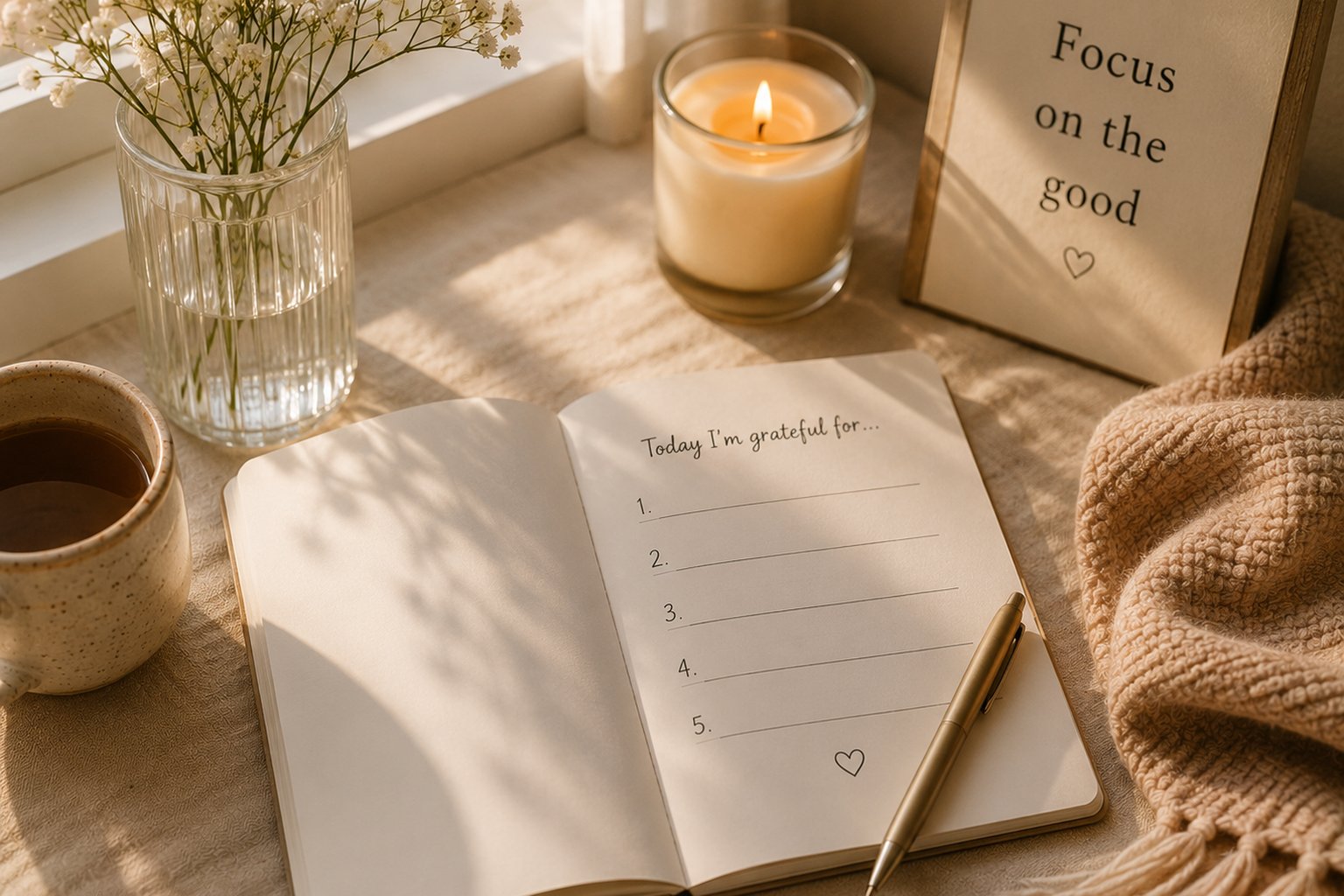
Most gratitude practices die in week two because they feel performative. You sit down to write three things you're grateful for, draw a blank, type "family, health, coffee," close the journal, feel slightly worse than when you started. The exercise meant nothing because the entries meant nothing. The research on gratitude is real - it does measurably improve mood, sleep, and stress baselines - but only when the entries are specific and honest. Generic entries produce none of that. The plan below uses specificity over volume to keep the practice from collapsing into wellness theater. A smart habit tracker turns the daily entry into a one-tap record, visible proof that the anchor held on a given night.
Why most gratitude practices fail
The bar gets set at volume first, and that's usually what kills it. The classic "three things you're grateful for" prompt produces the same three generic items every night - family, health, coffee - and repeating that for 14 days means every entry reads identical to the last. The brain files it as meaningless within a week. Cutting the count to one and raising the bar for what qualifies fixes this directly: a single specific thing carries more weight than three vague ones.
Aspiration does the rest of the damage. Most people write what they think they SHOULD be grateful for, and the thing they actually noticed that day never makes it onto the page. The journal turns into a wellness performance for an audience of nobody, and it loses its weight the moment it stops recording reality. Whatever was actually noticed belongs on the page, even if it's small or weird or doesn't fit the "grateful" template.
Underneath both of those sits a missing anchor. An intention like "I'll do my gratitude practice each day" decays fast without something concrete to attach it to - the fix is tying the entry to a moment that already exists in the day. Right before bed works. So does the minute after dinner, or the first cup of coffee. The anchor does the work that willpower can't.
The plan below is built against all three failure modes at once: one specific, honest thing per night, tied to a moment already there.
The 21-Day Plan
The first week installs the trigger and the specificity rule. Right before bed (anchor: after brushing teeth, or right after closing your laptop), one sentence in a journal or note. Good entries: "the way the light hit the kitchen wall at 4pm." "My coworker remembered I hate pickles and asked them to leave them off." "The first sip of coffee being exactly the right temperature." The kind that kill the practice: "family." "health." "having a job." If you can't think of a specific thing, the day still had one - look harder, don't write a generic placeholder.
The depth upgrade. Week 2's entry has two sentences: the thing, and the reason it landed. The "why" sentence is where the practice actually starts moving your mood baseline - surface noticing on its own doesn't do much. Example: "My coworker remembered I hate pickles. It made me realize how rarely I feel actually paid attention to at work, and how much I needed that small acknowledgment." Two sentences. Total time: 90 seconds. Keep the rest of the practice identical (same anchor, same time).
The test week. Hard days decide whether the practice becomes real. On a day where everything went wrong, finding one specific thing takes more effort, and that effort is exactly where the value lives. The brain leans negative by default, so the entry you dig up on a bad day does more work than any entry from a good one. Don't skip it.
The habit is installed. Some nights the entry runs to three sentences, other nights it's one, and both are fine as long as one specific sentence still lands at bedtime. Don't try to scale to three things - the forced extras are what killed the last attempt. Hold the simple version for months; the research on gratitude interventions consistently finds the real mood shift showing up a few weeks in, not on day one.
The Rule That Actually Matters
Specificity over volume beats everything else on this list combined. One real thing, described precisely, does more for the practice than three vague ones ever will. When nothing comes to mind, the temptation is to fall back on a generic trio like "friends, my job, a roof over my head," and that fallback is exactly what kills most attempts by week two. If only one rule survives from this entire post, it should be this one: describe the thing precisely enough that it could only have happened today.
Three smaller habits support it. Write what actually happened rather than what sounds grateful - a petty moment like a shorter-than-usual coffee line counts as much as anything else, since nobody is grading the entries and the honest ones are the ones that survive. Anchor the entry to a moment already fixed in the day (brushing teeth, getting into bed) rather than a vague evening window, for the same reason journaling anchors work better than good intentions. Keeping the bar at one sentence matters too, because a full journal entry sounds noble on day one and impossible on day nine at 11:40pm with a 6am alarm - the 90-second version is the one that survives nights like that.
Running the plan
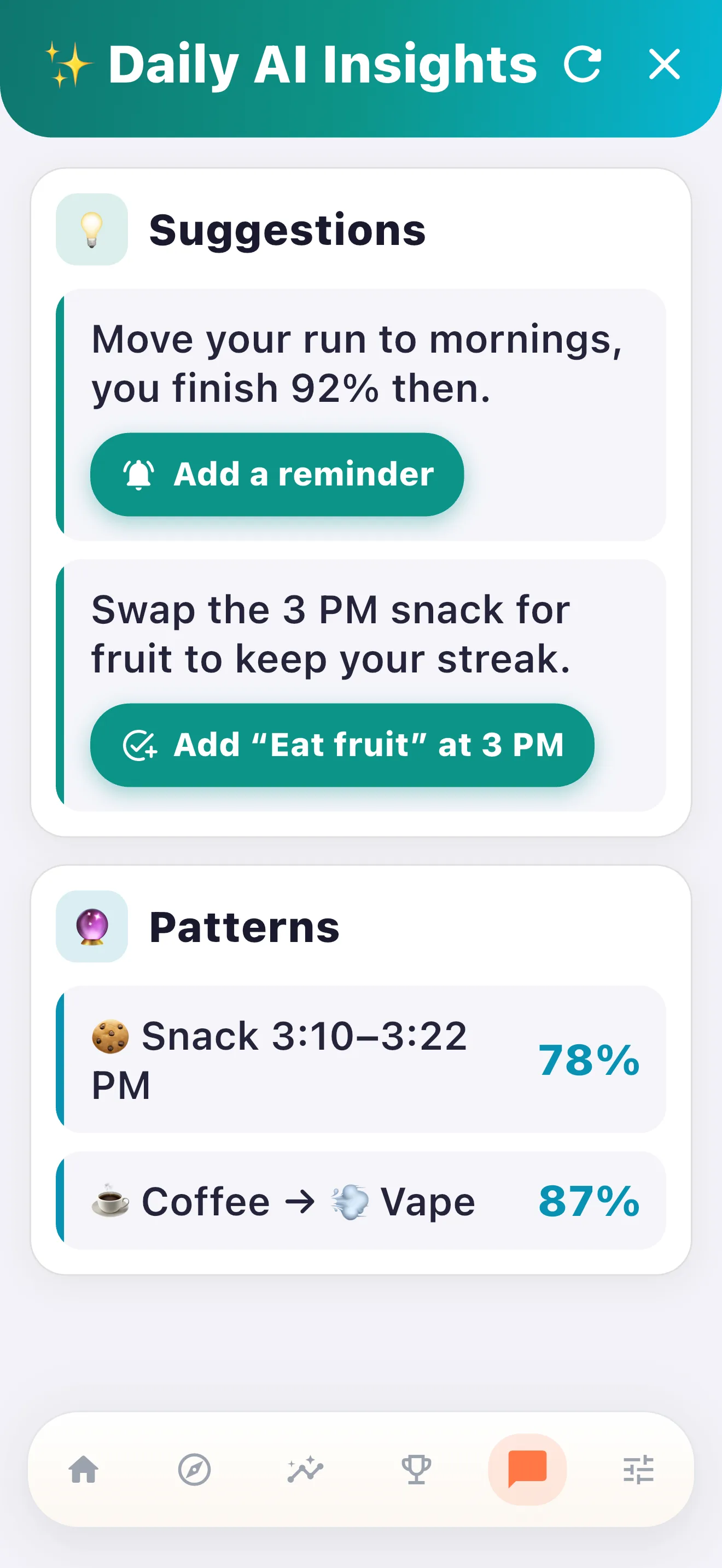
The medium matters less than the anchoring. A paper notebook works, so does the notes app already on your phone, so does a dedicated gratitude app, as long as the entry happens at the same trigger every night. A smart habit tracker logs it as a one-tap daily yes/no and surfaces the weekly pattern from the data.
The weekly review (Sunday morning, 5 minutes) is the upgrade. Read back the 7 entries from the past week and look for the pattern. Usually you'll spot which categories of moments you keep noticing - relationships, sensory stuff, work wins, small luxuries - and which days felt fuller than they seemed at the time. Over months, your weeks start tilting toward whatever shows up most in the log.
Gratitude prompts that don't feel fake come down to the two rules above, specificity and a fixed anchor. For the wider context, the journaling habit post covers the reflective-practice cluster, the meditation post handles the sister mindfulness habit, and anchoring gets a fuller treatment in the morning routine post.
Common failures
Defaulting to generics does the most damage - my dog, the weather, having a job. Once the brain settles into that groove the practice dies quietly over a week or two, so force the specificity even when it's hard. "The way the sun caught the dust in the window at 3pm" beats "sunshine" by an order of magnitude.
Timing sinks a fair number of attempts too. Morning gratitude has its place, but the evening slot is structurally better for two reasons: there's a full day of actual events to draw from, and the practice doubles as a wind-down cue for sleep. If mornings have felt like pulling teeth, moving the entry to bedtime is worth trying before giving up on the practice entirely.
Bad days tempt people to skip on the grounds that nothing was good. Something was - it just takes more digging, and the digging is the exercise.
Posting entries on social media is a quieter killer. An audience changes what gets written; the entries get sanitized for public consumption and the honesty that makes the whole thing work drains out along the way. Keeping it private is what keeps it real.
Scaling too fast closes out the list. Adding a morning session or bumping to three things a night tends to end the habit by week three, so the one-thing-at-night version deserves at least 60 days before anything gets added to it.
Beyond the 21 days
The data on gratitude practices is real but the effect size is small and slow, so don't expect a transformation in 21 days. Research on gratitude interventions has found measurable well-being gains emerging around the four-week mark and growing larger by three months, which lines up with how this plan is paced: the daily mechanics matter for weeks before the payoff becomes obvious.
The deeper point is about attention. An ordinary day holds more small moments worth noticing than it gets credit for, and without the practice most of them pass invisibly; the nightly entry trains the habit of catching them. After a month or two the catching starts happening in real time - mid-afternoon, half a second after something small goes right - and the mood shifts because more of the day's attention lands on those moments instead of sliding past them.
If you've tried gratitude journaling before and it felt empty, the issue was probably specificity. Start tonight. One specific thing, one sentence, held for 21 days, then add the why. The practice gets real around day 14 and stays real for years. A smart habit tracker shows you the weekly pattern - which evenings the anchor held and which slipped - so a wobbly week gets fixed by moving the anchor instead of by trying harder.
What "specific" actually means (with examples)
The specificity rule is the entire mechanism, so here are ten entries that count and ten that don't, for calibration.
Entries that count:
- The way the light hit the kitchen wall around 4pm and made everything look gold for about fifteen minutes.
- My coworker remembered I don't drink coffee and brought me a tea instead at the morning meeting.
- The exact temperature of the first sip of soup at dinner.
- That the bus was three minutes late, which let me finish a chapter of my book.
- My partner laughed at a stupid joke I made about the grocery clerk and I felt seen.
- The smell of the rain when I opened the front door this morning.
- That my hands felt warm after washing them with the new soap.
- The cashier at the corner store recognizing me by name for the first time.
- A small wave from the dog walker on my block who I've never spoken to.
- The way my desk looked after I cleaned it before lunch.
Entries that don't count:
- Family.
- My health.
- Having a job.
- The sun.
- Friends.
- A roof over my head.
- Coffee.
- My pet.
- The internet.
- Being alive.
Notice what separates the two lists. Every entry in the first could only have happened today, to you. Anyone could have written the second list, on any day, in any year. Writing the specific version makes the brain re-experience the moment as you put it down; the generic version produces words on a page and nothing else.
If you're stuck on a given night, ask yourself what made today different from yesterday. The difference is almost always where the noticeable moment lives - maybe a slightly better-than-usual sandwich at lunch, maybe the angle of a stranger's smile on the train. Size is irrelevant as long as the thing is specific.
Build your gratitude plan today
Free 3-day trial of all features. After that the free tier covers the basic plan. No subscription required.


Get the Free Gratitude Prompts Pack
Drop your email and we'll send a printable plan you can fill in and track. Occasional updates (max 1 per 2 weeks).
Success! Now check your email to confirm your subscription.
We respect your privacy. Unsubscribe at any time.