How to Start Running from Zero: A 30-Day Plan

Couch to 5K is a great program once you're already a few weeks into training. It assumes you can run for 60 seconds at a stretch and that you have some baseline cardiovascular fitness. If you're starting from zero - haven't run since high school, and stairs leave you a little winded - C25K starts too high. The plan below starts with walking. The first week is four 20-minute walks, no jogging at all. That sounds embarrassing. It works, because it installs the habit slot and builds base aerobic capacity before the running gets added. Most plans skip that step, and that's usually where people quit.
The pattern you already know
Here's how it usually goes. You decide to start running. Day one, you lace up and head out the door, feeling good about it. You run until you can't anymore, and walk until you catch your breath. Then you try running again, and somehow it's worse the second time. By the end of the block your lungs are burning and your shins hurt, and the whole thing feels harder than it should. You go home telling yourself you'll do better next time. Two days later you wake up with legs so sore the stairs are an event. Day three feels awful. By day five you've stopped.
Willpower had nothing to do with it. That first week asked you to install a new habit and build aerobic capacity at the same time, starting from nothing, and that's too much at once. The habit slot never got established. The aerobic base never showed up either, and every run felt like failure because your heart rate was already at the ceiling before you'd gone a quarter mile.
C25K has a high early dropout rate for true beginners. It assumes a baseline - some cardiovascular fitness, some habit formation - that most couch starters genuinely don't have. The fix is a longer ramp. Two things need to exist before running gets added: the habit slot and the aerobic base. Both get built in the first two weeks below, and the running arrives after them.
Why most attempts fail
The first mistake is starting with running before the aerobic base exists. If a brisk 20-minute walk leaves you noticeably tired, your heart rate is already in the zone where running will feel impossible. The cardiovascular system adapts, but it needs weeks of moderate load to do it, and a workout that feels like failure every time has no chance of becoming automatic. Once the base is there, running gets added to a body that can handle it, and that changes the whole experience.
The second is pace. New runners almost always run too fast. The target is conversation pace - slow enough to speak full sentences out loud while moving. Going faster than that turns every run into an all-out survival effort, which is exactly the sensation that produces the "I'm not a runner" conclusion. Slow down. Way down. You'll cover less distance and feel better about every session, and in month one that feeling is most of what you're training.
The third killer is vagueness. A run pinned to an exact day and time, with a specific route already chosen, is a run that actually happens. Tuesday at 7am on the path behind the school needs no deciding, because the decision already got made at some earlier, calmer moment, and all that's left is showing up in running shoes at a door. A loose plan to go running sometime this week leans on willpower at the exact moment it's weakest, and willpower at 6:45am on a work morning is not a lot to lean on. Without a slot and a route, every session requires a fresh decision.
The plan
Brisk, though - a stroll doesn't count. You should be slightly breathless but able to hold a conversation throughout. The whole point of this week is establishing the slot. Get the time locked in, and make sure your gear is sorted: real running shoes, tested and broken in, before this week is over if you don't have them yet. Your legs get used to the load along the way. By Friday there's usually an itch to run. Hold off. The walk week is doing exactly what it's supposed to do.
Total session: 20-25 minutes. The jog minutes are slow - conversation pace. If you can't speak a full sentence while jogging, you're going too fast. The goal this week is to experience running without the suffering. One minute of jogging is genuinely achievable. Finishing six of those across a session and feeling okay afterward is the actual goal. You're installing the feedback loop that running can feel okay.
The walking gaps get shorter each session, and the jog blocks get longer. Some people feel a breakthrough this week - somewhere around the third session, jogging quietly turns into something that could keep going a while longer. Others still find it hard. Both are normal. The breakthrough, when it comes, is the aerobic base switching on. Your body has adapted enough that the same pace that felt impossible three weeks ago no longer demands an all-out effort.
Not all four sessions need to be continuous. Two can stay as walk/jog intervals, and the last one works well as an easy recovery walk. Use whichever session fits best in your week for the one 10-minute continuous attempt - that's the session that shows the aerobic base exists and the habit is installed. The 5K doesn't matter yet, and neither does hitting 20 minutes. Ten continuous minutes at conversation pace is this week's actual target.
The four rules
1. Conversation pace, always. If you can't say a full sentence, slow down. This feels wrong at first: intuition says running slower means working less, which feels like wasting the session. Research on training intensity shows that runners at every level consistently misjudge what an easy pace should feel like, running harder than they realize on days meant to be easy.[1] Beginners feel this pull even more, since every run already feels hard enough that slowing down further seems pointless. Run slow enough to speak and you'll finish every session feeling okay about it, and in the first 30 days, that feeling is mostly what you're tracking.
2. Show up four times a week. Four 20-minute sessions at walk/jog pace, every week, is the whole job right now. There's no race being trained for in this plan. The point is carving out a repeating moment in your week where running happens automatically. Distance can wait for month three.
3. Gear matters from day one. Get real running shoes before you start - skip the cross-trainers and the old sneakers, and go to a running store where someone watches you walk or run and recommends a fit. Blisters and shin splints from bad shoes create the friction that makes it easy to skip sessions.
4. Learn to tell soreness from injury. Day-two muscle soreness is the body adapting - it shows up 24-48 hours after a session and fades over a day or two. That's normal, especially in week one, and no reason to skip a session. Sharp, localized pain in a joint during a run is a different signal, and so is anything that gets noticeably worse as the session continues. Either one earns a rest day.
Running the plan with HabitIt
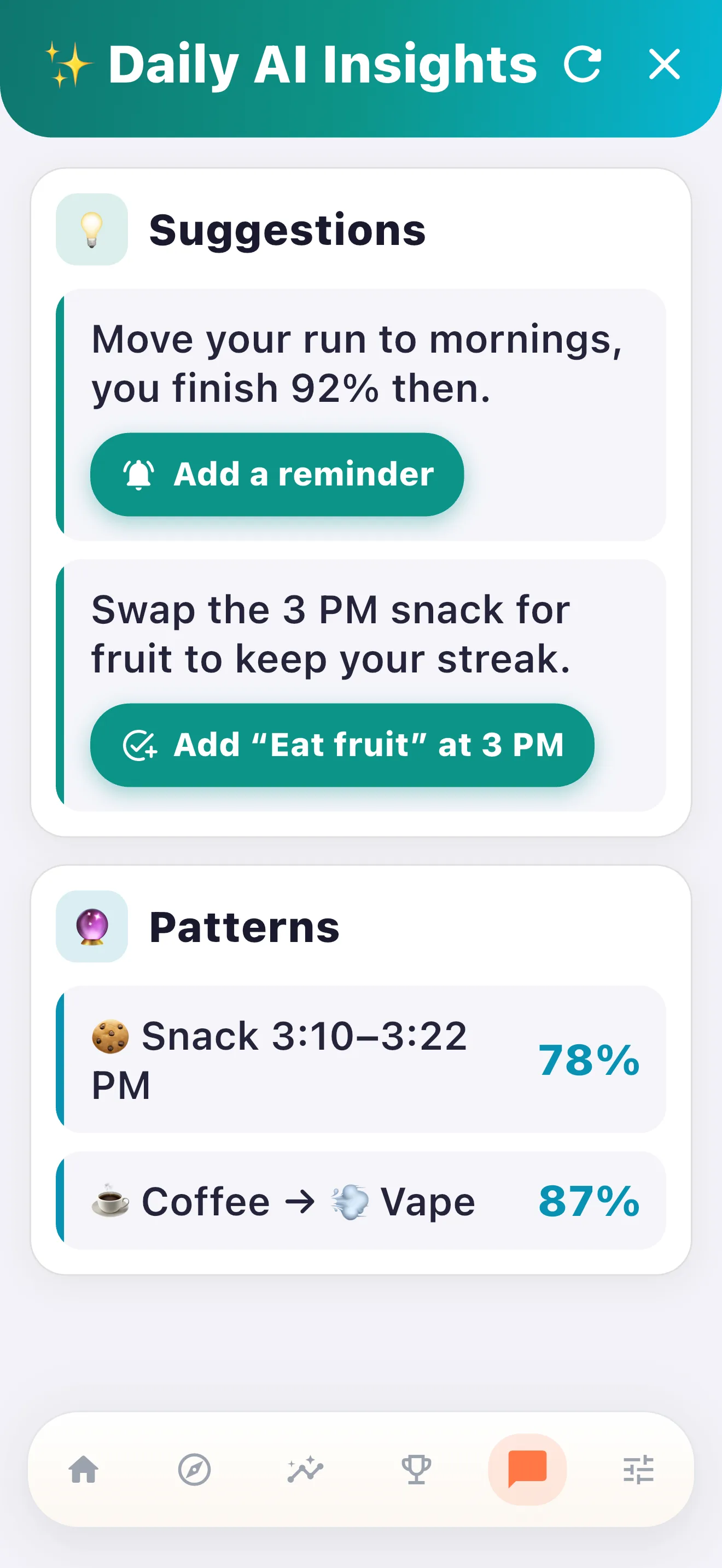
The simplest setup: create a "Running" habit in HabitIt, the smart habit tracker, and set the target to 4 sessions per week. Log each session when it happens, and use the notes field to jot the session type (walk, interval, continuous) and roughly how you felt. The notes matter more than you'd think - a few weeks in, HabitIt's pattern detection can flag things like which day of the week you skip most often, and looking back at week one after a successful week three is one of the better motivation tools available, because you've forgotten how hard it was and the notes remind you how far it's moved.
Four sessions per week gives you one flexible day - if Tuesday is impossible, Thursday works. A daily streak breaks the first time work runs late or a kid gets sick, and then you're staring at a zero. A weekly target absorbs that kind of miss without breaking, which is part of what makes this an automatic habit plan you don't have to manage day-to-day. That's also why the plan says four days a week and leaves the days up to you - the slots are yours to place, as long as they happen.
If you're building other physical habits at the same time, the home workout plan pairs well with this one - running three days and bodyweight strength two days is a solid first-month structure. The walking plan is also useful if you want to add daily step volume on top of the running sessions without overlapping them.
If you landed here searching for a how to start running from zero 30 day plan, this is that plan. It starts with walking in week one and works up to walk/jog intervals over the two weeks after that. By the end of the month, the target is a ten-minute continuous jog, with a weekly session count holding the whole structure together.
Common failures
Running too fast and using suffering as evidence of effort. This one is everywhere in beginner running - the sense that if you're not gasping, you must not be working hard enough. Gasping actually means you're above the aerobic threshold where adaptation happens, well into the zone where quitting starts to feel rational. Slow down until the suffering stops. Speed can come in month three, once the habit is installed and the base is built.
Skipping the walk week because it feels too easy. Telling a coworker you're training for running by going for walks sounds a little embarrassing, sure. The walk week is exactly why week two works: it builds base load and establishes the slot, so week two starts with legs that have already been out the door four times. Skip it, and week two starts from nothing - no aerobic adaptation, no habit formed. That's C25K week one, and it's where true beginners quit.
Keeping the schedule vague. You need exact days and exact times: the same four slots from week one, three weekday mornings plus one weekend day, sitting in the calendar like a real appointment. A loose plan rarely survives an ordinary busy week. The decision of whether to run should never be made on the morning of the run.
Buying new shoes after week two. Blisters from the wrong shoes in week one can sideline the whole plan, so the shoe purchase belongs before day one. Already a few sessions in with hot spots forming? Get the shoes today and take two days off before the next run.
Adding distance before adding consistency. The instinct after that first 10-minute jog in week four is to push straight to 20 minutes. Don't. Hold four sessions a week for two more weeks before the distance goes up - the habit needs to be automatic first, or you end up stacking a harder workout on a routine that hasn't set yet.
Beyond 30 days
By month three, running looks different. The sessions are mostly automatic - the internal debate about whether to go has gone quiet. Continuous runs are 20-30 minutes at conversation pace. The gear itch kicks in somewhere around here: new shoes, maybe a watch, possibly a running jacket. That's fine. Gear investment is a signal that the identity has shifted.
Distance comes after consistency, and once the base is there it adds up faster than the first four weeks did. A reasonable pace is adding 2-3 minutes to the continuous portion every week or so, not chasing it session to session. The aerobic base that weeks one and two built is what makes those increases feel manageable, in a way they would not have at the start.
This is also when C25K makes sense. By month two you have the cardiovascular base and the habit slot that C25K was quietly assuming you already had. The program's walk-to-run progressions now feel achievable because the baseline is there. If the goal is a 5K, plug into C25K at month two, when your body can actually handle what it asks for.
Link the running habit to the home workout plan for a full first-month fitness stack. Both habits are short enough that running three days and doing a 20-minute home workout twice just settles into how the week works.
Citations
- Seiler, S., "What is Best Practice for Training Intensity and Duration Distribution in Endurance Athletes?" International Journal of Sports Physiology and Performance, 5(3), 2010, 276-291. journals.humankinetics.com
Build your 30-day running habit plan today
Free 3-day trial of all features. After that the free tier covers the basic habit tracking. No subscription required.


Get the Free Week-Zero Running Plan
Drop your email and we'll send a printable plan you can fill in and track. Occasional updates (max 1 per 2 weeks).
Success! Now check your email to confirm your subscription.
We respect your privacy. Unsubscribe at any time.