How to Walk More: A 10,000-Step Plan That Sticks
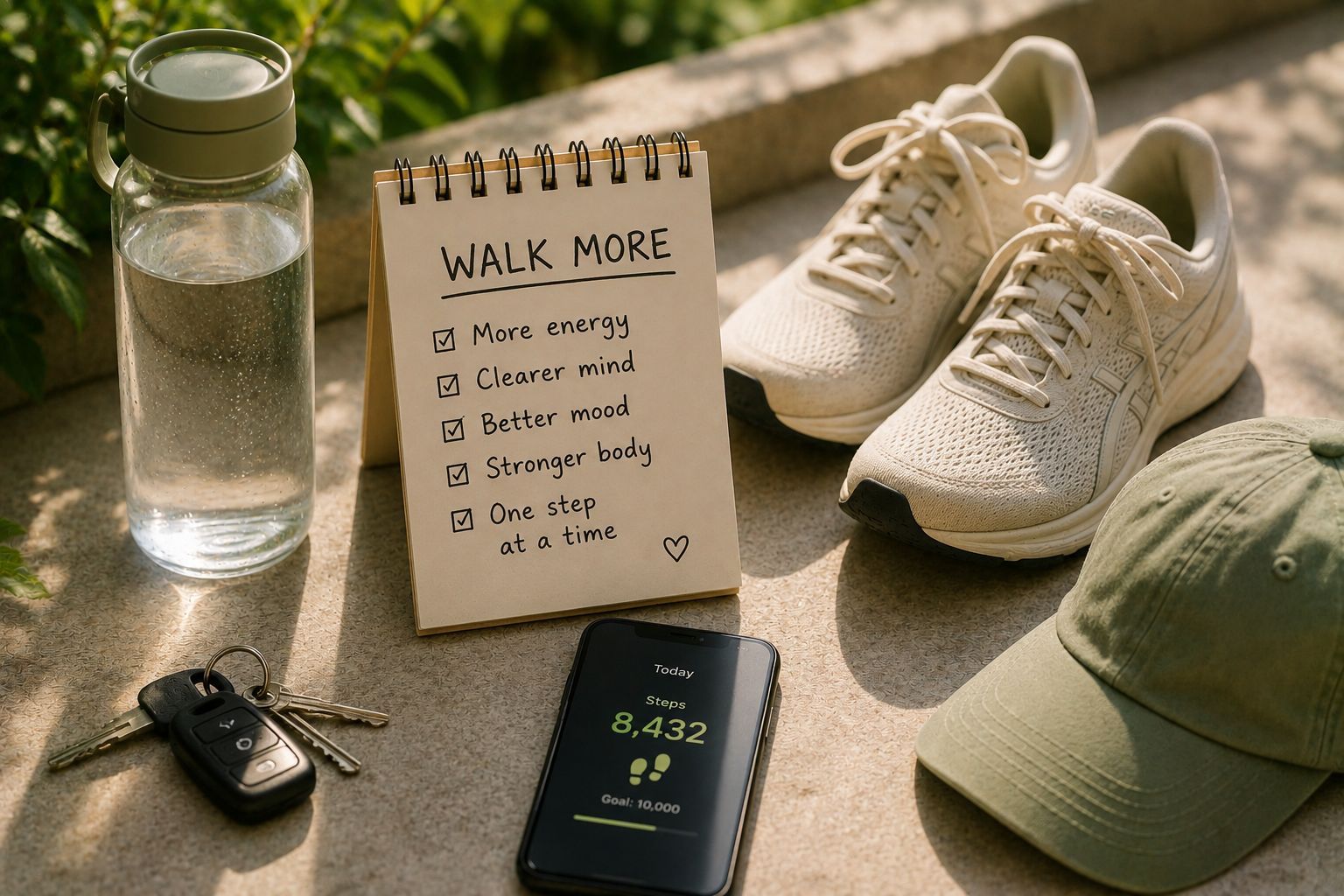
The 10,000 steps number is famously arbitrary. It came from a 1965 Japanese pedometer marketing campaign, not from research. The research that has come since says the real benefit curve plateaus around 7,000-8,000 steps for most adults, with diminishing returns above that. But the round number sticks for a reason: it's a target that's high enough to require deliberate effort and low enough to be hittable without restructuring your life. The plan below gets you from your actual baseline (which is probably 3,000-5,000 if you're reading this) to a sustainable 8-10K daily, in four weeks, without buying a treadmill desk or moving to a walkable city.
Why "I'm going to walk more" usually fails
Most attempts at walking more look the same. You read an article about 10K steps, you decide that's the new goal, you take a 60-minute walk on Sunday because you have time, you hit 11K, you feel great. Monday you're back to 4K because Sunday's walk was the exception not the system. Tuesday you skip because work is heavy. Wednesday you try again and burn out. By the following Sunday you've averaged 4,500 steps across the week despite "trying to walk more." The 10K target was real; the system to hit it wasn't.
The reason this pattern is so durable is that walking-more sounds like a willpower problem ("I should just walk more") when it's actually a scheduling problem ("when, specifically, will the extra 5,000 steps happen"). The morning walk doesn't happen because you didn't decide what time. The lunch walk doesn't happen because lunch got eaten at your desk. The evening walk doesn't happen because by 7pm you're tired. The steps don't show up not because you don't want them; they don't show up because nothing in your day is anchoring them. The plan below fixes that by force.
This isn't a fitness plan; it's a habit plan applied to walking. You're not training for anything. The goal is to insert 4,000-6,000 extra steps into your existing day via small anchored walks, not via heroic single sessions. Five short walks across the day produces the same total steps as one long walk with way better adherence and way less time pressure. The math is the same; the install rate is dramatically different.
Why most step-count goals collapse by week two
Three reasons, in order:
1. You set the target without measuring the baseline. "I'll walk 10K a day" sets you 5,000 steps above your actual baseline, which is a 100%+ increase in week one. That's not a step-up; it's a step-jump and it doesn't survive a busy Wednesday. The plan below measures your real baseline first and adds 1,500 steps at a time, so each week is a 30-40% increase rather than a 100%+ one.
2. The walks aren't anchored. "I'll walk after work" relies on remembering and feeling like it, both of which fail on bad days. "I'll walk for 10 minutes after lunch" anchors to a meal you eat anyway, and the anchor does the remembering. Every walk in this plan attaches to an existing daily event: coffee, lunch end, walk to coffee shop, end of work block. Habit chaining applied to movement.
3. You go for distance instead of frequency. One 60-minute walk a day requires a 60-minute block of free time, which most weekdays don't have. Six 10-minute walks a day require no single block; they fit between meetings and lunch and the school run. The same total time, distributed differently, produces dramatically better consistency. Most chronic non-walkers fail because they imagine the goal as "a walk" rather than "lots of small walks."
The plan below handles all three.
The 30-Day Plan
This assumes a baseline around 3,000-4,000 daily steps, which is roughly the average sedentary worker. If you're already at 6,000+, skip ahead to week 3. If you're under 2,000 (very sedentary), run the plan over 6 weeks and add only 1,000 steps per week instead of 1,500.
Most phones already track steps (iPhone Health, Google Fit, Samsung Health). Open whichever you have and look at the past 7 days. The median is your real baseline. Add 1,500 steps to it. That's your week 1 target. To hit it, install two 10-minute walks anchored to existing events: 10 minutes after morning coffee, 10 minutes after lunch. Both happen because the anchor happens. Most people add 1,800-2,200 actual steps this way without intending to.
The two walks from week 1 are anchored and automatic by day 8-10. Now you add a third. Options: 10-15 minutes mid-afternoon (anchored to the post-3pm slump, doubles as a caffeine alternative), 15 minutes after dinner (anchored to clearing the table), or extending the post-lunch walk from 10 to 20 minutes. The third walk is harder to install than the first two because the anchor is weaker; if it's not sticking by day 12, try extending an existing walk instead of adding a new one. Total daily target: baseline + 3,000.
By week 3 the walks are reflexive. You finish lunch and your shoes are already on. The third walk has its own anchor. The aggregate is now in the 7,500-8,500 range on weekdays. Don't push for 10K yet; hold at 8K. This is the inflection point most plans skip because users get excited and try to jump to 10K immediately, then burn out at 9K. The sustainable habit is built at 8K first, then the 10K is just an extension. Weekend walks can be longer (a real outdoor walk, not just chained 10-minute blocks) which often hits 10K naturally.
The 8K weekday number is the floor that survives bad days, busy weeks, and bad weather. Weekend walks can go longer because the time is more available. Aiming for 10K weekdays makes weekday adherence fragile; 8K is the sustainable number for most working adults. The yearly math at 8K daily is about 2.9M steps a year, which is roughly 1,400 miles of walking. That's the real outcome of this plan, and it shows up as better sleep, lower blood pressure, dramatically better lower-back resilience, and the small daily mood lift that walking produces.
The Four Rules That Make It Stick
1. Anchor every walk to an existing event. The single load-bearing rule. "After coffee," "after lunch," "after the school dropoff," "after the last meeting of the morning." The anchor does the remembering so the walk doesn't depend on willpower. Chain logic applied to movement.
2. Track frequency, not distance. Three 10-minute walks beats one 30-minute walk for habit-formation, even though the steps are the same. Frequency builds the pattern; distance is a measurement of how well the pattern is running. Optimize the pattern, the distance follows.
3. Weather doesn't get to break the walk. If it's raining, you walk in the rain (with a coat). If it's cold, you wear a coat. If it's hot, walk earlier or later. Allowing weather to skip the walk teaches your brain that the walk is optional, which is the death of the habit. The walk is mandatory; the version (route, duration, intensity) is flexible.
4. Don't skip on heavy days; shorten on heavy days. The most fragile day in any walking plan is the day you have 5 meetings back to back. The fix is to shorten the walks to 5 minutes each, not skip them. Five minutes is small enough that any meeting break can absorb it. Skipping entirely teaches the wrong lesson; shortening teaches the right one. The day-4 wall applies to walking too; survive the bad days with the smallest possible version.
Running the Plan With an App
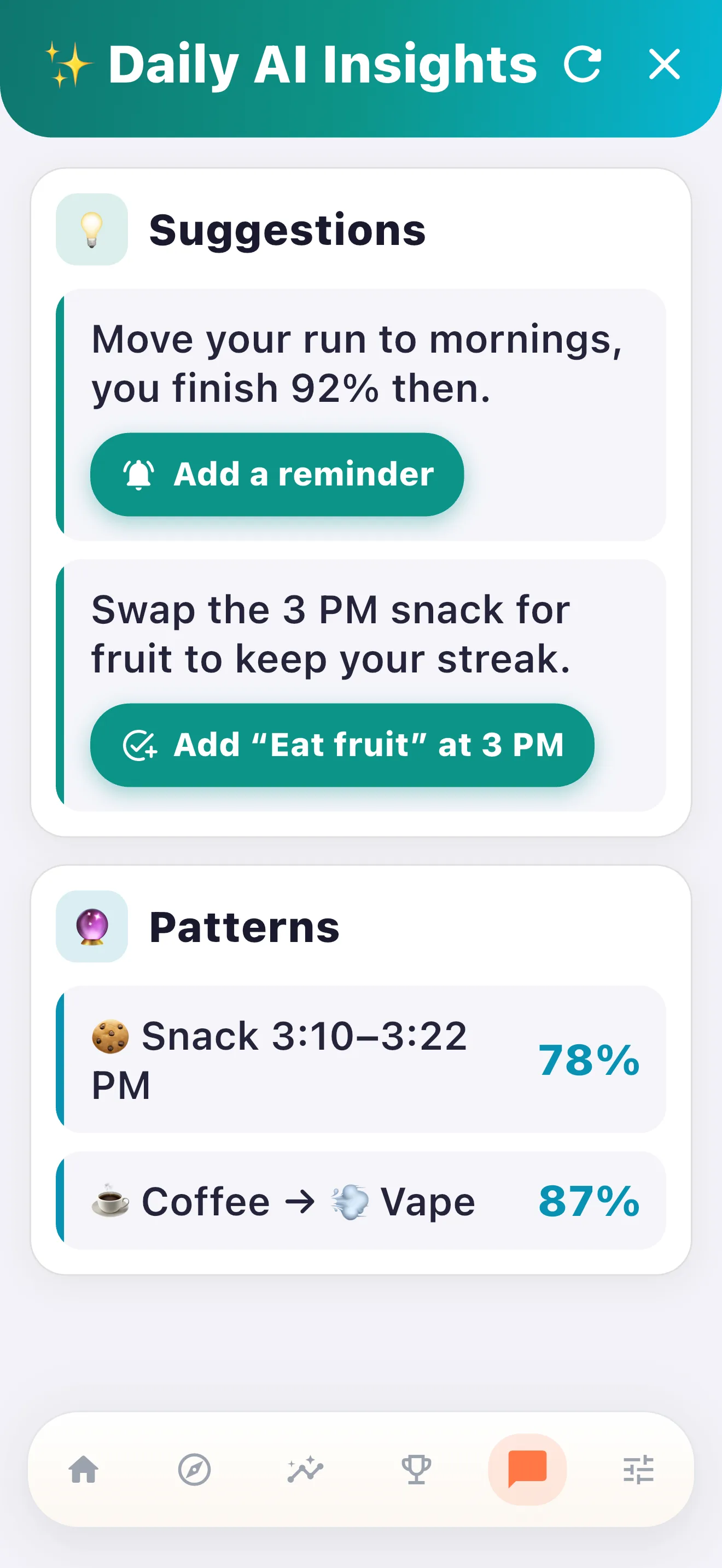
Your phone already counts steps; the question is whether the count is being used to drive behavior or just being collected passively. A walking-specific app or a general habit tracker that pulls step data from your phone's health system converts the passive count into an active target you can see throughout the day. Most users find that even just seeing the running total updates makes them more likely to add a quick walk to hit the day's number.
Three things to look for in whatever you use. One, can you set a daily step target that auto-adjusts week-over-week (3K + 1500 → 4500 + 1500 → 6000 + 1500 → 8K)? Two, does it sync with Apple Health or Google Fit so the count is automatic, not manual? Three, does it shrug off a low day without zeroing the streak, because there will be travel days, sick days, and meeting-stack days.
If you're looking for how to walk more daily, a 10000 steps plan, or a walking habit app that builds from your real baseline, HabitIt was built around exactly this kind of structured ramp-up. You can build a walk more automatic habit plan in about ten seconds, free, no signup, and it syncs steps from Apple Health automatically.
Five Ways the Plan Still Falls Apart
Trying to jump to 10K in week one. The most common failure. The week-one target is "baseline + 1500," not "10K cold." Users who skip the ramp end up at 5K average by week three because the early big-jump days produced exhaustion and missed days that the math couldn't recover from.
The "I'll just do one long walk" strategy. Works for a few days then dies. One 60-minute walk requires a 60-minute block, which doesn't exist on busy days. The frequency approach (3-4 short walks) survives busy days; the long-walk approach doesn't.
Tracking only via phone. If you leave your phone at your desk and walk away, you don't get the steps. Solution: bring the phone or wear an Apple Watch / Fitbit / similar that captures movement even when the phone isn't with you. The tracking error is bigger than people assume; 1,500 phantom missed steps per day is common.
Skipping the post-lunch walk because of weather. The most common skip. Once you skip for weather once, the rule becomes "walks happen on nice days" and the average drops fast. Pick a route that has indoor options (mall walking, parking garage in bad weather, treadmill at the gym near work) so the walk can always happen.
Quitting after a sick week. A week off doesn't kill the plan; restarting at the smallest version does. After a sick week, resume at week 1's target (baseline + 1500) for two days, then jump back to your previous level. The restart protocol applies the same way.
Beyond day 30
The first 30 days install the anchors. The next 60 build the new baseline. Around day 60 you'll notice 8,000 steps doesn't feel like effort anymore; it's just the shape of an ordinary day. Most users naturally drift toward 9,000-10,000 by month three without consciously targeting more, because the anchored walks expand slightly when life allows it. The compound effect over a year is roughly 2.9 million steps (1,400 miles), which is a meaningful amount of movement and produces the cardiovascular, mood, and sleep benefits the research on walking has documented.
The honest meta-point is that walking is the highest ROI habit on the activity side because it's the lowest-friction. Running requires recovery; gym workouts require gym time; yoga requires a class. Walking happens in the cracks of your day, requires nothing but shoes, and accumulates real cardiovascular benefit if held over years. Most users who hold the 8K daily for 12 months describe it as the single highest-impact habit change they've ever made, in part because it doesn't feel like a habit change after the first month. A morning walk as part of a routine is the natural compound move once the basic walking habit is solid.
Build your walk more plan today
Free 3-day trial of all features. After that the free tier covers the basic plan. No subscription required.


Get the Free Walk More Plan
Drop your email and we'll send a printable plan you can fill in and track. Occasional updates (max 1 per 2 weeks).
Success! Now check your email to confirm your subscription.
We respect your privacy. Unsubscribe at any time.