How to Stop Biting Your Nails: A 6-Week Habit Reversal Plan

You catch yourself mid-bite during a meeting, then stop and feel embarrassed and hide your hand. Twenty minutes later you're doing it again with zero memory of starting. You've tried bitter polish to find it only lasted a week, gloves, and even manicures hoping it would help, to no avail. Willpower was never really the variable at play - nail biting is what behavior scientists call a body-focused repetitive behavior, and it plays by different rules than substance habits, which is exactly why the usual quitting tactics fail here. In here you'll find a 6-week habit reversal protocol that actually works, as well as an AI habit tracker with pattern detection to show you where your triggers lie.
The pattern you already know
You've been biting since you were a kid. Maybe a sibling did it. Maybe a parent. At some point it stopped being a phase and became a thing, and now you're older and your hands look like a teenager's. You've told yourself you'd quit for job interviews, for weddings, for that one date. The longest you've ever made it is about three weeks. Then a stressful Tuesday hit and you bit one nail and the rest cascaded.
Here's what's actually going on. Nail biting is classified as a body-focused repetitive behavior (BFRB). This is in the same family as hair pulling and skin picking. The defining feature is that it happens largely outside of conscious awareness, often when the brain is occupied with something else (a meeting, a movie, scrolling a feed). Your hand is in motion before any thought registers, and by the time you notice, you've already bitten through three nails. The behavior also delivers a mild dopamine bump from the satisfying click and the tactile feedback, which trains the brain to repeat it during low-stimulation moments. Nail biting is what your nervous system does when it has nothing else to do with your hands.
The reason cold-turkey nail biting fails is the same reason every "just stop" approach to BFRBs fails, and that's because there's no chemical to taper, no substance to gradually reduce. You can't dose down on nail biting the way you can on caffeine. What you can do is train a competing physical response that occupies the same hand-to-mouth pathway during the same trigger moments. This is the protocol called Habit Reversal Training (HRT), developed in the 1970s by behavior therapists Azrin and Nunn, and it has the strongest evidence base of any behavioral intervention for nail biting in the clinical literature. The 6-week plan below is the consumer-friendly version of HRT, adapted for self-directed use.
Why most "I'm going to stop biting my nails" attempts fail
Not having built awareness before trying to stop is the single biggest predictor of failure here. Most people who decide to quit jump straight to "I will not bite my nails" on day one and fail within hours, because they bite without ever noticing it happening - nobody can quit a behavior they don't see themselves performing. The first two weeks of any working plan are about noticing the bite, not stopping it, and skipping straight past that step is where most attempts actually end.
Two other mistakes finish off whatever survives that first one. Trying to taper a behavior that has no chemical curve is one of them. Tapering works on substances because the body adapts to a smaller dose over weeks, but nail biting has nothing to dose down, so "bite less each day" gives the urge nothing to actually compete against in the moment it fires. This shows that the plan needs a physical action between urge and biting, not a percentage target. Reaching for bitter polish, gloves, or a manicure is the other mistake. This is because all three attack the symptom rather than the mechanism. The polish wears off, the gloves come off, the manicure chips, and none of them ever trained a competing response, so the bite comes right back the moment the barrier fails.
The 6-week protocol below avoids both by force.
The 6-Week Habit Reversal Plan
This plan runs longer than the substance-quit plans on this blog because behavior change without a chemical taper is slower. There is no day-25 dopamine recalibration to look forward to. What you're rewiring is the unconscious motor pathway that fires the bite, and motor pathways take longer to retrain than receptor populations. Six weeks is the minimum that the HRT literature shows produces a stable result. Many people need eight to twelve. Don't shorten the schedule because you feel ready by week three; you won't be.
Log every episode for two weeks. Any contact between teeth and fingernail counts, and make sure to note when and what was happening when the event occurred. Skipping straight to "I'll just stop on Monday" without this step is how most attempts relapse inside a week, while doing the full two weeks usually reveals a daily count three to five times higher than expected. By day 14, the top three trigger contexts are identifiable (many times it's around focused work, screen scrolling, and one personal context like driving or watching TV).
When the urge happens, try to keep your hand occupied. This can be applying hand cream and massaging it in slowly, or holding a small fidget object like a smooth stone or a paperclip. Which one gets picked matters far less than whether it gets picked once and never swapped out. The entire mechanism behind habit reversal training depends on one motor pattern getting enough repetition to out-compete the old one. Splitting that repetition across multiple responses is the single fastest way to waste these two weeks. Every notice of fingers heading toward the mouth, every urge caught before it's acted on, every mid-bite catch - all of it gets the same response, every time, without exception. Somewhere around week four, most people start catching the urge before the hand even moves. That moment is the actual inflection point of the whole six weeks. This is the proof the new pathway is starting to fire before the old one does.
Meetings get a hand on the knee, thumb tracing the seam. Screen scrolling gets one hand occupied holding a coffee mug or water glass. Driving gets hands at 10 and 2, no exception. The general response from Phase 2 still works everywhere, but the trigger-specific versions cut harder by pre-empting the urge before it fires at all. By week six, the old bite-during-meeting reflex has been replaced by hands on the knee, which is the habit reversal actually locking in.
The Rule That Actually Matters
One competing response, not three, is what actually makes the six weeks work. A common failure mode is switching responses every other day looking for the perfect one - the motor pathway needs repetition to overwrite the old one, and switching resets that repetition back to zero each time. This keeps the whole protocol stuck in week-one beginner territory indefinitely. Picking one response in week 3 and running it for the full four weeks is non-negotiable, as variations can wait until after week 6.
Three smaller habits protect that rule. Counting every bite, including the small ones - a finger-to-mouth that doesn't break the nail, a hangnail nibble, a cuticle pull - is what keeps the audit honest, since day 4 of any habit attempt is exactly where most people start quietly underreporting to themselves. Keeping hands busy matters because almost every biting episode happens when both hands are idle, and the same logic behind replacement habits for any quit applies here too. Tracking the trigger context alongside the bite count rounds it out: "8 bites" says nothing useful, but "8 bites, 6 during the morning meeting" points directly at where Phase 3's intervention needs to go.
Running the AI habit tracker plan with an app
You can run this with a paper tally and a note in your phone for each bite. People did it that way for decades. The failure mode of the paper version is that on day six you forget the count, on day twelve you can't remember which trigger context the most bites were in, and the trigger data (which is where the actual intervention happens) becomes unusable. Awareness training only works if the data stays clean across all six weeks.
Three things to look for in whatever you use. One, can you log a single bite in one tap from your home screen widget without opening the app? If logging takes 10 seconds, you'll underreport. Two, can you tag the trigger context (meeting, scroll, drive) when you log? Without trigger data, Phase 3 has nothing to plan around. Three, does it shrug off a missed day rather than zeroing the count? Because you will have an awful Wednesday where you bite 15 times, and an app that punishes that is how the protocol dies in week four.
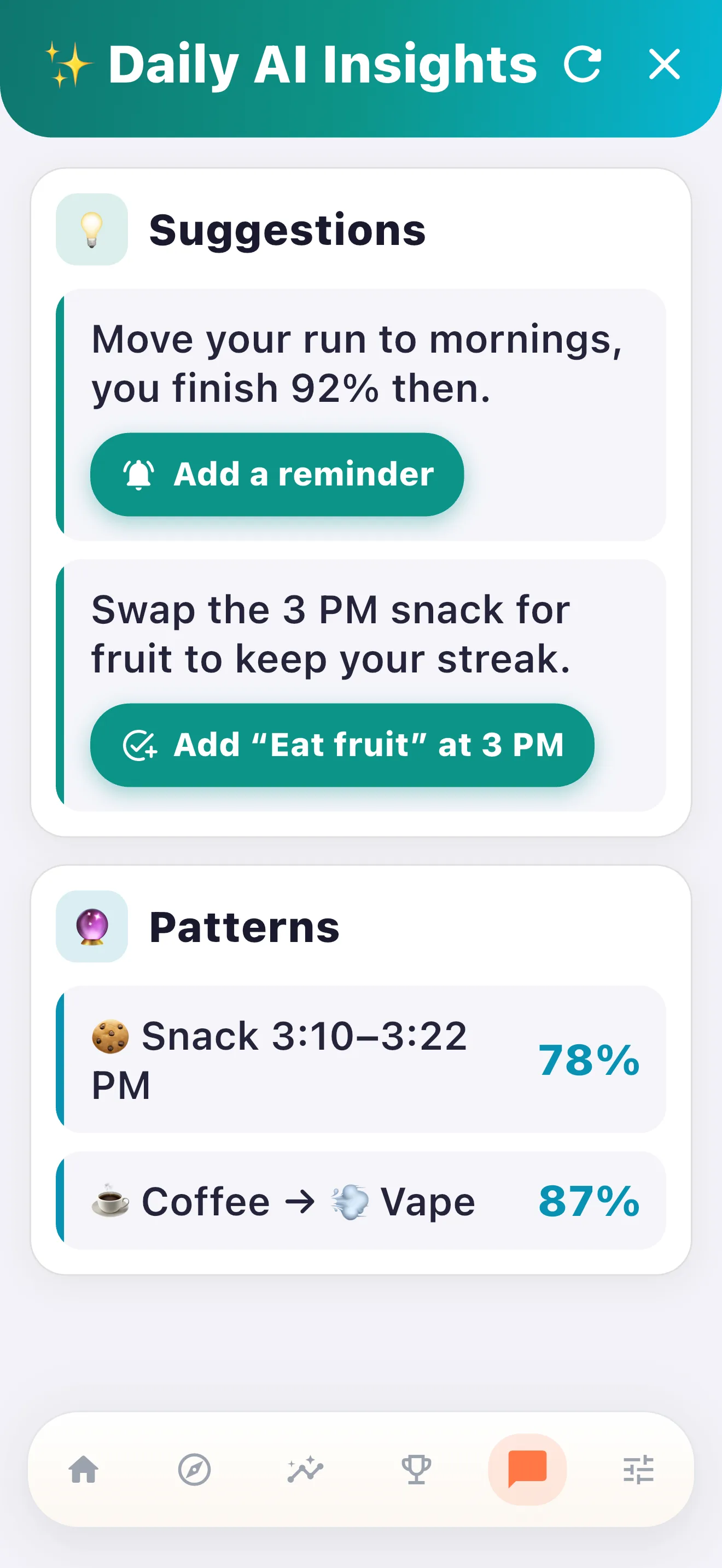
If you've been searching for a quit nail biting app that actually tracks trigger context instead of just counting days, a nail biting tracker app that logs episodes with one tap, or just a way to stop biting nails permanently rather than the cycle of bitter polish and broken promises, HabitIt's quit journey was built for exactly this kind of behavior change. You set the start number (your audit count) and the end number (zero), and the app generates the 6-week competing-response schedule. Each log can include the trigger context, so Phase 3 has the data it needs. When you slip, the journey rebuilds the next day's target rather than burning the streak.
The Failure That Ends Most Attempts
The "I'm cured" gear-shift at week 4 ends more of these protocols than anything else on this list. The bite count has already dropped noticeably by then and the urge starts to feel manageable, which is exactly when the competing response and the tracking both quietly stop - and within two weeks, baseline returns. The protocol works precisely because of weeks 5 and 6; quitting at week 4 is the equivalent of stopping a course of antibiotics the moment symptoms ease, and the residual habit is what causes the relapse.
A handful of smaller traps explain most of what's left. The bitter polish revival shows up around week 3, when adding polish "just to help" feels harmless but actually hurts the whole system. The polish trains taste, not hands, and it reads to the brain as "the polish is doing the work," which robs the competing response of the repetition it needs. The manicure trap works the same way in reverse. A nice manicure in week 2 or 3 feels like a commitment device but really functions as the opposite, since the single chipped nail by week 4 is the most common trigger of a full relapse cascade. Stress relapse is a different kind of response and is not a mistake so much as a normal event. An unusually stressful week can re-trigger the bite reflex even after a clean six-week run, and the people who treat it as a single-day setback are back on protocol by the weekend, while the ones who read it as a full restart almost always quit.
Beyond 6 weeks
Around day 50 most people notice that they haven't thought about biting for several days in a row. The unconscious thumb-trace fires automatically during meetings and drives. The nails are visibly different (still short, but with smooth edges instead of bitten ones). Within another month they grow out enough that a real manicure becomes possible without immediately failing. This is the inflection point, and it shows the habit hasn't been replaced by deliberate effort anymore. It's now been replaced by a new unconscious motor pattern. That pattern, once established, is as durable as the bite was.
The interesting thing the literature shows is that successful HRT for nail biting often produces a generalized reduction in other BFRBs. Cuticle picking goes down. Hair twirling reduces. The trained motor pathway transfers. This makes sense because the underlying urge mechanism is shared across body-focused behaviors. The single behavior change is doing more work than its name suggests. Anchoring the competing response to other daily triggers (post-coffee, post-shower) extends this generalization further.
For now, get a notebook or open the app, then count for two weeks. Remember, during this time we don't make changes yet, we just try to understand. That's the entire week-1 agreement. Best of luck!
Build your 6-week nail-biting plan today
Free 3-day trial of all features. After that the free tier covers a basic quit journey. No subscription required.


Get the Free Nail-Biting Reversal Plan
Drop your email and we'll send a printable plan you can fill in and track. Occasional updates (max 1 per 2 weeks).
Success! Now check your email to confirm your subscription.
We respect your privacy. Unsubscribe at any time.
Want the protocol tracked? Build a nail-biting habit tracking plan with the awareness and competing-response phases built in.