Top 8 Apps to Cut Sugar in 2026
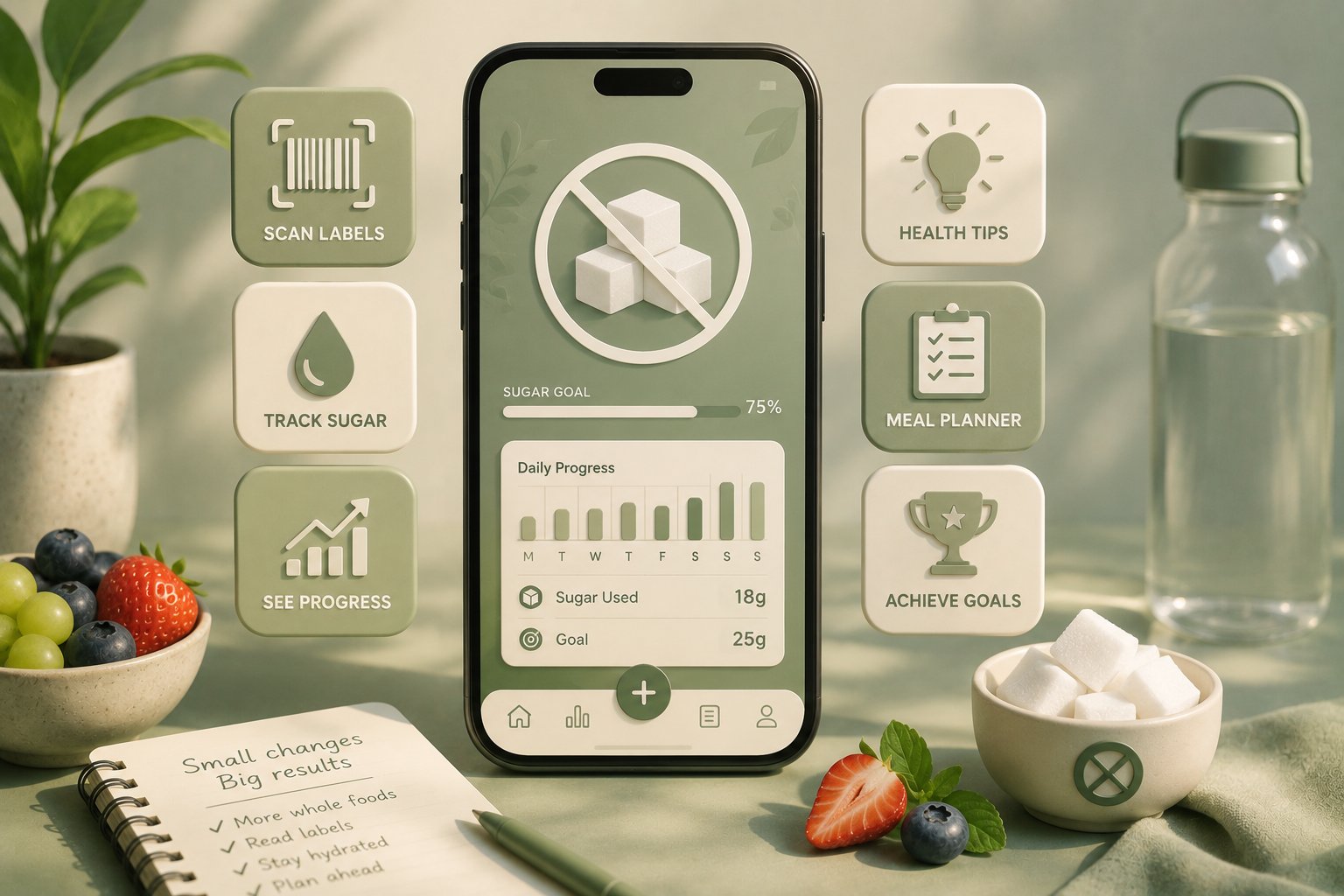
Sugar hides in almost everything processed, and the craving that follows hits hard and passes fast. Most apps miss that window entirely - they log what you ate after the fact, when the moment that actually needed help is already over. A handful do something smarter. They set a target ahead of time and make logging quick enough to survive an actual afternoon. And none of them shame you when that afternoon goes sideways anyway. Here are the 8 worth knowing about, several of them built around the WHO's added-sugar guidance further down.
Quick comparison
| App | Best for | Price | Platform |
|---|---|---|---|
 HabitIt HabitIt |
AI builds your plan and recalibrates when you slip with automatic pattern detection | Freemium | iOS & Android |
 Cronometer Cronometer |
Detailed micronutrient and sugar gram tracking | Freemium | iOS & Android |
 MyFitnessPal MyFitnessPal |
Calorie and macro logging with huge food database | Freemium ($19.99/mo) | iOS & Android |
 Noom Noom |
Behavior-change coaching for food habits | ~$70/mo | iOS & Android |
 Lose It! Lose It! |
Calorie tracking with barcode scanner | Freemium | iOS & Android |
 Yazio Yazio |
Food diary with sugar and carb focus | Freemium | iOS & Android |
 Sugar Sense Sugar Sense |
Blood sugar logging for diabetics and prediabetics | Freemium | iOS & Android |
 Done Done |
Habit streaks with no food-tracking depth | Free (3 habits) + one-time unlock | iOS & Android |
How we compared these
We pulled each app's current App Store or Google Play listing fresh in July 2026 rather than trusting an old review. That covered the price and what the free tier actually includes. Then we sorted them on two things: whether they support a declining daily target, and how much of the app you actually get before hitting a paywall.
The list
1. HabitIt
HabitIt is a smart habit tracker built around a target that moves. Pick a starting point - 80 grams a day is a common one - and set where you want to land, say 25. The app steps you down toward it over about a month, and you log against wherever today's number sits. Go over on a Tuesday, and Wednesday's target just quietly absorbs it, so the whole week doesn't read as a wash. Plenty of sugar apps never build that piece in at all; they just count. HabitIt's reduction tracking sits in the free tier, so the taper itself doesn't cost anything to try. Build a cut sugar plan here, takes about ten seconds.
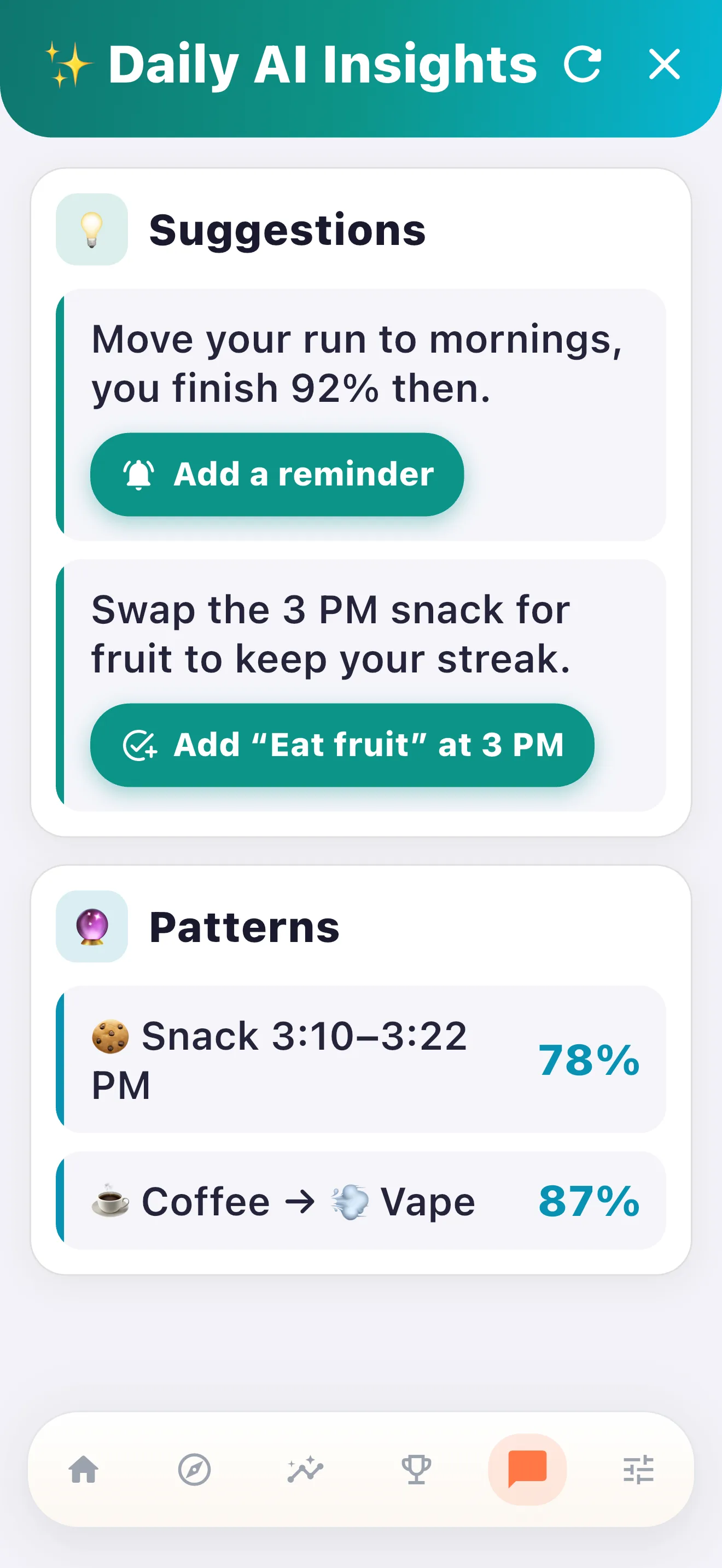
As an AI habit tracker, it's also watching for shape in the slips themselves. A granola bar most afternoons, takeout most Fridays - once a pattern like that shows up often enough in the log, HabitIt's pattern detection surfaces it plainly: your slips cluster right after your 2pm meeting, say. That's a fact you can actually work with. Move the snack earlier, or leave something better than a granola bar in the desk drawer.
2. Cronometer
Cronometer is the most precise nutritional tracker on this list, by a clear margin. It logs full micronutrient detail well past the usual macro summary, and it separates added sugar from what's naturally occurring in the same meal - useful if you actually want to know how much of your breakfast yogurt's sugar came from the honey you drizzled on top. There's a real learning curve on the interface. The payoff is data quality close to what a registered dietitian's own software produces, which is a rare thing for a consumer app to pull off.
3. MyFitnessPal
The most widely used food tracker around, mostly on the strength of its database - over 20 million foods, restaurant chains included. There's a barcode scanner for anything packaged. Sugar sits right in the nutrition summary next to the other macros, and you can set a custom limit that turns red once you're over it for the day. Free tier covers basic sugar tracking fine; paid removes ads and opens up more detailed nutrient data. Whatever time you're going to spend logging food, this database is what shortens it.
4. Noom
Noom bolts behavioral psychology onto regular food tracking - short daily articles, coaching questions aimed at your actual relationship with food. That's more territory than a plain diary tries to cover. Its color-coded food system, green for low density up through red for high, doubles as a rough sugar-density gauge. A candy bar or a soda comes up red without you ever reading the label. It's the priciest option on this list, and the price buys the coaching layer specifically. Whether that's worth it comes down to whether a plain tracking app has already let you down before.
5. Lose It!
A strong food diary with a label scanner that's quicker to use than MyFitnessPal's. The free tier is notably more generous here - sugar breakdown sits right in the daily macro summary at no cost. Calories are the app's main lens, and sugar still surfaces easily enough in the macro settings, with the daily total kept front and center. A solid pick for MFP-level database quality without MFP's paywall pressure. It also tracks net carbs, worth knowing if you're coming at sugar from a low-carb angle.
6. Yazio
Yazio earns its spot specifically for the European food database. Eat mostly European brands, or live there, and MFP starts missing products that Yazio actually has on file. Sugar sits in the macro summary same as the others, and the free tier handles daily logging reasonably well before the paywall shows up. For most people it won't feel dramatically different from Lose It!. For anyone who keeps striking out searching MFP for what's actually in their kitchen, it's worth a two-week trial.
7. Sugar Sense
Sugar Sense started out built for diabetics tracking blood sugar, and that history shows in everything it does. The real question it answers is how food maps to glucose response, a step past simply counting grams. A doctor might be involved. Maybe it's PCOS. Or the afternoon energy crash just has a medical explanation nobody's confirmed yet. Entry is manual, and the interface won't win awards. The clinical angle here is still genuinely unique on this list. It's built for someone whose reason for cutting sugar came from a lab result rather than a New Year's resolution.
8. Done - A Simple Habit Tracker
Done takes a different angle entirely. There's no food logging and no gram breakdown to speak of. You set one daily habit - "under 30g added sugar today" - and get a green or red at the end of the day. That's the whole thing. It suits people who want to build the noticing habit before taking on a full tracking setup, and it also works well for anyone who finds a food diary itself a little anxiety-inducing to open. Once the noticing sticks, you can graduate to something more granular. Plenty of people just never bother and run on the binary check for months, and that's fine too.
- Best declining-target taper: HabitIt
- Best nutritional precision: Cronometer
- Best food database: MyFitnessPal
- Best behavioral coaching: Noom
- Best generous free tier: Lose It!
- Best European food database: Yazio
- Best for a metabolic health signal: Sugar Sense
- Best bare-minimum check: Done
How to actually reduce sugar without losing your mind
A lot of sugar reduction attempts skip straight past the awareness part and jump right into restriction, and that's usually what does them in. Spend the first two weeks just logging whatever you already eat, no target attached yet, just to see it. You'll probably run into a few surprises along the way - a flavored Greek yogurt sitting at 22 grams, or a "healthy" trail mix bar quietly carrying nearly as much. Those two weeks end up being your real starting number, whatever it turns out to be. Without them you're just guessing at a target instead of actually reducing from something real.
Once you've got two weeks of data, the reduction phase is simple in concept. A reasonable pace, as a practical starting point, is cutting the daily target by 5 to 10 grams a week. Dropping it all at once tends to bring on a rough afternoon that feels a lot like genuine hunger - low blood sugar is a recognized trigger for that exact sensation, along with fatigue and a shaky, unfocused feeling.[2] Spreading the cut out over weeks gives your system room to adjust gradually, which is the whole reason the 30-day cut sugar reduction plan actually holds where a sudden cut doesn't.
Sauces are a source people rarely count. Ketchup and teriyaki both run higher than most people guess, and "low-fat" salad dressing is often no better. Savory bread can add another 3 to 5 grams a slice. None of that shows up if it isn't logged, and small untracked amounts add up fast across a day. The junk food quit post covers how processed labeling buries sugar content in ways a quick label check won't catch.
Beyond that, what actually decides this is whether you're still opening the app once the first two weeks of novelty have worn off. Every one of the eight above can do the job if it gets used consistently.
Common failures
Drinks alone can rack up 60 grams before any solid food even shows up in the log. A juice at breakfast does a lot of that work on its own, and an afternoon iced tea usually finishes the job. Drinks are also the easiest thing to leave untracked, since a drink rarely feels like "eating" the way a snack does. Once someone logs a full day honestly for the first time, the drink column is usually where most of the surprise total turns out to be hiding.
Dropping fast is its own trap, for the blood-sugar reason already covered above. A jump straight from something like 80 grams a day to 25 tends to bring the cravings and fatigue back hard, and it usually shows up as a headache that gets blamed on willpower when biology is the actual cause. Cut by 10 grams a week, and the odds of it actually sticking go up considerably. A target you can hold week after week is worth more than one heroic white-knuckle week that ends in a rebound.
A food diary with no number to aim for usually stalls out at awareness and goes no further. Logging everything without ever setting a limit just produces a pile of data with nothing pushing against it. Pick a target before you start, even a loose one - stepping down from your current intake by 20 or 25 grams for the first week is plenty.
Whole fruit and added sugar aren't nutritionally interchangeable, even in equal amounts. Fiber in whole fruit slows the sugar's absorption and smooths out the resulting glucose response. Strip the fiber out - a glass of fruit juice does exactly that - and the same amount of sugar hits the system a good deal quicker. The WHO's guidance is specifically about added sugar: under 10% of daily calories, about 50g on a 2,000-calorie diet, with extra benefit reported below 5%, roughly 25g.[1] Whole-fruit sugar doesn't count against that number at all. Cronometer is the one app here that reliably tells the two apart.
Whichever of these you end up using, an automatic habit plan that steps itself down week over week beats one you have to renegotiate with yourself every single morning. That's the specific gap HabitIt, the smart habit tracker, was designed to close.
Citations
- "Sugars intake for adults and children," World Health Organization guideline (2015). Read the source ↗
- "Hypoglycemia (Low Blood Sugar): Symptoms & Treatment," Cleveland Clinic. Read the source ↗
Build your 30-day cut sugar plan today
Free 3-day trial of all features. After that the free tier covers the reduction tracking. No subscription required.


Get the Free Cut Sugar Plan
Drop your email and we'll send a printable plan you can fill in and track. Occasional updates (max 1 per 2 weeks).
Success! Now check your email to confirm your subscription.
We respect your privacy. Unsubscribe at any time.