Top 6 Apps to Drink Less Alcohol in 2026
Most "quit drinking" apps are built for people who want to be sober, period. Meanwhile the drink-less-without-quitting crowd is enormous and underserved: damp-lifestyle types, Dry-January graduates who don't want to slide back to the old baseline, the partner of someone in AA who wants a moderation plan of their own. The 6 apps below are the ones worth your time in 2026 for that specific use case, tested on taper support, missed-day handling, and whether the app treats moderation as a real outcome or as a stepping stone to sobriety. No affiliate links here. One of the six is ours, and it's ranked where the testing put it, not at the top by default. The category that matters most for moderation is whether the app behaves like a smart habit tracker with an automatic daily plan or just a checkmark grid.
Quick comparison
| App | Best for | Price | Platform |
|---|---|---|---|
 HabitIt HabitIt |
AI builds your plan and recalibrates when you slip with automatic pattern detection | Freemium | iOS & Android |
 Reframe Reframe |
AI-powered drink-less coaching | $13.99/mo | iOS & Android |
 Sunnyside Sunnyside |
Weekly drink targets with check-ins | $14.99/mo | iOS & Android |
 Try Dry Try Dry |
Sober-day streaks and drink logging | Free | iOS & Android |
 I Am Sober I Am Sober |
Sobriety counter with daily check-ins | Freemium | iOS & Android |
 Less - Drink Less Less - Drink Less |
Simple daily drink count tracker | Freemium | iOS & Android |
What actually got tested
App-store search for "drink less" returns a mix of sobriety apps and lifestyle trackers, and the difference matters more than the ratings suggest. A sobriety app treats every drink as a failure. A moderation app treats your drinking pattern as data you're tuning, and if the goal is five drinks a week alongside a normal social life, that second framing is the one that holds up. So forget download counts. The real test was whether each app could hold a weekly target like 14 drinks stepping down to 5. Slip handling mattered even more: a heavy Saturday should get you a re-planned Sunday, and a couple of these apps just zero a streak and sulk. Bar nights got their own test too, since the easy Tuesday evenings were never anyone's problem. (For a broader take on which habit trackers move past the streak monoculture, the apps roundup goes through 5 picks across categories.)
All 6 got tested over three weeks, against a real moderation goal of reducing from 14 drinks a week to 7. The logging stayed honest, including a deliberately heavy weekend mid-test, to see how each app handled the bad data. That's where they separate.
The list
1. Reframe
The biggest drink-less app on the market by a wide margin, with hundreds of thousands of users and aggressive social-ad spend. Reframe's core is a daily CBT-based lesson program, which is unique on this list - everything else here is a tracker at heart. The content is genuinely good, the design is polished, and the science-backed framing pulls users who would never download a "quit drinking" app. What it doesn't have is a true taper-counter; you log drinks, but the app doesn't auto-set tomorrow's target based on this week's data. The premium pricing is on the high end at around $80/year for full access. If a coached program is what you're after, Reframe earns its price. People who just need a tracker will be paying for a lot of lessons they never open.
2. Sunnyside
Built explicitly for the damp-lifestyle crowd. Sunnyside pitches itself at mindful drinkers with no plans to quit, and the product matches. You set weekly goals, text or chat with a coach, and get gentle accountability nudges along the way. The text-message format is the differentiator, since checking an app is often the friction that kills moderation tracking. Sunnyside premium is subscription-only and pricier than most of the list, but the coach interaction is meaningful for users who respond to accountability over content. The best fit here is someone who wants a person involved. Pure data trackers will find the check-ins chatty.
3. HabitIt
Full disclosure: this one's ours. The differentiator on this list is that HabitIt is the only one that auto-builds your weekly drinks target and steps it down toward your goal across a timeline you set. You tell it you're at 14 drinks a week and want to be at 5 in 8 weeks, and the app lays out the weekly targets and tracks against them. When you go over on a weekend, it re-plans the next week instead of zeroing a streak. The weak side is community: HabitIt has no built-in forum like I Am Sober does, and no daily CBT lessons like Reframe. If you want pure plan-and-track for moderation, HabitIt is built for it. If you want company, pair it with I Am Sober below.
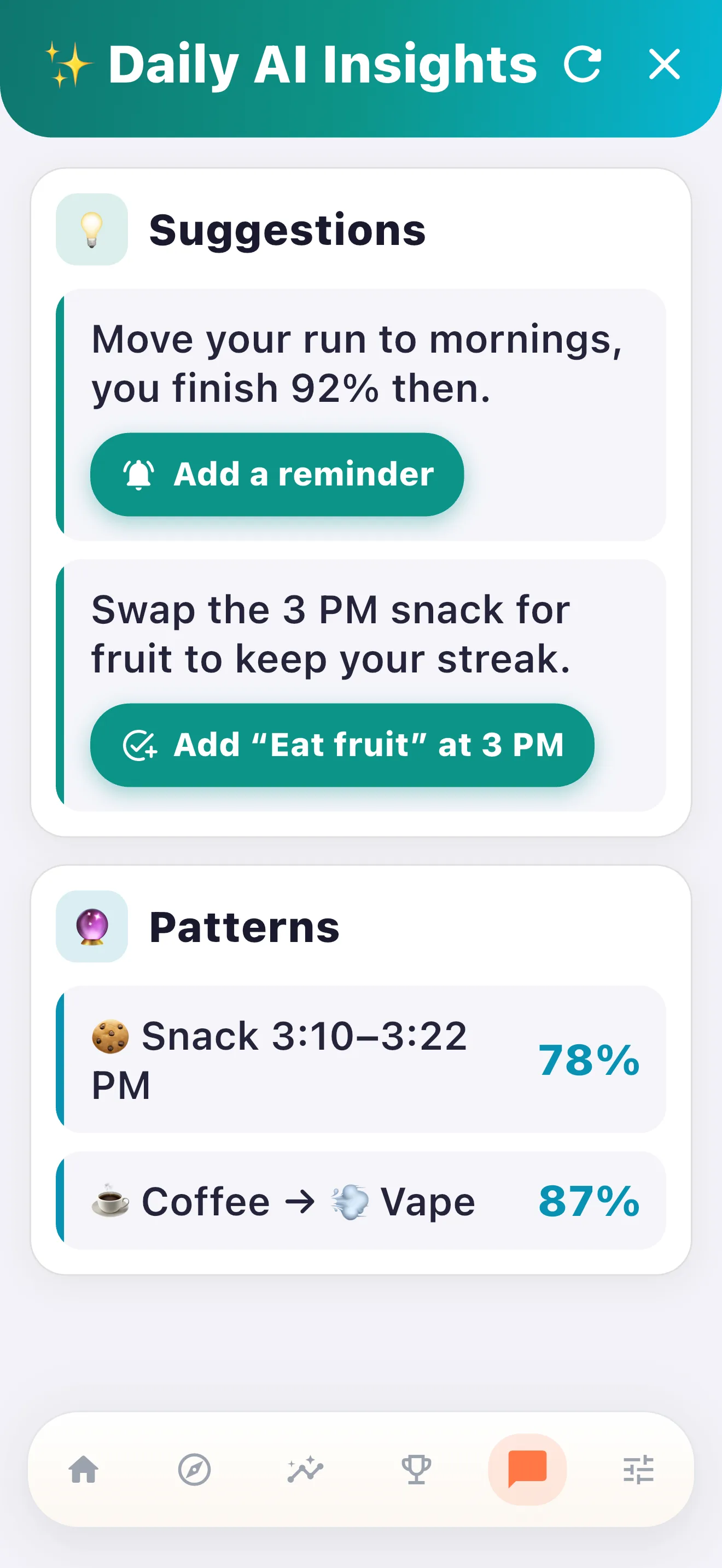
Drinking has patterns. The after-work wind-down that starts at 6pm, the Friday that runs long, the hard week that shows up in Sunday's log. When those cluster, the AI surfaces them. Anyone cutting back already has a rough sense of when the problem happens, but "your Wednesday drinks are double your Monday target" gives you a number to point at. That's different from a feeling.
4. Try Dry
Free app from Alcohol Change UK, the charity that runs Dry January. Best in class for dry-month tracking with a clean calendar interface, badges that don't feel performative, and money-saved/calorie-saved counters that are accurate. Where it falls short is ongoing moderation, because the whole design points at counting dry days, and a sustainable weekly number is a different shape of goal. Users who finish a dry month and want to slot into moderation often outgrow Try Dry after week 3. Pair it with HabitIt or Sunnyside for the moderation phase if you started with Try Dry.
5. I Am Sober
The biggest sobriety-focused app on the App Store, but it works surprisingly well for moderation if you redefine "sober" as your own daily limit. The community is the load-bearing feature; the daily check-in scrolls through other users' messages and is genuinely active. The data side is lighter than Reframe or HabitIt, and the streak counter does what streak counters do (punishes slips). Best paired with another app for the planning side, used here for the human contact and daily accountability piece. The premium tier is reasonably priced and the free tier is usable for months.
6. Less - Drink Less
Bare-bones tracker. Counts drinks per day, displays a trendline, that's the product. No CBT content, no community, no taper structure. It makes the list because a subset of users genuinely wants less app, and Less delivers exactly that. If you've used Reframe and found the daily-lesson cadence overwhelming, or Sunnyside and didn't want the coach interaction, Less is the minimalist option. Free with a small premium upgrade for advanced trends. Best for users who already have a moderation plan from somewhere else and just need a tracker.
How to Use This List
Don't pick one app. Pick a planning app and a community app, like a quit-vape build but lighter. For most damp-lifestyle moderation that means HabitIt or Sunnyside holding the weekly target, with I Am Sober on the side for the daily community check-in when motivation dips. If you respond better to content than to data, run Reframe for the daily lessons and add Try Dry when you're starting with a dry month before moderation. Single-app attempts tend to fail because no single app does both the planning and the human-touch side well. Picking the two that fit your specific failure mode beats picking the highest-rated one.
Three different approaches cover three different problems. A weekly target tracker (HabitIt, Sunnyside, Try Dry) handles volume. Reframe goes after the emotional trigger behind the volume, and I Am Sober covers the accountability gap. Most people need two of the three. Build a drink less plan directly in HabitIt, free, no signup.
Common failures with drink-less apps in general
Treating the weekly target as a budget to spend. The most common failure pattern. Users see they're "under" by Tuesday and unconsciously make it up on Friday, and by the third week the Friday spend has quietly become the plan. The weekly target is a ceiling. Unused drinks from Tuesday are gone; Friday doesn't inherit them. Tracking weekly average plus week-over-week change matters more than hitting any single week's cap.
Logging drinks without bar-night context. Five drinks at a Friday bar and five drinks alone on a Wednesday couch are two very different data points, and an app that only counts drinks can't tell them apart or predict the next slip. Use the notes feature or write down WHY you went over alongside the count. The three-number method covers this nuance more deeply.
Picking a sobriety app for a moderation goal. The streak counter on I Am Sober or AA-aligned apps makes any drink a "failure," which is corrosive when cutting back is the whole plan. Pick a moderation app, or accept that you'll be ignoring the sobriety messaging in the one you use.
Going free-only and not upgrading. Most of these apps paywall the taper, the unlimited custom goals, or the community access behind a $50-80/year premium. The cost is small versus what you'd spend on alcohol; pay for the one app you use.
Mistaking the log for the plan. Logging is not moderating; the log is just the data the plan runs on. If you have an app and no replacement-habit framework for the bar-night and stress-trigger windows, you're just watching yourself drink with better graphs.
Beyond the list
The honest version of this post is that the gap between drink-less apps in 2026 isn't enormous; the top 3 all solve similar problems with different leans (data, content, accountability). What actually moves the needle is consistency of use, which is heavily personal. The right app for you is the one you'll open on a Wednesday evening when nothing is happening, because that's when the moderation habit gets reinforced. Apps you only open after a heavy weekend don't build the pattern.
A note on pricing across the category. Reframe and Sunnyside are at the high end at $60-80/year. HabitIt, I Am Sober, and Try Dry premium tier are in the $20-30 range. Less is largely free. The price differences are small versus a single week of bar tabs, so sorting by price gets you the wrong answer. What matters is which one you'll still be opening in week 12. A $30 app you use is worth more than a free app you don't. Most apps offer a 7-day trial; install two, run them parallel for a week, uninstall the one you didn't open as often.
One last meta-point: the apps not on this list are mostly AA-aligned recovery apps or generic habit trackers without alcohol-specific features. The AA-aligned options are great for sobriety but treat moderation as a stepping stone you should outgrow, which wears you down if moderation IS your endpoint. Generic habit trackers don't have the standard-drink unit, the calorie-saved counter, or the bar-night context features that make the dedicated apps useful. Stick with the 6 above for moderation-specific work.
If you're choosing based on lifestyle pattern, here's a quick decision guide. Weeknight home drinkers tend to do best with HabitIt or Less, because the daily log is fast and the slip-handling is forgiving. Bar and social-event drinkers do better with Sunnyside or I Am Sober, since the coach or community gives you something to think about before you order the third drink. Anyone in or near a dry month should start with Try Dry, then transition to HabitIt or Sunnyside in week 5 for the moderation phase. App quality barely enters into it (the top 4 are all good). The real question is when and where you actually drink.
A word on the messaging across the category. Reframe, Sunnyside, and HabitIt all treat moderation as a legitimate endpoint. I Am Sober and the AA-aligned options assume sobriety is the goal, and Try Dry is framed around the calendar month, good for breaks and thinner for ongoing moderation. If you've tried quit-drinking apps before and felt judged by them, that was the design working as intended, and it's a solid reason to pick from the moderation-first end of this list. Your relationship to the tool stays healthier across months.
Finally, on the data side. The apps that track standard drinks (Reframe, Sunnyside, HabitIt, Try Dry) all let you log a beer, glass of wine, or shot as one unit. Less and I Am Sober just count "drinks" and leave the unit definition ambiguous, which tends to produce logs that feel honest but run low, since people round down when the unit isn't pinned to a specific pour. The standard-drink unit is small enough that the logging stays honest. If you're moderating and the daily count matters, pick one of the four standard-drink apps. People who are there mainly for the community and identity side can worry less about unit precision.
Build your drink less plan today
Free 3-day trial of all features. After that the free tier covers the basic taper. No subscription required.

Get the Free Drink Less Plan
Drop your email and we'll send a printable plan you can fill in and track. Occasional updates (max 1 per 2 weeks).
Success! Now check your email to confirm your subscription.
We respect your privacy. Unsubscribe at any time.