Top 5 Habit Trackers That Aren't Just Streaks
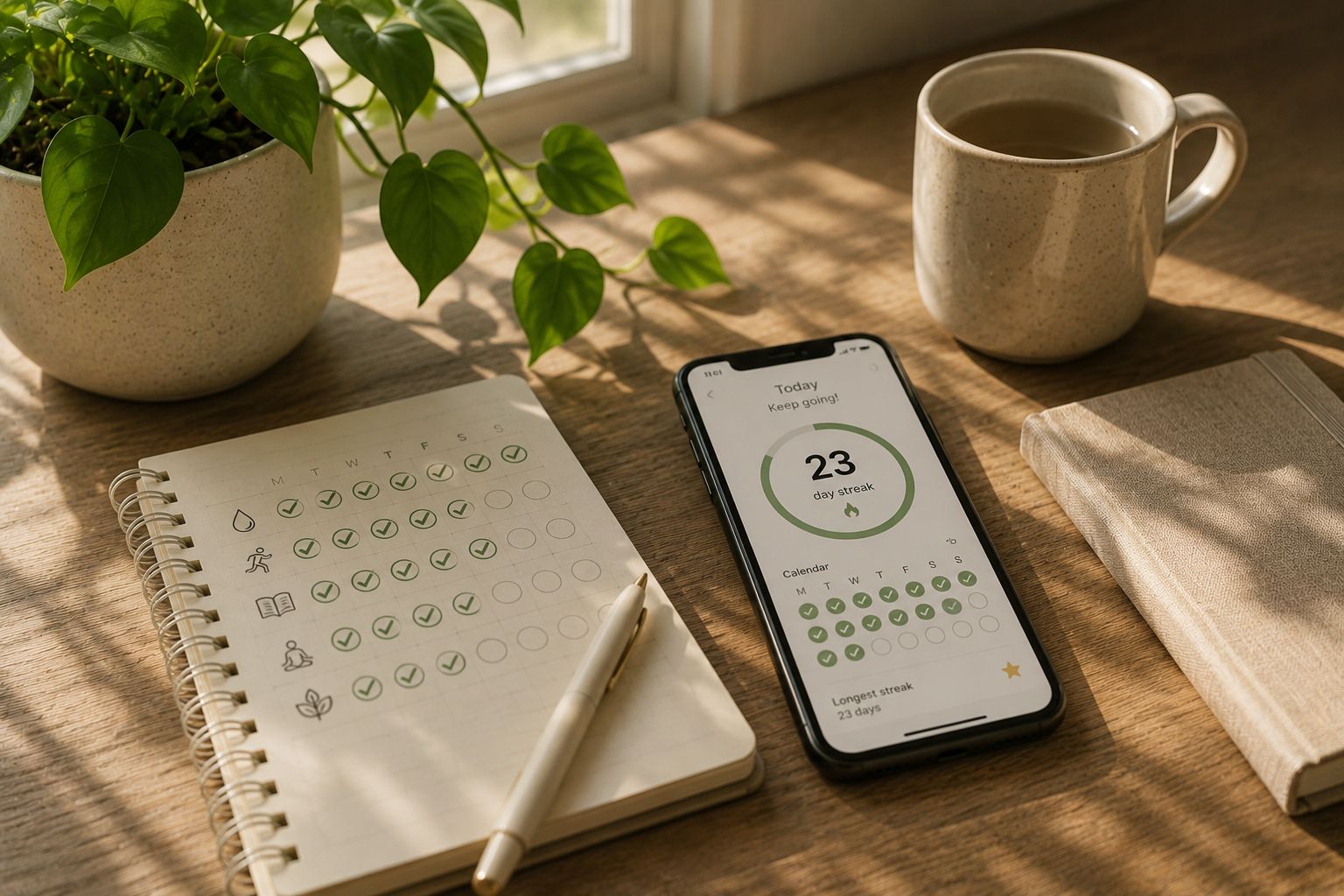
Open the App Store, search "habit tracker," and 90% of the results are variants of the same thing: a calendar grid that turns green for every day you do the habit and resets to zero the first time you miss. That model works well for a minority of users and burns out most everyone else within a couple of months. For a lot of people, missing a Tuesday is a small thing the app turns into evidence of failure. The habit didn't get harder that week. The app just made one slip feel catastrophic, and that feeling is what triggers the relapse. The 5 apps below are the ones built on a different metric. Honest reviews, no affiliate links, and one of the five is HabitIt, disclosed upfront rather than buried.
Quick comparison
| App | Best for | Price | Platform |
|---|---|---|---|
 HabitIt HabitIt |
AI builds your plan and recalibrates when you slip with automatic pattern detection | Freemium | iOS & Android |
 Way of Life Way of Life |
Yes/no logging with long-term trend charts | Freemium | iOS |
 Atom Atom |
Atomic Habits companion with guided plans | Freemium | iOS & Android |
 Habitica Habitica |
RPG gamification for daily habits | Free | iOS & Android |
 Strides Strides |
Goal + habit tracking with SMART targets | Freemium | iOS |
Why streaks fail for most people
The streak counter was a genuinely smart product decision when habit-tracking apps first went mainstream. It made the category feel like a game, drove daily engagement, and helped it grow into what it is now. It is also a terrible primary metric for what habit-formation actually is. A real habit holds for years; a streak counter resets a year of work to zero on the first missed day. The mismatch produces a specific failure mode: a user slips once, the counter shames them for it, and within a week of that first reset the app is gone from their phone. The apps below all do something different with that mechanic, ranging from "streaks exist but aren't the main view" to "no streaks at all." For the full psychological case before diving into the list, why streaks are a trap covers the intermittent reinforcement research in depth.
To be clear, Streaks-the-app is well-designed for what it is, and this post has no quarrel with it. This is for the user who's tried Streaks-style apps, bounced off all of them, and wants to know what comes next. Same goal, different mechanic.
The list
1. HabitIt
Full disclosure: this is HabitIt's own blog, and yes, it's ranked first. The reasoning: most habit apps zero out weeks of taper progress over one bad day, which is the exact failure this app was built to fix. Take the top ranking with that bias in mind. The question HabitIt asks every day is whether you hit the plan target. Streaks exist (people like seeing the number), but they live in a secondary view, and a single slip resets nothing - the plan just recalibrates forward from wherever you landed. The differentiator is the auto-built taper for quit habits: you set "from 100 puffs a day to zero in 8 weeks" and it lays out daily targets. Weak sides exist too. HabitIt doesn't have the community some of the apps below do, and the gamification is minimal next to Habitica. Right for people who want a plan with slip-tolerance built in; wrong for people who want company or game mechanics.
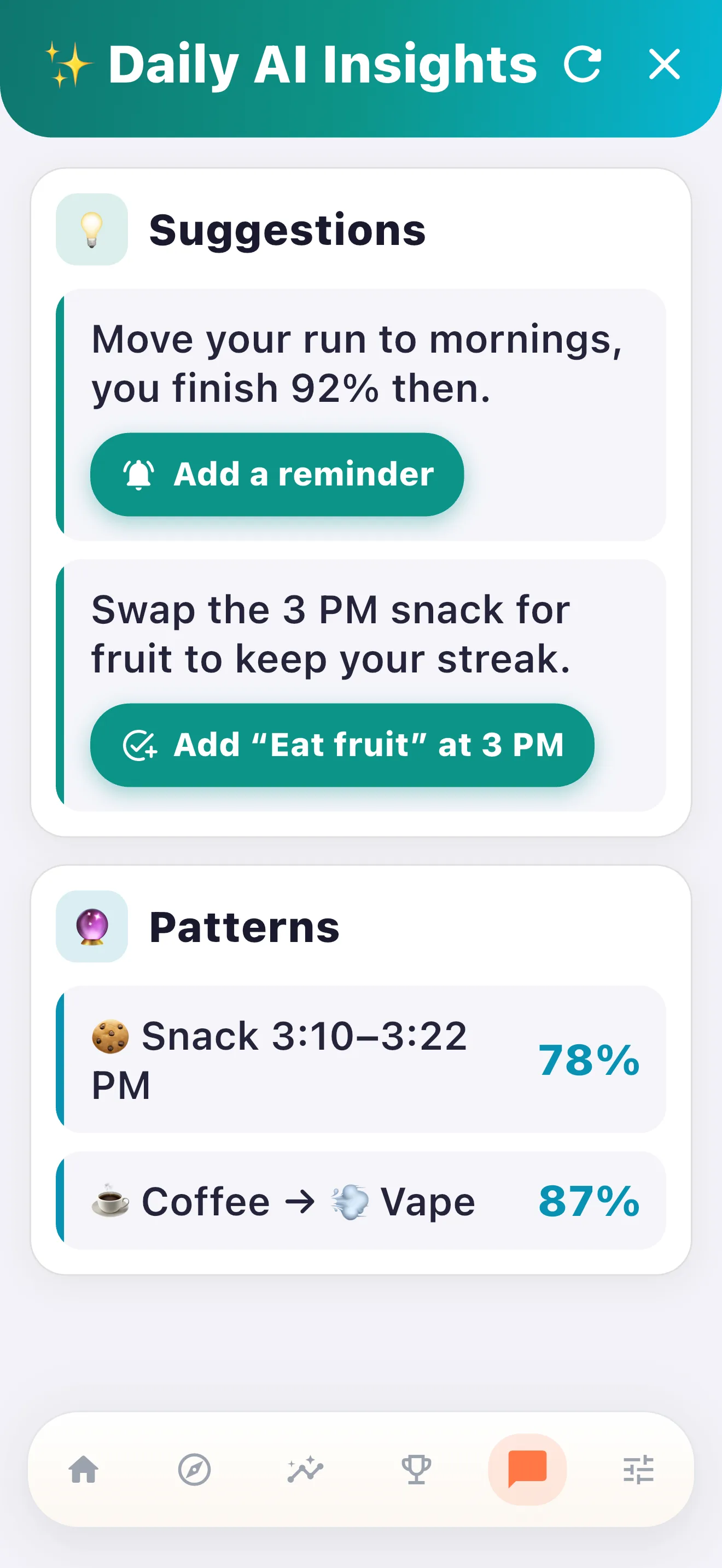
Habits that feel random in their failure usually have a pattern in the data. Maybe the morning workout always dies on Mondays, or the journal entry drops whenever a week gets busy, or two seemingly unrelated habits keep failing on the same days. When that clustering shows up across your logs, the AI surfaces it. If the workout and the water habit both drop on Mondays, something is happening Sunday night or Monday morning - one evening of the week to look at, which is a much smaller problem than a general lack of motivation.
2. Way of Life
The oldest serious-design habit tracker still actively maintained. Way of Life uses a daily yes/no/skip check with a long-arc calendar view showing months at a glance. There is no dominant streak counter; the display is the calendar pattern itself, and the question it trains you to ask is what the last 90 days look like as a whole picture. For users who want a minimal-friction daily check (it takes about 4 seconds to log a day), Way of Life is the cleanest pick on the list. The trade-off is no plan structure: it tracks habits but doesn't help you design them, so pair it with a planning system from somewhere else if you need one. Pricing is a one-time lifetime purchase, which is increasingly rare in this category.
3. Atom
James Clear's official Atomic Habits app. The primary view is identity-based ("you're becoming the kind of person who...") - the book's central thesis turned into a product. The two-minute-rule and habit-stacking templates get first-class treatment in the UI here, with real screens behind them. Streaks exist but are framed as identity reinforcement, and the all-or-nothing pressure is dialed way down. The downside is the price (premium-only after a free trial) and the heavy lean on Clear's specific frameworks, which is great if you've read the book and want them and less great if you haven't or don't. Strong for atomic-habits-curious users; less useful if you're trying to quit something specific.
4. Habitica
RPG-style gamification of habits. Your character has stats, doing habits levels the character up, and skipping habits damages it, so the metric that matters is character progress over time. This is the most genuinely different framing on the list, and it's polarizing: some users love the game layer and find it the only thing that ever kept them tracking, while others find the RPG mechanics absurd and uninstall within the hour. The right test is whether you've ever played an RPG and enjoyed the daily-quest loop. If yes, Habitica might be the only habit tracker you ever finish a month on. If no, this is not your app. Free with optional premium.
5. Strides
Multi-metric goal tracker that supports yes/no, count, total, and average tracking modes. The streak counter exists but sits alongside several other metrics and never dominates the screen. Strides is built around the idea that different habits need different measurements. Daily meditation is a simple yes/no, while water intake wants a count and a savings goal is a running total you chip away at over months. The flexibility is what differentiates it. The downside is the same as the upside: more flexible means more setup, and casual users sometimes don't get past configuring their first habit. Strong for users who want one app for many habit types; less so for users who want minimalist UX.
How to pick from this list
Match the app to how streak trackers failed you last time. When the all-or-nothing reset is what killed your motivation, look at HabitIt or Way of Life first. Maybe the problem was tone instead - the apps felt too productivity-bro and you wanted something with a pulse - in which case Atom and Habitica both have more personality than the category average. And Strides was built for exactly one situation: you track a mix of habit types (some yes/no, some counts, some averages) and every other app forced them all into the same shape. All 5 are well-designed. The right one depends on what specifically didn't work before, which only you know.
People land on this page searching for some version of "habit tracker without streaks," and any of the five will get you there. If you want to feel the plan-based mechanic before committing to anything, you can build a plan in HabitIt in about ten seconds - free, no signup, no download.
Common failures when switching apps
The classic mistake is re-creating everything at once. New tool, fresh enthusiasm, 12 habits created in the first sitting, and by day 4 the whole thing is overwhelming enough that the new app gets uninstalled too. Create ONE habit, hold it for a week, then add more. Chain logic applies to app-switching too.
There's a subtler failure where you treat the new tracker like the old one. Coming from Streaks, your eye will go straight to the streak number out of pure muscle memory, even in an app that deliberately buried it. For the first two weeks, force yourself to look at whatever the new app treats as primary - the calendar pattern in Way of Life, the identity dashboard in Atom, character stats in Habitica. The mental shift is half the value of switching.
Money trips people up too. Atom, HabitIt, and Strides all paywall core features behind premium, and the free tier is usable for one habit but not for the full system. If the new approach is working after week 2, pay for it. Under $30/year for any of them.
Then there's the history problem. You knew which days you'd usually miss in the old app because months of data told you so; the new app starts at day 0 blind. Manually backfill 4-8 weeks of historical data if the app supports it. That trend visibility matters more than starting clean.
The last failure is quitting when the second app's novelty wears off in week 3. Every new app has a honeymoon. The real test is whether you open the app on day 22 when nothing dramatic is happening - an app that survives day 22 matches your actual usage pattern, and one that doesn't deserves to be switched away from as well. The day-4 wall applies to app-relationships the same way it does to habits.
Beyond the list
The honest meta-point is that the habit-tracker category converged on streaks for a simple reason: streaks drive the numbers app stores reward - daily active users, retention, ratings. Whether they're the best mechanic for actual habit formation never really entered into it. The 5 apps above each made a deliberate bet on something else. Way of Life bet on long-arc visibility, Atom on identity, HabitIt on plan adherence, Habitica on the game loop, and Strides on metric flexibility. None of them are bigger than Streaks, and all of them fit the users streaks failed better than another streak counter ever will.
If you've used streak-based apps and gotten years of value from them, keep using what works and skip the rest of this section. But if you've tried 3 streak apps and bounced off all of them, the issue isn't your willpower, it's the mechanic. Pick one of the 5 above, give it 30 days with one habit, and see whether the different mechanic produces a different result. The phrase that comes up over and over from people who make the switch and hold a habit for the first time is some version of the app finally stopped fighting them. When you notice that feeling around week 3, you picked right.
A pricing note across the category. Way of Life is a one-time purchase (rare and great). Habitica is free with cosmetic premium. HabitIt, Atom, and Strides are subscription-based at roughly $20-40/year for the full feature set. The price differences are small versus the cost of trying and failing at a habit for a year because the tool was wrong; pay for the one that actually fits, treat the others as sunk cost of the search.
One pattern worth flagging across all 5: none of them, including HabitIt, will fix a habit that has no clear structure underneath. The tool tracks what you do; the plan determines what you do. Anyone switching apps in the hope that the new app will manufacture consistency they never had ends up disappointed, usually by week 3. The tool change is real but small compared to the plan you load into it. So if you're switching because a habit failed, do the plan post-mortem before anything else - check whether it was the right size, whether it had an anchor, and what was supposed to fill the slot the old behavior occupied. The new app is a fresh canvas for that work.
If you're choosing today and just want a default pick, go by use case. HabitIt for plan-based habits - quits, tapers, structured builds. Way of Life for simple yes/no daily habits you don't need help designing. Atom if you read Atomic Habits and want the book's frameworks built in, Habitica if you've ever enjoyed an RPG, and Strides if you're tracking several habits with different metric types. Framed that way the decision rarely takes more than a few minutes. Don't spend three weeks reading reviews when you could spend them using the one you picked.
If part of your decision is whether to use an app at all versus a physical notebook, the apps vs notebooks comparison covers that medium question directly - when paper wins, when digital wins, and what actually drives the difference in compliance.
One final caveat about switching apps mid-habit: the cost of switching is real even when the new app is better. You lose the historical data, the muscle memory of where to tap, the familiarity of the streak shape. Don't switch unless the current app is actively making the habit harder. If you're maintaining a habit and the app is fine (even if not perfect), staying is the right call. The switch tax is roughly 2-3 weeks of slightly lower compliance while you rebuild the daily-open ritual on the new app, and that tax is only worth paying if the destination is meaningfully better for your specific failure mode.
Try a plan based tracker today
Free 3-day trial of all features. After that the free tier covers the basic plan. No subscription required.


Get the Free Habit Tracking Plan
Drop your email and we'll send a printable plan you can fill in and track. Occasional updates (max 1 per 2 weeks).
Success! Now check your email to confirm your subscription.
We respect your privacy. Unsubscribe at any time.