Top 8 Apps to Quit Weed in 2026

Quitting weed doesn't have a Chantix. There's no patch, no nicotine gum equivalent. The withdrawal is real - irritability, sleep disruption, appetite changes that mostly resolve within 2-4 weeks[1] - but most of the fight is psychological and behavioral. Which means the tool that actually helps is the one that holds the plan through the first three weeks, handles the slip when it happens on day 11, and doesn't make you feel like the whole thing is over. These 8 apps do some version of that. Some better than others.
Quick comparison
| App | Best for | Price | Platform |
|---|---|---|---|
 HabitIt HabitIt |
AI builds your plan and recalibrates when you slip with automatic pattern detection | Free + Premium | iOS + Android |
 I Am Sober I Am Sober |
Sobriety counter with daily check-ins | Freemium | iOS & Android |
 Nomo Nomo |
Multiple sobriety clocks for different substances | Freemium | iOS & Android |
 Sober Time Sober Time |
Clean-time tracker with milestone reminders | Freemium | iOS & Android |
 Streaks Streaks |
Streak habit tracking, no substance-specific tools | Paid ($5.99) | iOS |
 Habitica Habitica |
RPG gamification for habit building | Free | iOS & Android |
 Done Done |
Simple daily habit check-ins | Freemium | iOS & Android |
 WeedSmart WeedSmart |
Cannabis usage logging and reduction tracking | Free | iOS & Android |
How we compared these
We checked each app's current App Store or Google Play listing in July 2026 for price and free-tier limits, then grouped them by whether they support a taper (a declining daily target) or only a cold-turkey streak/clock, since that split matters more here than star ratings or download counts. Prices and free tiers change often, so verify before you pay.
The list
1. HabitIt
The taper approach, from HabitIt, the AI habit tracker. You start at your current daily session count and it builds an automatic habit plan that steps it down by one session every 4-5 days, so you're not recalculating targets in your head on a Tuesday morning. Slip a day and tomorrow's target adjusts. No streak counter goes to zero, and that one design choice is the biggest behavioral difference between a taper app and a cold turkey tracker. The free tier covers the basic taper plan, so you're not paying to try it. Works especially well for heavy daily users who've tried cold turkey before and hit the wall around day 3. The quit weed plan builder lets you set your start count and see the full 30-day step-down before committing to anything.
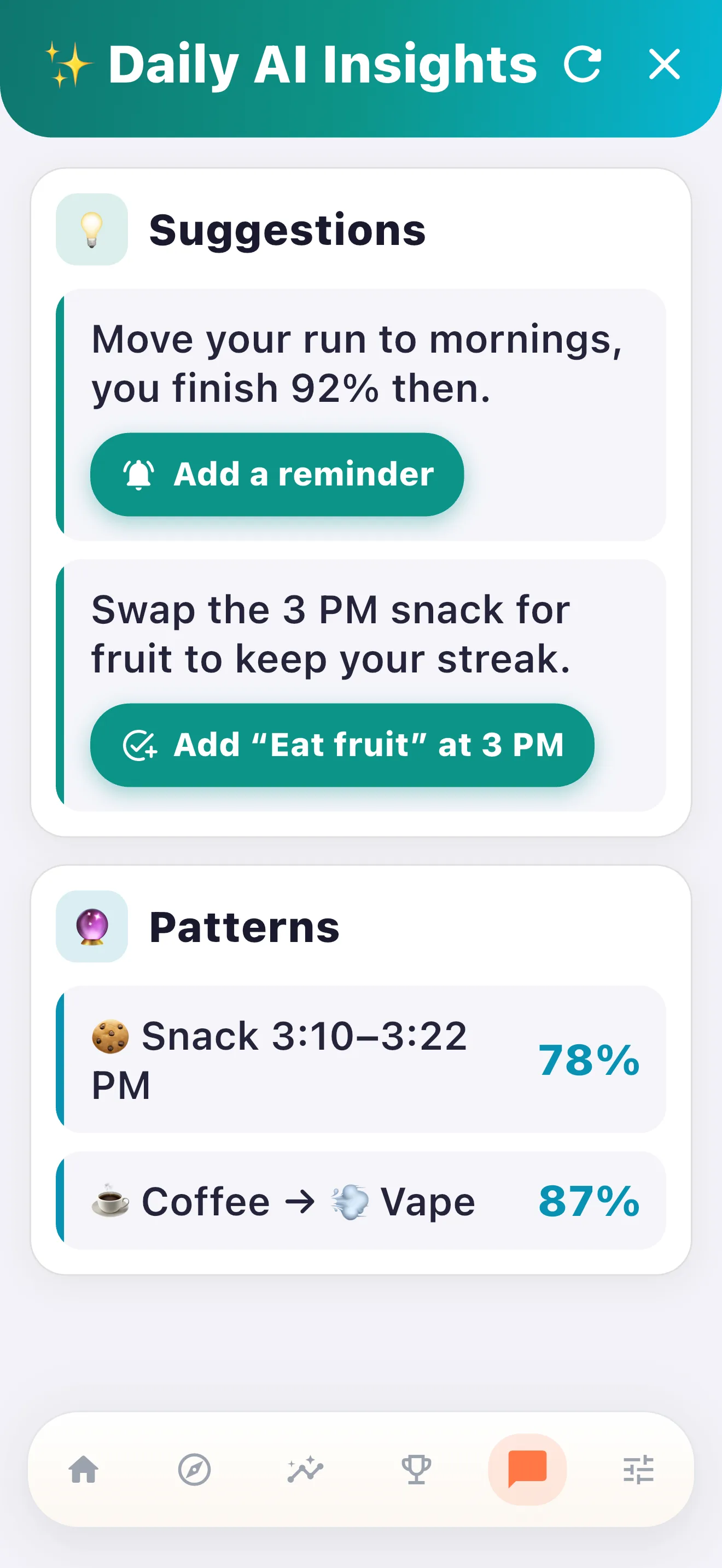
Weed use runs on patterns that are easy to describe and surprisingly hard to see until they're sitting in a log. The after-work session that's become the default way to decompress, the weekend days that run longer, the evenings where one session becomes two. As a smart habit tracker, HabitIt's pattern detection surfaces those clusters on its own. "Your session count doubles on Friday and Saturday evenings" is something you can actually prepare for - a different plan for those nights, something else at 8pm, a target set before the evening starts.
2. I Am Sober
Pledge-based sobriety tracker where you commit to 24 hours at a time, renewing the pledge each morning. Strong for cold turkey quitters who want a simple commitment cycle and don't need the taper structure. The community element is genuinely useful here - you can scroll through other people at the same day count, which helps with the specific "nobody else is doing this" feeling that weed quits produce. Less suited for tapers since the binary pledge logic doesn't map to a step-down plan. Good first app if you're going cold turkey and know it.
3. Nomo
Tracks multiple substances at once, which is relevant if you're smoking tobacco alongside the weed and need to separate the two habits in your data. Sobriety clock is clean, the design is minimal, and the app has one behavioral quirk worth flagging: it doesn't automatically reset your clock on a slip. You reset it manually. Compared with apps that dock you automatically when you log a slip, this puts the acknowledgment in your hands. Some people find that gentler. Others find it makes skipping the reset a little too easy to rationalize.
4. Sober Time
Clean iOS and Android app with milestone notifications at 24 hours, 1 week, and 1 month. Best for cold turkey quitters who want the milestone reinforcement layer. The notification cadence is actually well-calibrated for the weed quit timeline - it fires during the windows when motivation is hardest to sustain (days 2-4, the end of week one, the month mark). That said, there's no taper logic and no step-down planning. A slip on day 11 gets you a reset clock and nothing else.
5. Streaks
Task-based streak counter. Works well for someone who just needs "no weed today" tracked against a clean green-and-red calendar without any of the community or pledge overhead. There's no taper support and no craving log - just the binary daily count. If you smoke lightly, have already tried the heavier apps and found them distracting, and want a simple visual record, this is the right pick. A daily heavy user will need more scaffolding than a red square can provide.
6. Habitica
Turns the quit into an RPG. Your character takes damage on a day you mark as failed, and gains XP and gear when you succeed. Some people find this genuinely motivating - the gamification creates a different kind of accountability. It can also bolt a shame spiral onto failure, since your character takes visible damage on what was already a hard day. Worth knowing which camp you're in before downloading. Doesn't have weed-specific features or taper logic; you configure a "no weed" daily task and the RPG mechanics run on top of whatever habit system you set up.
7. Done - A Simple Habit Tracker
Three-habit limit on the free tier, genuinely clean interface. If you're tracking just the weed quit and want nothing else in the visual field, this works. The constraint of three habits is a feature for some people: it forces you to pick only the habits you're actually serious about. Doesn't have taper logic or slip-specific handling, but the design is clear enough that logging a miss doesn't feel like a punishment. Entry point for people who find most habit apps cluttered.
8. WeedSmart
Cannabis diary specifically designed to log consumption patterns over time - when you smoked, how much, what strain, how you felt afterward. Works differently from the quit trackers: this one is for the pre-quit audit phase, when you're trying to understand your own pattern before you attempt the stop. If you've tried cold turkey before and don't know why it failed, a week of WeedSmart data will usually show you the when and the why. Switch to HabitIt or one of the trackers above once you have that picture. Think of it as step zero.
- Best for a structured taper: HabitIt
- Best cold-turkey community: I Am Sober
- Best for tracking multiple substances: Nomo
- Best milestone notification timing: Sober Time
- Best bare-minimum streak counter: Streaks
- Best gamified accountability: Habitica
- Best distraction-free interface: Done
- Best pre-quit audit tool: WeedSmart
How to use a quit-weed app that actually holds
The challenge with weed quits specifically is that there's no pharmacological support - nothing that handles the craving chemistry for you the way a patch or a pill does for other substances. What works instead is behavioral: a plan that steps down gradually, plus a log that shows you your own pattern. The third piece is slip handling, and it's the piece that decides whether the attempt survives week two.
For heavy daily users - three or more sessions a day - the taper tends to work better than cold turkey for a straightforward reason. Cold turkey stacks all the chemistry adjustment into the first 5-7 days, which overlap exactly with the peak withdrawal window. Whatever symptoms hit hardest for you personally, they all land in that same short stretch instead of getting spread out. A taper distributes the step-down across 3-4 weeks, so by the time you reach zero, your system has already been running at a low baseline for a while. The jump to zero is shorter. That part is just arithmetic.
The sleep disruption window deserves specific planning - it tends to peak in the first week and can linger for several weeks after that for some users.[1] Weed suppresses REM sleep, so quitting produces vivid dreams and disrupted sleep during the rebound period. This is temporary. Knowing it's coming before day 3 makes it dramatically easier to get through. Keep the phone logged, adjust targets if the sleep disruption is affecting your ability to hold to plan, and don't make any decisions about whether to continue during that window. The 30-day quit weed taper plan covers the sleep window in detail, including what a reasonable adjusted target looks like during those days.
The slip usually arrives on a social occasion somewhere in weeks 2-3, once the initial resolve has faded and someone at a party has a joint going. What matters the next morning is tomorrow's target. A streak counter reads that morning as a verdict. A recalibrating taper treats it as a schedule change, hands you an adjusted target, and moves on. That distinction is at the heart of the cold turkey vs taper debate and it's why app type matters more than most quit-weed posts acknowledge.
If you came here hunting for the best app to stop smoking weed, the honest answer depends on your use pattern. A heavy daily user needs a taper tracker with slip handling. A weekend smoker can get away with a cold turkey tracker or a plain streak counter. And since almost everything in this category is a general habit tracker dressed up for cannabis, the pre-quit audit week (WeedSmart, or even a paper log) is what actually tells you which kind of user you are.
Common failures
Trying cold turkey with a streak app when you're a daily heavy user. The streak counter punishes a slip that was close to guaranteed in week two, while a taper app had it penciled in from the start. Match the tool to the use pattern.
Not planning for the sleep disruption window. Days 3-10 of a weed quit are harder than they need to be if you don't know the REM rebound is coming. Log it, expect it, and don't let disrupted sleep in that window convince you the whole plan is failing. It's a sign the quit is working.
Treating a social slip as a relapse and abandoning the plan. A slip carries information - which situation, what time of night, what mood you were in when it happened. Write that down and it becomes preparation for the next Friday. Abandon the plan over it and the information disappears along with the quit.
Using the app but no replacement behavior for the evening ritual. For daily users, the evening smoke session is often as much ritual as it is substance. It happens at the same time, in the same spot, as the moment you switch off from the day. An app can tell you whether you smoked, but the 45 minutes you used to spend on the ritual still sit there empty at 9pm. That gap needs its own plan, even a boring one - a walk, a shower, a different drink.
Citations
- Budney, A.J., Hughes, J.R., Moore, B.A., & Vandrey, R., "Review of the Validity and Significance of Cannabis Withdrawal Syndrome," American Journal of Psychiatry, 161(11), 2004, 1967-1977. psychiatryonline.org
Build your quit weed plan today
Free 3-day trial of all features. After that the free tier covers the basic taper. No subscription required.


Get the Free Quit-Weed Plan
Drop your email and we'll send a printable plan you can fill in and track. Occasional updates (max 1 per 2 weeks).
Success! Now check your email to confirm your subscription.
We respect your privacy. Unsubscribe at any time.