Top 8 Apps to Reduce Coffee and Caffeine in 2026
Cutting coffee without a plan tends to end the same way: a bad headache by day two, and a full revert to your old cup count by day four. That headache is real, and it's a recognized withdrawal symptom that peaks roughly a day or two after your last normal dose. The apps that actually help do the taper math for you, so willpower isn't the only thing carrying it. A plain streak counter falls apart the moment you hit a 10am meeting where the only option is the work coffee machine. Not many apps do the math specifically for coffee. These 8 are the ones worth your time.
Quick comparison
| App | Best for | Price | Platform |
|---|---|---|---|
 HabitIt HabitIt |
AI builds your plan and recalibrates when you slip with automatic pattern detection | Freemium | iOS & Android |
 Daily Bean Daily Bean |
Minimalist coffee intake counter | Free | iOS |
 Cronometer Cronometer |
Caffeine logging by mg with nutrition data | Freemium | iOS & Android |
 Streaks Streaks |
Habit streak tracking for daily limits | Paid ($5.99) | iOS |
 Waker Waker |
Caffeine taper calculator for withdrawal reduction | Free | iOS |
 HabitBull HabitBull |
Flexible habit tracker with charts | Freemium | iOS & Android |
 Water Reminder Water Reminder |
Hydration tracking as a coffee replacement | Freemium | iOS & Android |
 Done Done |
Simple daily check-in for drink habits | Freemium | iOS & Android |
How we compared these
We checked each app's current App Store or Google Play listing in July 2026 for price, platform and free-tier limits, then sorted them by whether they actually support a declining daily target or just count cups after the fact. Prices and free tiers change often, so verify before you pay.
The list
1. HabitIt
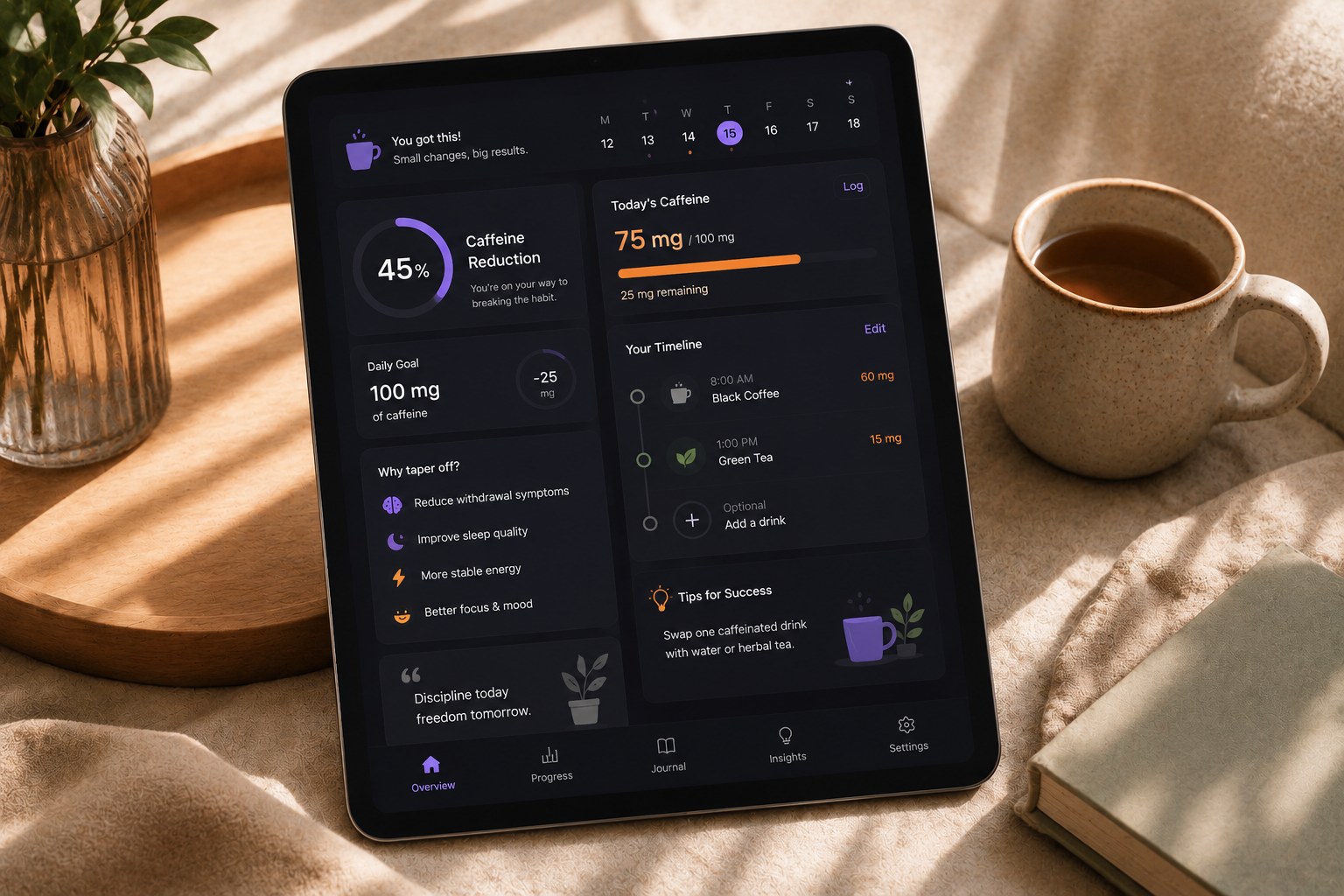
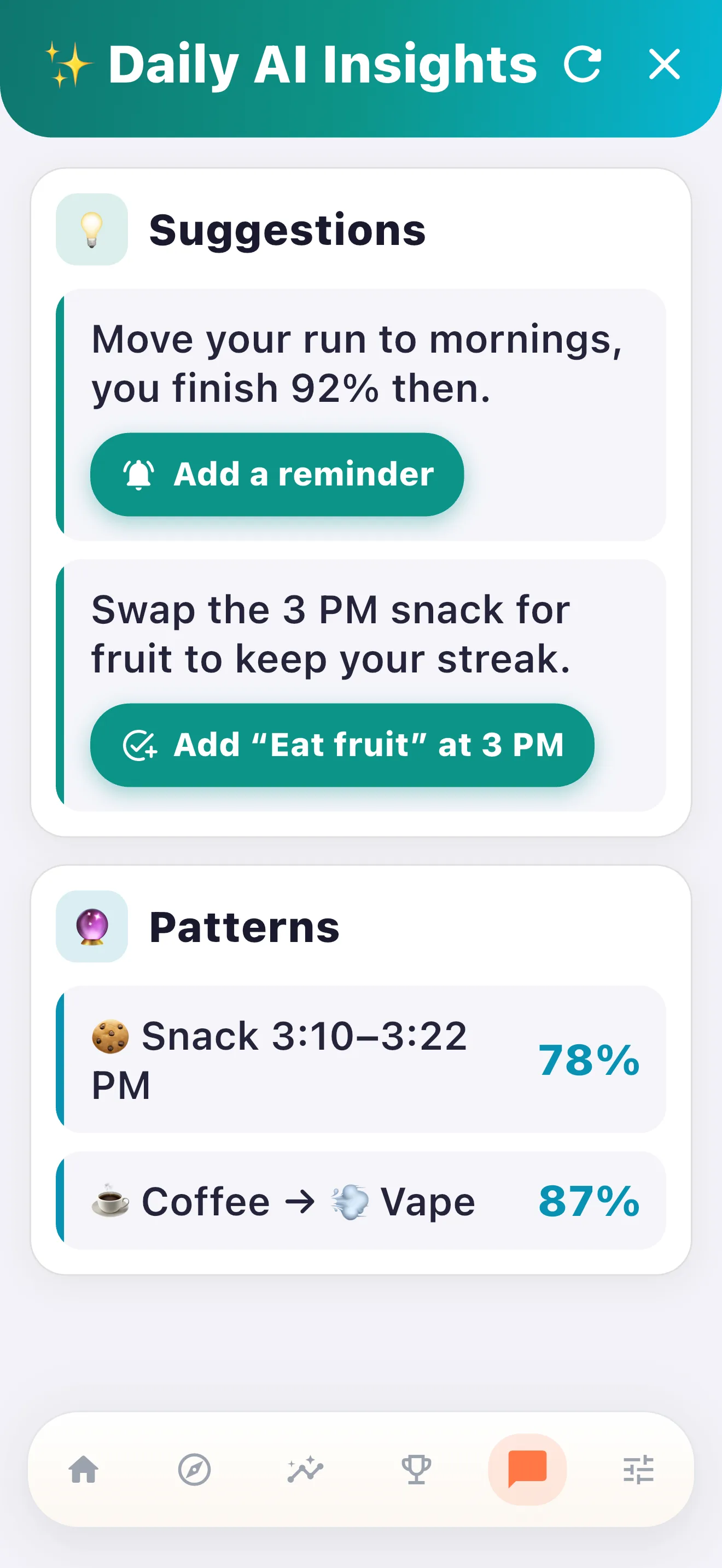
HabitIt is a smart habit tracker where the taper itself is the whole point. Set your current cups per day, set your goal (one cup, or none), and it builds a 30-day step-down plan. Four cups this week, three and a half next week, three the week after - automatic, no manual recalculation required. When you slip and drink an extra cup, tomorrow's target adjusts. No zeroed streak. Plenty of habit trackers treat one extra cup as total failure, and that framing is what starts the all-or-nothing spiral - back at four cups by day five, wondering why you bothered. The free tier covers the taper. Start at the caffeine reduction plan builder, takes ten seconds.
Coffee habits have a shape you won't spot until it's sitting in front of you as data. Maybe it's the extra cup that appears before every stressful call, or the 2:30pm one that feels necessary but isn't. As an AI habit tracker, this is where HabitIt's pattern detection actually earns its keep: once those slips cluster often enough in the log, it names the pattern for you plainly. Knowing your extra cup almost always appears between 2-3pm gives you something to actually plan around that afternoon.
2. Daily Bean
Built mainly for coffee enthusiasts who care about brew method and roast notes. The logging behavior itself is what makes it useful here anyway. People who write down every cup in detail tend to become sharply aware of how many they're actually drinking, and that awareness alone puts a mild brake on frequency. The effect is more indirect than a dedicated taper tracker, and real enough anyway for moderate drinkers who aren't ready for a structured plan yet. The free tier is generous. It doesn't do the math for a step-down, so pairing it with something like HabitIt covers that piece.
3. Cronometer
Tracks caffeine in milligrams across every source - pre-workout and even some medications carry a real dose that cup-counting apps never see. That offset is exactly what a simple cup counter misses, and the mg-level breakdown catches it. Particularly useful for anyone who gets caffeine in multiple forms and actually needs a real daily total. Free version covers the caffeine tracking; premium unlocks the full nutrition suite.
4. Streaks
Task completion tracker with a simple, clean interface. Set a task like "max 2 cups today" and you get green if you hit it, red if you don't. There's no taper math here and no mg breakdown either - a daily pass/fail against a limit you set, and that's it. Good for someone who's already down to two or three cups and just wants to hold a ceiling. The binary feedback is honest and unforgiving, which works fine for maintenance. For an active taper it's the wrong shape. iOS only.
 5. Waker
The most distinctive app on this list. Waker's main feature is a caffeine half-life visualizer: you log what you drank and when, and it graphs the active caffeine in your bloodstream across the day. The visualization makes viscerally clear why you can't sleep even after stopping coffee at noon - with a roughly 5-hour half-life, 200mg at 12pm still leaves about 50mg active in your system by 10pm, which is enough to disrupt sleep onset for a lot of people. Understanding that changes how people think about timing more than total cups ever did. Waker isn't really a habit tracker at all, but it earns its spot on this list anyway - the sleep-disruption piece is the part that usually goes missing when someone tries to cut back.
6. HabitBull
General-purpose habit tracker that you configure for coffee by setting a custom habit "cups of coffee" with a daily target. Charts progress, sends reminders, tracks streaks across multiple habits. More flexible than Streaks if you're tracking several habits at once, though the reduction math isn't as built out as HabitIt's. The streak mechanic means a slip day shows as broken even if you were only one cup over target - fine for some people, discouraging for others. Free tier available with a limited number of habits.
7. Water Reminder - Daily Drink
A hydration tracker, relevant here because the headache from caffeine withdrawal is often partly a dehydration symptom - caffeine has a mild diuretic effect, so a lot of regular drinkers run slightly dehydrated without ever connecting the two. Replacing a cup of coffee with a glass of water fills the habit slot - you're still doing something at the moment you'd normally make coffee - and it addresses the fluid side at the same time. Pair it with a dedicated reduction tracker, since on its own it won't run a taper. Simple, free, and easy to actually use.
8. Done - A Simple Habit Tracker
Three-habit free tier. Set one habit as "under 2 cups today" and check it off when you've hit the day without going over. Minimal friction, and almost nothing to configure. Right for someone who wants a single daily check with no charts, reminders, or taper calculations in the way. The three-habit limit on the free tier makes it an honest choice only if coffee reduction is your main focus right now. If you want to track several habits simultaneously, the paid tier or a different app makes more sense.
- Best declining-target taper: HabitIt
- Best for coffee enthusiasts: Daily Bean
- Best mg-level precision: Cronometer
- Best simple maintenance ceiling: Streaks
- Best half-life visualizer: Waker
- Best flexible multi-habit tracker: HabitBull
- Best hydration replacement: Water Reminder
- Best bare-minimum check: Done
How to use an app to cut coffee without the crash
The caffeine half-life is the piece that gets skipped in most quit attempts. It runs roughly five hours in most adults, so a 200mg cup at 8am still leaves about 25mg active by 10pm - and four cups spread across a morning can leave meaningful active caffeine in your system well into the night, even if your last sip was at noon. Regular caffeine use gradually increases the brain's adenosine receptor count, and withdrawal happens because that larger receptor population is suddenly under-stimulated once the caffeine stops.[1] Cutting slowly gives that receptor count time to come back down on its own schedule, rather than yanking the rug out overnight.
As a practical starting point, cutting by roughly half a cup every five to seven days tends to avoid the headache reliably. It'll feel frustratingly slow if you're used to more dramatic interventions. HabitIt handles that pacing automatically; on a simpler tracker, you'd build the weekly step-down in your notes and update the daily target by hand each Monday. The full week-by-week version is in the 30-day caffeine taper post, and the afternoon-specific angle - why a 2pm coffee hurts sleep quality even when you feel fine - is covered in how to cut caffeine after 2pm.
Then there's the inevitable meeting where the only coffee is the office machine and you're already at your day's limit. Drink water instead. Most of what feels like a focus boost from that next cup is really just relief from mild withdrawal - you're a few hours past your last dose, and the cup is bringing you back to baseline, not lifting you above it. Knowing that helps on its own. A replacement ritual helps too, something to do with your hands around 10am, since the ritual is often what holds the taper together after the chemistry itself has settled.
What actually separates these apps is whether they hand you a target before you brew, or just a dashboard after you've already had the cup. A dashboard tells you what already happened. A daily target gives you something to aim at right when the 2pm craving hits, which is the whole idea behind HabitIt, the smart habit tracker - an automatic habit plan that quietly adjusts the target for you, so that math never has to happen half-awake at 7am.
Common failures
Cutting coffee as the tea and pre-workout quietly creep up. This is the easiest way to fool yourself in caffeine reduction. You drop from four coffees to two and feel genuinely virtuous about it. Somewhere along the way a pre-workout shows up before the gym, plus a couple of green teas in the afternoon. A week later the headache still hasn't improved, because your total caffeine actually ended up higher than when you started. Cronometer is the fix here - cup-counting apps have no way to catch it.
Going from four cups to zero without a taper. The withdrawal is severe enough to send you back to full dose by day three, and willpower has very little to do with it - this one is chemistry. The taper exists precisely because the withdrawal is predictable and avoidable.
Using a streak app that makes one extra cup feel like total failure. Day twelve of your two-cup limit, a third cup at the work party, streak broken - and the next morning the app treats you like you never started. Plenty of people quit right there instead of carrying on with the original target the next day. If you know that's your failure pattern, pick an app that handles slips without zeroing your progress.
Tracking cups without ever looking at the clock. You can hit a two-cup daily target every day for two weeks and still end up with disrupted sleep and a racing heart most evenings. If those two cups land at 2pm and 4pm, there's still active caffeine in your system at midnight. Timing carries as much weight as volume here, and an app that never asks when you drank is only ever seeing half the picture.
Citations
- Rocha Cabrero, F. & Hamilton, R.J., "Caffeine Withdrawal," StatPearls, NCBI Bookshelf (NIH), updated Dec 2025. Read the source ↗
Build your reduce coffee plan today
Free 3-day trial of all features. After that the free tier covers the basic taper. No subscription required.


Get the Free Coffee Reduction Plan
Drop your email and we'll send a printable plan you can fill in and track. Occasional updates (max 1 per 2 weeks).
Success! Now check your email to confirm your subscription.
We respect your privacy. Unsubscribe at any time.