How to Taper Off Caffeine: A 30-Day Plan

Cold-turkey caffeine quitting usually means a multi-day headache and a real chance you're back at your original intake within a month. Willpower rarely survives that trade. A taper sidesteps most of it by spreading the same drop across a few weeks. Below is the 30-day schedule, plus the receptor biology explaining why the slow version works so much better. A smart habit tracker with an automatic daily plan runs the math so each morning has its target and skips the guesswork.
Why cold turkey doesn't work
Quitting caffeine cold turkey rarely sticks, and a large share of attempts end up back at the original intake within a month. If that's happened to you before, the setup was the actual problem: dropping from a full daily habit to zero overnight asks more of your receptors than they can deliver in 24 hours, no matter how much willpower you bring to it.
Caffeine's whole trick is blocking adenosine receptors - adenosine being the chemical that quietly piles up all day and eventually taps your brain on the shoulder to say it's tired. Coffee sits on those receptors, so the tap never really lands. Your brain, not thrilled about being ignored, responds by growing more receptors so it can hear the message over the caffeine. Do that every day for a few months and the receptor count gets so inflated that plain baseline, no caffeine at all, now reads as sluggish. You need the coffee just to feel like a normal person again, which is a strange thing to need.
So when you quit overnight, all those extra receptors are suddenly empty and binding adenosine like crazy. What follows is a real symptom cluster - headache as the blood vessels rebound-dilate, plus brain fog and irritability that can run several days. A systematic review of the clinical research found withdrawal headache alone shows up in about half of cold-turkey quitters, peaking around 24 to 48 hours and lasting up to nine days in some cases[1]. A lot of quits break right around day three. You've probably been there. (Day 3-4 is the wall almost every quit hits - see why you keep quitting habits on day 4 for the deeper pattern.)
Why Tapering Works
A taper is a planned reduction in dose, spread across enough weeks that your brain can keep pace with the change. Doctors already lean on this exact logic when they wean patients off anti-anxiety medication or opioids. Antidepressants get a slower version of the same idea, typically stretched over months. Receptor adaptation runs downward at roughly the rate it ran upward on the way in, and dropping the dose by something like 10-15% a week gives your brain just about enough time to prune receptors before withdrawal symptoms get bad.
The clinical picture backs this up: the same review found that withdrawal symptom severity tracks how abruptly you drop the dose and how much you were taking to begin with[1]. A slow cut from a high starting dose tends to keep symptoms mild. A fast cut from the same dose usually doesn't. That's most of the logic behind spreading a caffeine taper across a full month.
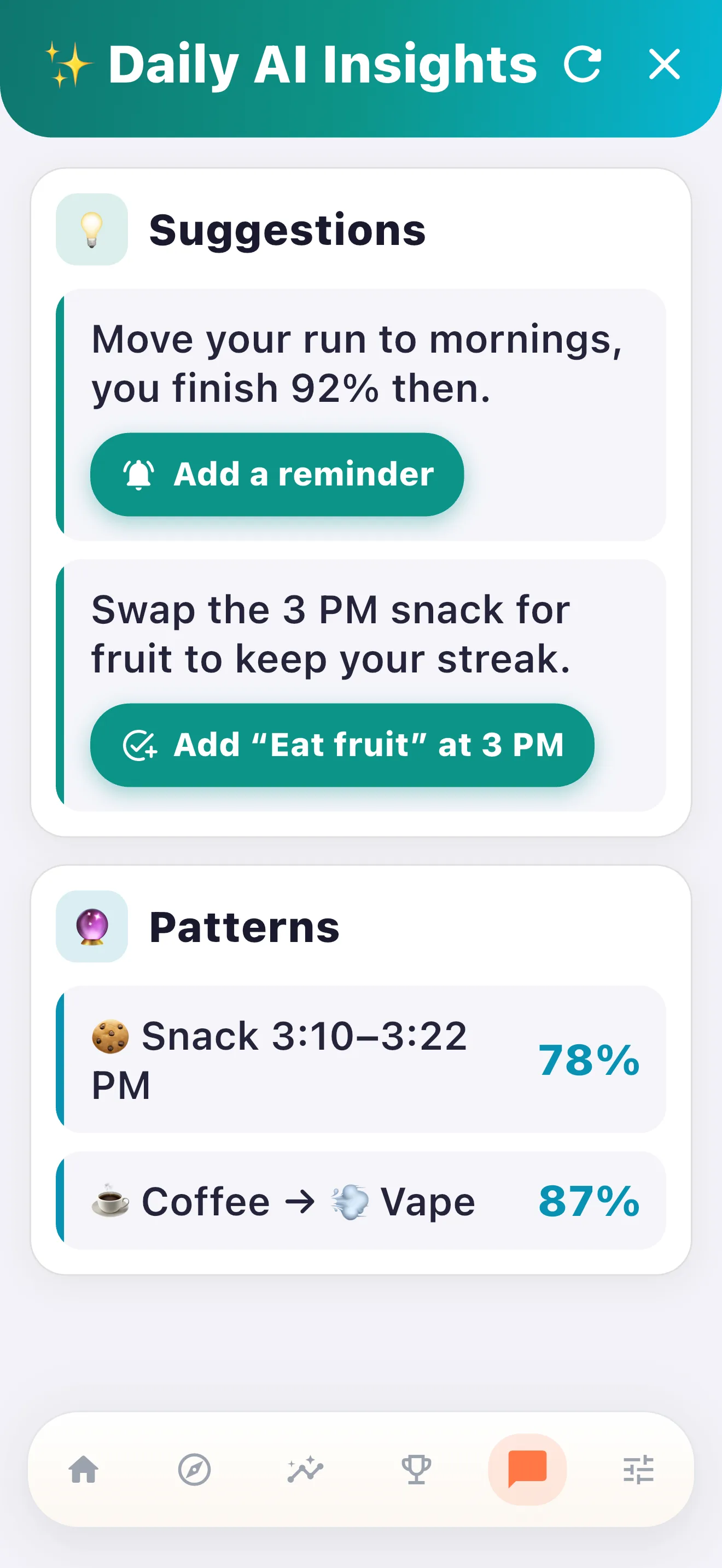
This is the principle behind HabitIt's journey system: tell it your starting caffeine intake and your target, and it builds the day-by-day schedule for you. Slip on a random Tuesday and it just recalculates from wherever you landed - nobody's streak count actually resets, though it can feel that way for about five minutes.
The 30-Day Caffeine Taper Plan
This schedule assumes a starting point around 400 mg a day (basically four cups of drip coffee) with zero as the target. If your own number looks different, the principle still holds: cut about 12-15% a week and hold steady on weekends, since your brain does better with two stable days than with a constantly moving target. Skip the temptation to kill the last cup early; that jump goes a lot smoother once you're already down to just one a day.
For three days, log everything with caffeine in it - coffee and tea obviously, plus soda and energy drinks. Chocolate counts too, and it's the one nobody thinks to log until the total comes up short. Don't reduce anything yet. The number you land on is almost always 30-50% higher than what you'd have guessed. If most of your caffeine load comes from soda, the 30-day quit soda taper handles the caffeine and sugar cravings together, plus the carbonation ritual. It's a cleaner fit than this caffeine-only plan.
Caffeine intake usually clusters in two windows: the first hour after waking, and a 2-4 PM "fade." The waking-hour dose is the one people cling to hardest. The fade window turns out to be the easier one to cut, and it's usually gone by week three before you've really noticed it slipping away.
Cut a quarter-cup off your largest serving. If you were drinking three cups of drip coffee plus a 16 oz cold brew, drop the cold brew to 12 oz. Adjust nothing else.
Replace your second daily coffee with a half-caf blend. Coffee shops will usually mix this on request, or you can cut your own grounds 50/50 at home. Half-caf still gets you the mug-in-hand ritual, just with a lot less caffeine riding along.
Eliminate the afternoon caffeine entirely. This is the step where a lot of tapers quietly fall apart. Swap it for something physical: a short walk or a quick set of pushups both work well. Cold water on your wrists is a smaller trick that helps some people, and staying hydrated matters here too, since dehydration has a way of sneaking up on you mid-taper - a tall glass of plain water covers that base. The afternoon fade is real, but it's also the easiest dose to cut, since the receptor pressure is already lower by week three. If you're not quitting caffeine entirely and it's really just the 3pm crash and the bedtime impact bothering you, the 2pm cutoff approach or the coffee-timing fix are lighter versions of the same idea.
You're down to about 80 mg a day now - one 8 oz cup, and nothing else. Hold there for four days without pushing further. Sleep is usually where you notice the improvement first, sometimes within a night or two of hitting this step.
Either drop the last cup or hold it as a maintenance dose. A single morning cup keeps most of the alertness lift and rarely restarts the dependence cycle at that low a dose. Plenty of people just stop right here and stay there, permanently.
Skip the spreadsheet
HabitIt builds this plan for you. Tell it your starting intake and target - it generates the day-by-day schedule and adjusts when you have a hard week.


What to Expect Physically
A well-paced taper still causes some withdrawal. Receptor downregulation is a real biological process, but the symptoms stay below the threshold where you'd reach for a cup just to make them go away. Here's the honest week-by-week:
- Week 1: mild afternoon fatigue, occasional dull headache. Usually manageable with hydration and a 10-minute walk.
- Week 2: sleep gets noticeably deeper around night four or five. You may feel groggier than usual on waking - that's adenosine doing its job.
- Week 3: the afternoon fade is the worst stretch. A short walk works better here than reaching for a snack, and naps longer than 20 minutes tend to backfire.
- Week 4: morning alertness by this point is often noticeably better than it was on full caffeine - a strange thing to notice the first time it happens. The receptor count is just catching up to the lower dose, nothing mystical about it.
The Three Mistakes That Sabotage a Caffeine Taper
1. Switching to tea on day one. Black tea runs 40-70 mg a cup, which sounds low right up until you replace a 200 mg coffee with three of them and realize you've barely tapered anything. Tea earns its keep as a reduction tool later, in week three, once the baseline dose is already low. Day one, it barely counts as a taper at all.
2. Treating "soda" or "energy drink" caffeine as different. A 16 oz energy drink runs 160-300 mg, and pre-workout supplements can hit 150-400 mg depending on the brand. Both count toward your total. So does the dark chocolate bar sitting in your desk drawer, at 30-80 mg a bar, which sounds low until you eat half the box during a stressful afternoon. A lot of failed tapers happen because someone cut their coffee in half and then went straight through a can of Bang like it doesn't count. If energy drinks are the larger half of your caffeine load, the 21-day energy drink taper is the better starting point, since it unstacks the sugar layer too.
3. Pushing through a missed day with a "make-up" reduction. If week 2 went sideways and you landed at 350 mg against a 280 mg target, do not try to "catch up" by cutting harder in week 3. The schedule recalculates from wherever you are. Replacement habits close the actual gap a slip leaves behind, which is more than guilt ever manages to do.
"The tapers that finish are almost always banged up somewhere along the way - a skipped cut here, an extra week held at 340 mg there. The clean, on-paper-perfect version is usually the one abandoned by week two."
When a Taper Isn't Enough
The schedule alone is enough for the large majority of people who try it. A smaller group, roughly 5-10%, has a deeper dependence, often driven by chronic sleep debt or undiagnosed ADHD. A few signs point that way: needing 600+ mg/day just to function, or stalling at the same point on two separate taper attempts. Some people also get hit harder by the 2-4 PM fade - heavy brain fog, a short temper, the kind of afternoon that derails a whole workday.
If that's you, two things help. First, fix sleep before tapering. Caffeine dependence often masks chronic 6-hour-nights. Second, a primary care visit is a reasonable next step. Persistent stimulant cravings sometimes point to something else going on entirely, like a sleep disorder or an unaddressed attention issue, and it only takes a short conversation to start ruling that out.
Why Track Caffeine Reduction With an App
Caffeine taper is unusually well-suited to an app. The unit is milligrams, which is about as precise as habit-tracking gets, and the schedule underneath it is pure math. Even the slip pattern is predictable enough to plan around. A spreadsheet can technically do the math too, but it won't ping you at 2 PM with "you're past your daily limit, try water first," and it definitely won't visualize the receptor-rebalance arc that's supposed to keep you motivated through week three.
If you've been looking for a caffeine taper app, or just an app for tapering off coffee at a pace your brain can keep up with, HabitIt was built around this exact use case. The journey system handles the daily target math, and the habit chain feature lets you stack a coffee replacement (a short walk, a glass of water) onto the morning routine you already have. The cost tracker adds up the cumulative dollars saved as its own kind of motivation. When you slip, and you will slip, tomorrow's plan just recalculates around wherever you are - no streak lost, no guilt tax. For the broader question of when tapering wins over cold turkey across substances, that comparison covers the wider pattern in more depth than there's room for here.
Start your caffeine taper today
Free 3-day trial of all features. After that the freemium tier covers the basic taper journey. No subscription required.
Get the Free 30-Day Caffeine Taper Plan
Drop your email and we'll send a printable plan you can fill in and track. Occasional updates (max 1 per 2 weeks).
Success! Now check your email to confirm your subscription.
We respect your privacy. Unsubscribe at any time.
Let the app plan each day's dose with a quit caffeine habit tracking plan that eases you through the headache window.
Citations
- Juliano, L.M., & Griffiths, R.R., "A Critical Review of Caffeine Withdrawal: Empirical Validation of Symptoms and Signs, Incidence, Severity, and Associated Features," Psychopharmacology, 176(1), 2004, 1-29. pubmed.ncbi.nlm.nih.gov