Top 8 Apps to Stop Impulse Spending in 2026

Impulse spending isn't a math problem. The budget app that shows you a red bar at the end of the month doesn't help you in the 40 seconds between seeing the sale notification and tapping "buy." The apps that actually reduce impulse spending work at one of three points. A few add friction right at the decision. Others make you log the purchase the moment it happens, while the box is still in the cart. The rest build enough awareness that you start recognizing the trigger before the tap. These 8 split across those three approaches, and knowing which one you need matters more than which one has the best reviews.
Quick comparison
| App | Best for | Price | Platform |
|---|---|---|---|
 HabitIt HabitIt |
AI builds your plan and recalibrates when you slip with automatic pattern detection | Free + Premium | iOS + Android |
 YNAB YNAB |
Zero-based budget with proactive planning | $14.99/mo | iOS & Android |
 Copilot Copilot |
AI-categorized spending with custom budgets | $13/mo | iOS |
 Rocket Money Rocket Money |
Subscription cancellation and spending alerts | Freemium | iOS & Android |
 Wallet by BudgetBakers Wallet by BudgetBakers |
Manual and auto budget tracking | Freemium | iOS & Android |
 Buddy Budget Buddy Budget |
Simple shared budget for couples | Freemium | iOS & Android |
 Emma Emma |
Bank-connected spending categorization | Freemium | iOS & Android |
 Spendee Spendee |
Visual spending wallets with color-coded limits | Freemium | iOS & Android |
How we compared these
We checked each app's current App Store or Google Play listing in July 2026 for price and free-tier limits, then grouped them by which point in the spending decision they actually intervene at - before the purchase, in the moment, or after the fact in a monthly review. Prices and free tiers change often, so verify before you pay.
The list
1. HabitIt
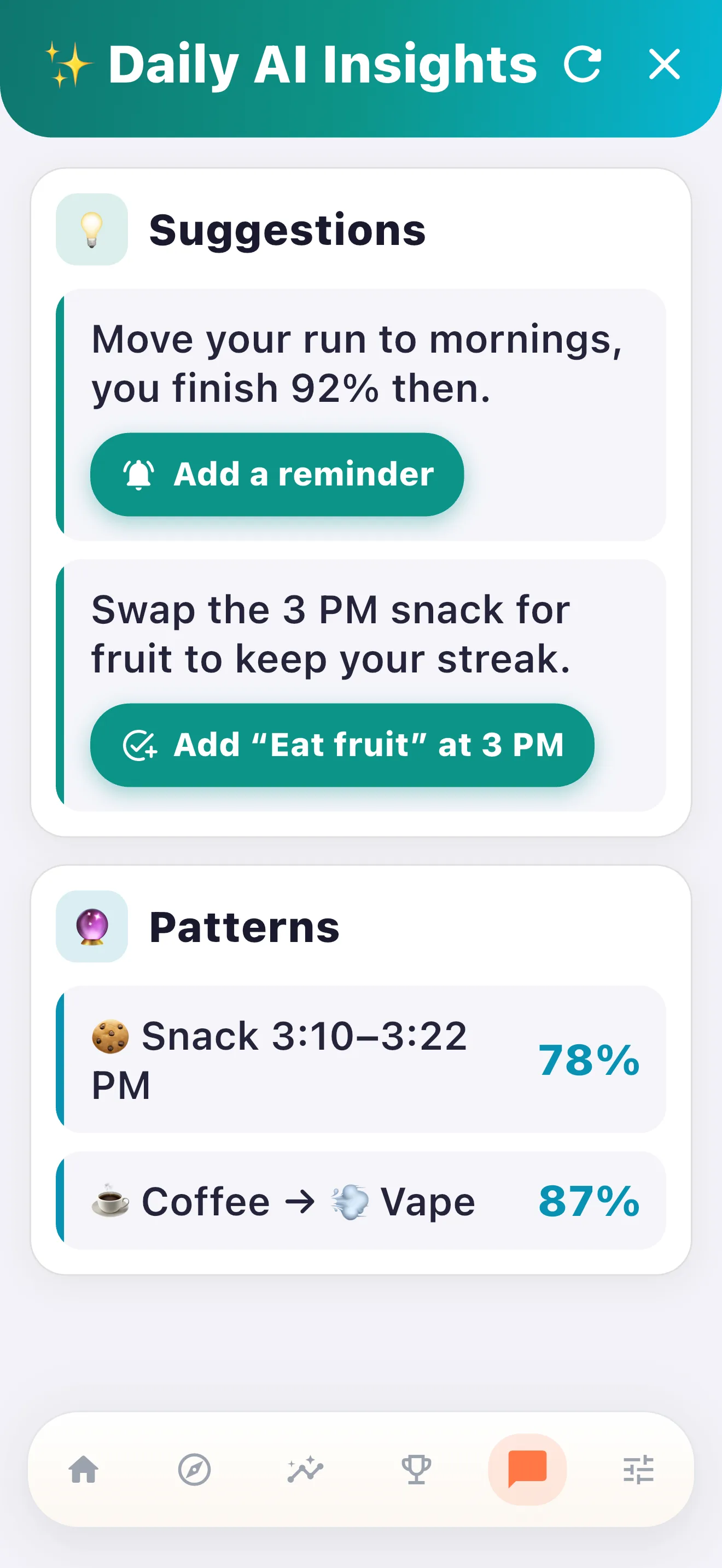
HabitIt, the AI habit tracker, lets you track impulse purchases as a countable habit. You set your current daily count (say, five unplanned buys a week) and a target of zero, and it generates an automatic habit plan that walks the number down over 30 days - no cold-turkey demand on day one. The difference from a budget tracker is timing. You log the behavior the moment it happens, while a bank statement won't show it to you for another three weeks. Good fit if your impulse buys come often enough to taper. The impulse spending plan builder is free, no email required, takes about ten seconds to set up.
Impulse purchases cluster around emotional states and times of day. The late-night cart-add. The scroll-and-buy on a lunch break, or the stress purchase half an hour after a rough meeting. As a smart habit tracker, HabitIt's pattern detection picks these clusters up on its own. "Your unplanned buys are mostly between 10pm-midnight and spike on Fridays" is something you can act on - log off the shopping apps at 9pm, turn off sale notifications, go into Friday already knowing it's the high-risk window.
2. YNAB (You Need A Budget)
The strongest budget-discipline app on this list. Every dollar is assigned to a category before you spend it, so an impulse buy requires you to explicitly move money from somewhere else - groceries, rent, savings - before the purchase clears. That friction is the whole mechanism, and it bites much harder than a warning notification you tap past. The learning curve is steep. Most users take two to three weeks before the system clicks into place. After that, the weekly check-in becomes genuinely useful for identifying which categories you keep raiding. $109/year on the annual plan (or $14.99/mo month-to-month); no meaningful free tier after the trial.
3. Copilot
iOS-only, bank-linked, AI-assisted spending categorization. The value is pattern recognition. After four to six weeks, Copilot can tell you that your Sunday afternoon impulse buys add up to $340 per month, or that 60% of your unplanned spending happens within 90 minutes of opening Instagram. That kind of specific, context-linked data is what separates behavior change from wishful thinking. Annual subscription, no free tier after the trial period. Not for Android users.
4. Rocket Money
Best for people whose impulse problem is partly subscription creep. Rocket Money scans your linked accounts, surfaces recurring charges you may have forgotten (that $14 streaming service, the $8 app you downloaded twice), and can cancel subscriptions on your behalf. The impulse-spending tracker is secondary to the subscription audit tool, but both are in there. Free tier covers the subscription scanner; premium unlocks the spending breakdown and budgeting tools. Worth a look even if budgeting isn't your primary goal.
5. Wallet by BudgetBakers
Manual entry. Every purchase you log yourself. That sounds like more work, and it is. But the act of manually typing "$47, Amazon, impulse" creates a friction moment that bank-sync apps completely skip. Some people find this exact friction - the two-second pause to type the amount and category - is what builds awareness and gradually reduces frequency. The app itself is full-featured with budgets, charts, and bill tracking. Whether the manual-entry workflow is a feature or a dealbreaker comes down to one thing - will you still be typing entries in week three?
6. Buddy Budget
Shares your budget in real time with a partner, family member, or accountability friend. The knowledge that someone else can see your spending in near-real-time is a different kind of friction from an app that only you see. Works particularly well for people whose impulse spending tends to happen when they're alone or in a specific headspace. If the awareness of a shared ledger feels uncomfortable, that discomfort is usually the point. Free tier available; the core shared-budget feature is accessible without a subscription.
7. Emma
Spending breakdown by merchant, category, and subscription, with analytics on where your money goes across time. Emma is good at surfacing the insight that your impulse spending is concentrated in two or three specific contexts - late nights, post-work decompression, certain days of the week. That context is what lets you go after the trigger itself. The app won't stop an impulse buy in the moment, but it gives you the data to know when and where to expect the urge, which is the foundation of a longer-term change. Free tier covers the basics.
8. Spendee
Visual-first, colorful charts of where your money goes. It gives up some of YNAB's budget control and some of Copilot's analytical depth. What it has instead is a low enough barrier that people actually open it daily. The visual format resonates with some people who tune out spreadsheet-style budget reviews entirely. If you've tried and quit more functional apps because the interface felt like work, Spendee is worth trying. The lower barrier to daily engagement matters more than the missing features if the alternative is not using anything at all. Free tier available with some limits on connected accounts.
- Best pre-purchase taper plan: HabitIt
- Best zero-based budget discipline: YNAB
- Best AI-surfaced spending pattern: Copilot
- Best subscription cleanup: Rocket Money
- Best manual-entry friction: Wallet by BudgetBakers
- Best for shared accountability: Buddy Budget
- Best merchant-level breakdown: Emma
- Best low-friction daily use: Spendee
How to use a spending app to actually stop the impulse
An app can step into an impulse buy before it happens, while it's happening, or after the money is already gone. Most apps on this list operate at that last level. They show you what you spent, how it compares to last month, and which category went over. That's valuable for structural overspenders who need a clear financial picture, but it does almost nothing for pure impulse buyers. By the time the dashboard is showing you the red bar, the purchase happened three weeks ago and you've already bought four more things the same way.
The apps that work at the point of purchase are the ones that require you to interact with them in the moment. Wallet by BudgetBakers' manual entry is the clearest example. Logging the purchase right when it happens forces a pause, and sometimes a pause is all the decision needs. YNAB pulls the same lever slightly earlier - if you know you'll have to move money from your groceries category to cover an Amazon order, you're more likely to hesitate before clicking checkout. HabitIt's countable-habit approach sits at the pre-purchase level too, in a different way. You know you have a daily target, you think of the potential purchase as a unit against that target, and that reframe changes the decision geometry slightly.
The awareness apps - Copilot, Emma, Spendee - are most useful as a second layer. Run one of them alongside a behavior-change tool like HabitIt and you get both the day-to-day tracking of the habit and the monthly insight into your specific patterns. The combination of a habit tracker for the daily behavior and an analytics app for the context is more effective than either alone. Read the 30-day impulse spending reset for the full framework, or how to stop buying things you don't need for the trigger identification piece.
If you came here searching for the best app to stop impulse spending, the distinction above is the one that matters. Someone who caves at checkout needs friction before the purchase. A person who never notices the damage until the statement arrives needs in-the-moment logging, or an analysis layer that surfaces the pattern each month. Figure out which one describes you before you download anything.
Common failures
Using a budget app but only checking it at month end. The most common failure mode by a wide margin. Data only changes behavior when it arrives close enough to the purchase to still mean something, and a monthly review of a month-old transaction arrives about 29 days too late. Weekly is the minimum. Daily is better.
Bank-linked auto-sync removing the manual friction that builds awareness. Auto-sync is more convenient, which is exactly the problem - convenience is what lets you stop looking. If a bank-linked app hasn't changed your behavior after a couple of months, try manual entry for thirty days and see what typing the numbers yourself does.
Tracking spending without identifying the trigger context. You can know exactly how much you spent on impulse purchases last month without having any idea what triggered them - what time of day it tends to happen, or what you were doing on your phone right before. Apps like Copilot and Emma help surface that layer; if yours doesn't, write the context down manually when you log a purchase.
Downloading three apps at once. You research the category, install three of these, use each one inconsistently for two weeks, and end up with fragmented data none of them can make sense of. Pick one. Use it for 30 days. Daily engagement with a single tool builds faster than the habit of checking three.
Build your stop impulse spending plan today
Free 3-day trial of all features. After that the free tier covers the basic taper. No subscription required.


Get the Free Stop Impulse Spending Plan
Drop your email and we'll send a printable plan you can fill in and track. Occasional updates (max 1 per 2 weeks).
Success! Now check your email to confirm your subscription.
We respect your privacy. Unsubscribe at any time.