Top 9 Morning Routine Apps of 2026
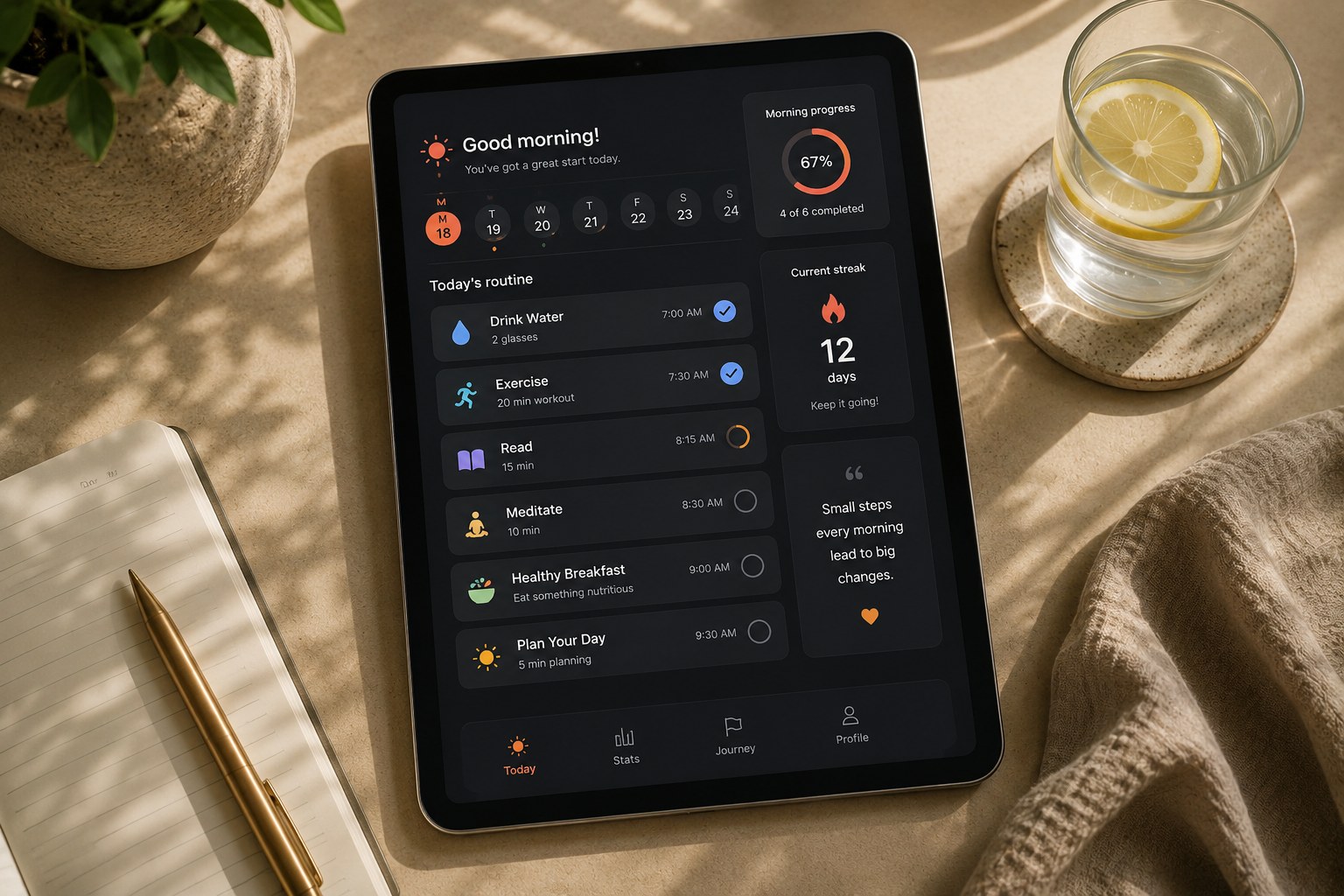
Most morning routines fail because people design the ideal version of themselves and expect that person to show up at 6am. The apps that actually work come in two types. Trackers log what you did and surface the pattern, which is what you need when you have a routine but keep drifting off it. Guides walk you through a pre-designed sequence step by step, and those matter when you don't yet know what your routine should look like. Figuring out which problem is yours will do more for you than any ranking. Here's the top-9 anyway.
Quick comparison
| App | Best for | Price | Platform |
|---|---|---|---|
 HabitIt HabitIt |
AI builds your plan and recalibrates when you slip with automatic pattern detection | Freemium | iOS & Android |
 Fabulous Fabulous |
Science-backed morning ritual builder | ~$40-50/yr | iOS & Android |
 Streaks Streaks |
Morning habit streaks, up to 12 habits | Paid ($5.99) | iOS |
 Routinery Routinery |
Timed step-by-step morning routine guide | Freemium | iOS & Android |
 Rise Sleep Rise Sleep |
Sleep debt tracking to optimize wake time | $69.99/yr (~$5.83/mo) | iOS & Android |
 Alarmy Alarmy |
Mission-based alarm to force getting out of bed | Freemium | iOS & Android |
 Way of Life Way of Life |
Daily yes/no habit logging with trends | Freemium | iOS & Android |
 Tiimo Tiimo |
Visual schedule planner designed for ADHD | Subscription (~$8/mo) | iOS & Android |
 Done Done |
Simple check-in streaks for morning habits | Freemium | iOS & Android |
How we compared these
We checked each app's current App Store or Google Play listing in July 2026 for price, platform, and free-tier limits, then sorted them by which morning-routine problem they actually solve: not knowing the routine at all, knowing it but not sticking to it, or a physical failure point like getting out of bed or fixing bad sleep underneath it. Prices and free tiers change often, so verify before you pay.
The list
1. HabitIt
If you already know what your morning routine should be but keep losing track of it, HabitIt's morning routine Journey is the straightforward answer. You build the routine out of whatever habits make up your stack - a glass of water, a short stretch, maybe no phone for the first while - and the app groups them into one Journey that tracks completion across all of them together. A morning routine is really just several small habits stacked on top of each other, and most trackers don't treat it that way. HabitIt does. Free tier covers basic tracking and one journey. It's built for people who already know what they want and just need the log to stay honest.
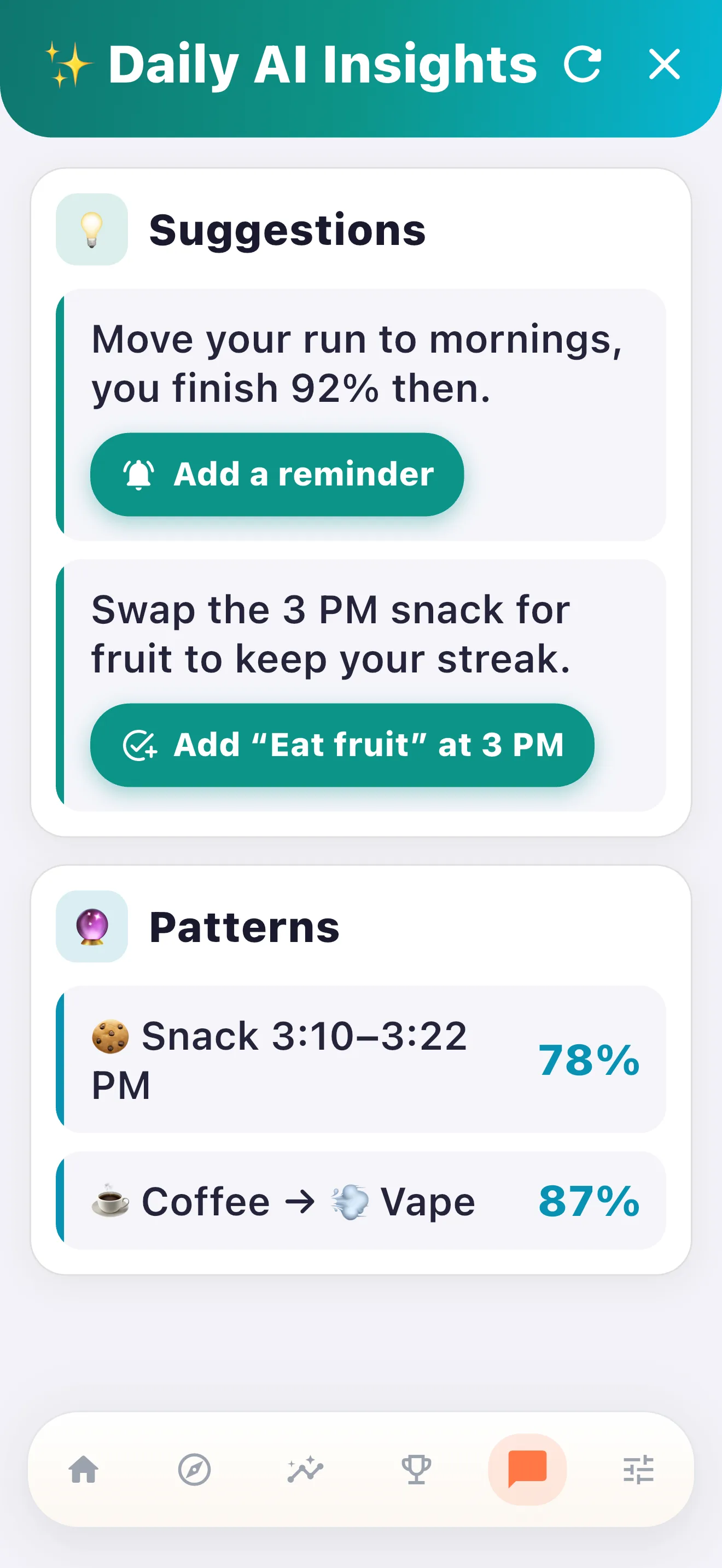
Morning slips tend to cluster around one bad decision more than they're just random. Maybe it's whatever happens the morning after a late meeting runs long. Over enough weeks, the AI in the app starts noticing which habits keep dropping together - if the workout and the journaling always vanish on the same days, that usually traces back to a single earlier decision point, not two separate failures.
2. Fabulous
Probably the most polished morning routine guide app around right now. It was incubated at Duke University's Center for Advanced Hindsight, working with behavioral economist Dan Ariely,[1] and that background shows in the pacing. It skips the full-routine-on-day-one approach and starts you with a single behavior - drink water immediately on waking, say - adding one new behavior per week from there. Rushing the stack is a common way morning routines collapse, and Fabulous is deliberately built to stop you from doing that. Onboarding is genuinely good, and the nudges still feel useful weeks in, which is more than most apps manage. It's a paid subscription after the trial, but the trial runs long enough to actually tell if the approach fits you.
3. Streaks
Tracks up to 12 tasks a day in a clean visual grid, and morning habits fit that format naturally. The Apple Watch integration is really the differentiator here - if you want a wrist-based checklist you can tick off without ever picking up your phone, this is the best option on the list for it. There's no guidance and no coaching, just clean daily tracking. It suits someone who's already worked out their own morning routine and just wants a log that stays out of the way.
4. Routinery
Routinery runs on time, which is what sets it apart from everything else here. You give each step a duration - a couple minutes for brushing your teeth, five for coffee, whatever fits your routine - and the app counts down through each one before nudging you into the next. If you tend to lose track of time in the morning and end up running late even when you got up on schedule, that timed structure is the actual fix. It behaves less like a habit tracker and more like someone standing next to you keeping the pace.
5. Rise Sleep
Rise isn't really tracking your morning routine at all. It's tracking your sleep debt - the gap between the sleep you needed and the sleep you actually got - and using that to predict your energy through the day. Where it gets useful for mornings specifically is finding the wake time your body actually wants, which is usually not whatever time you picked because it sounded disciplined. If what looks like a broken morning routine is really just bad sleep wearing a different costume, Rise is one of the only things on this list that will actually tell you that. It's a paid subscription, but worth running even briefly just as a diagnostic, whether or not you keep it long-term.
6. Alarmy
Alarmy makes you complete a task before the alarm actually stops. Snap a photo of your bathroom sink, solve a math problem, whatever mission you've set it to. The mechanism is blunt, and it's deeply effective for one specific failure type: the person who turns the alarm off while still half-asleep and has zero memory of doing it later. The task forces just enough cognitive load to pull you out of sleep inertia before you can dismiss anything on autopilot, and there's enough mission variety that it doesn't become something you can do half-conscious either. Not a routine tracker. A reliable "get out of bed" tool that pairs cleanly with anything else on this list.
7. Way of Life
Color-coded habit charts stretching back months, and the long view is really the whole value here. By the 30-day mark, Way of Life shows you what actually held and what quietly gave out around week two - the kind of pattern data most trackers just don't preserve in a form you can read at a glance. If you've cycled through several different morning routines over the years, this is how you finally see the shape of what tends to survive. Treat it as a diagnostic layer running alongside whatever you use day to day, not a replacement for it.
8. Tiimo
Tiimo is a visual schedule app built for ADHD and autism, though it's genuinely useful for plenty of people outside that group too. Your morning renders as a color-blocked timeline running across the screen, not a list - a block sized to how long your workout takes, another for breakfast, and so on. Seeing it laid out that way genuinely changes how it feels to move through the morning. Notifications and sounds cue you between blocks as each one ends. The design choices here are unusually thoughtful for what's ultimately a niche category. If the list format has never worked for you, this is worth trying.
9. Done - A Simple Habit Tracker
Three habits on the free tier. If your whole morning routine is really just two or three things, Done is the lowest-friction tracker on this list for it. There's nothing to configure beyond adding the habits themselves, and no bill unless you go past three. A lot of people reach for an elaborate tracking setup before they've even worked out whether the routine itself is going to hold. Done skips that step entirely - it's sized for testing a small morning stack before you invest in anything more complicated.
- Best for an existing routine you keep losing: HabitIt
- Best science-based guide for beginners: Fabulous
- Best frictionless checklist: Streaks
- Best timed step-by-step guidance: Routinery
- Best sleep-debt diagnostic: Rise Sleep
- Best for people who can't wake up at all: Alarmy
- Best long-term pattern data: Way of Life
- Best visual schedule: Tiimo
- Best bare-minimum tracker: Done
Tracker vs guide: which type do you actually need
There are two distinct failure patterns in morning routines, and they point toward different types of apps.
The first failure pattern is not knowing what your morning routine should even be. You've got a vague sense it should involve water, movement, maybe something that counts as intentional - but you've never actually sat down and built a real sequence with times attached. Fabulous and Routinery are built specifically for that gap - they hand you the structure you're missing, and without it you'd be rebuilding the whole thing from memory every week.
The second pattern runs the other way. You already know exactly what your morning routine should be. You've done it before, it's worked, you feel good doing it - but life gets in the way on a Tuesday, and by Thursday you've quietly drifted off the plan entirely. This is where HabitIt, Streaks, Way of Life, and Done earn their place instead. The routine already exists in your head; what's missing is just something keeping it visible and honest day to day.
Someone who actually needs a tracker but downloads a guide app instead ends up spending three weeks being walked through a routine they already know, gets bored of it, and quietly decides morning routines just don't work for them. Whole months get lost to that one mismatch. There's a fast way to check which one you are: try writing down your ideal morning routine right now, off the top of your head. Done in under three minutes? You need a tracker. Stalled out halfway through? Go get a guide first.
One more thing worth saying: a workable morning routine can start as small as 3 habits for the first month. The people who actually manage to build morning routines that stick tend to start with the smallest core they can get away with and only add complexity once that base is running on its own. If you came here hoping an app would finally hold together a 90-minute perfect-life morning, the problem was never the app - it's the 90 minutes. That goes double if you're also trying to wake up earlier at the same time, since a 90-minute routine simply won't fit inside a 45-minute window no matter which tracker gets the blame.
Common failures
Designing a 90-minute routine when you actually have 30. This is probably the single most common failure, and the most avoidable one. Add up a full workout, a cold shower, real journaling time, and a proper breakfast, and the math just doesn't work on a normal day - let alone a chaotic one. Whatever routine holds is whatever actually fits inside the time you have on your worst mornings, not your best ones.
Switching apps every couple of weeks before any habit gets a real chance. New-app energy feels like progress right up until it wears off, which happens fast. If you've cycled through five different morning apps in the last three months and none of them stuck, the app was probably never the actual variable - the duration was. Research on habit formation puts the real range at anywhere from about 18 to 254 days depending on the habit and the person, averaging somewhere around two months.[2] Give one app that long before deciding it failed. Switching apps constantly lets you feel productive without doing the one unglamorous thing that actually matters, which is just showing up again tomorrow.
Tracking but not protecting the first 5 minutes from the phone. You open the tracker app, log the habit, then spend 25 minutes reading news, and the rest of your morning feels off. The tracking did its job. The phone was the first trigger you fired, and everything downstream suffered for it. The no-phone-first-20-minutes habit is one of the highest-leverage items in any morning routine and one of the hardest to hold, because the tracker lives on the same device as everything designed to eat your attention. A paper log for the first stretch of the morning gets around this if it's your pattern.
Building a great routine and then stopping the app because you think you've got it. Day 30, you feel solid. The routine is running. You delete the app. Three weeks later the routine has quietly dissolved, because the log was the feedback loop keeping it visible and durable under load. Keep it going even when the habit feels automatic; the data also comes in handy later, when you want to understand why one particular season disrupted everything.
Citations
- "The Science Behind Fabulous," The Fabulous, incubated at Duke University's Center for Advanced Hindsight with Dan Ariely. Read the source ↗
- Lally, P., van Jaarsveld, C.H.M., Potts, H.W.W., & Wardle, J., "How are habits formed: Modelling habit formation in the real world," European Journal of Social Psychology, 40(6), 998-1009 (2010). Read the source ↗
Build your morning routine habit plan today
Free 3-day trial of all features. After that the free tier covers basic tracking. No subscription required.


Get the Free Morning Routine Plan
Drop your email and we'll send a printable plan you can fill in and track. Occasional updates (max 1 per 2 weeks).
Success! Now check your email to confirm your subscription.
We respect your privacy. Unsubscribe at any time.