How to Build a Morning Routine That Sticks

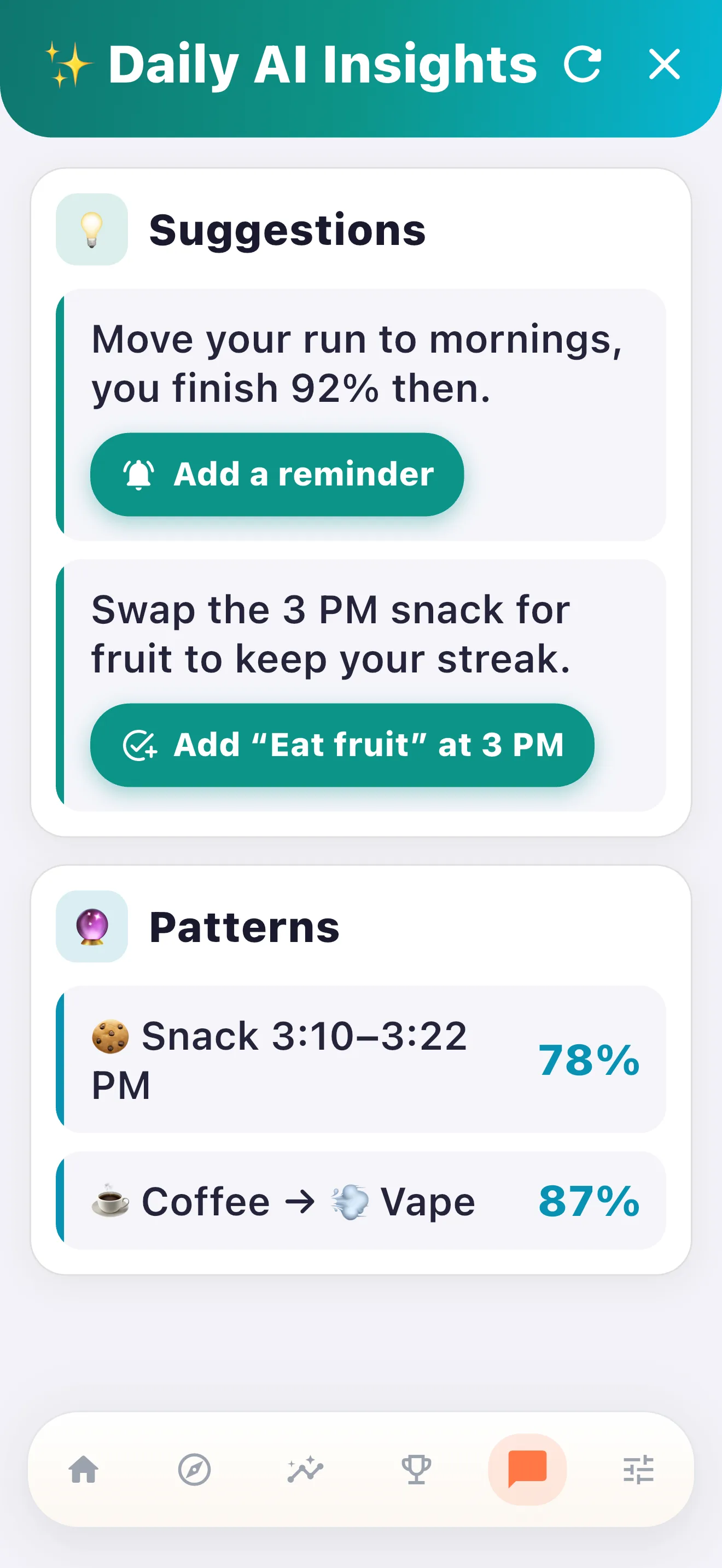
You watched a video about someone's perfect morning. Cold plunge, meditation, journaling, twenty minutes of reading, workout, lemon water, all before 7am. You wrote down a version for yourself, did it Monday, did most of it Tuesday, half of it Wednesday, and by the following Monday you were back to scrolling in bed until the moment you had to get up. The problem isn't that you lack discipline. The problem is that you tried to install seven new habits at once, and seven new habits at once is approximately seven times harder than installing one. The morning routines that actually hold are built one link at a time off an anchor you already do, so each new habit has somewhere to land and nothing to remember. An AI habit tracker with an automatic daily plan handles the scheduling so the only thing you carry is showing up.
The pattern you already know
You watched someone's 5am morning routine on YouTube and felt fired up about it. The next morning you tried to do all seven things at once. By day three you were skipping the journaling because you didn't have time, by day five you cut the workout because you were tired, and by day eight the whole stack had quietly collapsed back to what you were doing before. The mornings that started so promising ended exactly where they began, with you on your phone in bed for ten minutes too long. (For a shorter-form take on which morning habits are actually worth the trigger slot, the 8 morning habits ranked by stickability goes through them one by one.)
Almost every failed morning routine looks like this. The person isn't lazy and they're not unmotivated. They tried to install a finished routine all at once instead of growing one over a few months. Every habit in the stack has its own setup cost, its own ramp-up, its own moment of "do I really want to do this right now," and stacking seven of those into a 45-minute window before work means every single one is fighting for attention from a brain that hasn't even fully woken up. The first one that doesn't have a strong trigger gets dropped, then the second, and the whole thing dominoes.
This post is the habit-chain version of a morning routine. You start with one anchor you already do every day (first coffee, brushing teeth, whatever) and you attach exactly one new habit to it. You hold for a week or two until that one link runs without thinking. Then you add a second. Then a third. By month three you have a four-or-five-habit routine that runs as a single chain off the anchor, and the only one you ever consciously decided to do is the anchor itself. This is the mechanism behind habit chains applied to mornings specifically.
Why most morning routines collapse by week two
Three reasons, ranked by how often they kill the routine:
Every habit needs a trigger, and triggers compete. Try to add seven new things to a morning all at once and maybe one or two land a strong trigger, usually whichever sits nearest the anchor. The rest hang in the middle relying on memory and motivation, both of which run low at 6am. Day three, one gets forgotten. Day five, another. Day eight, the stack is gone. One new habit at a time isn't the slower plan; it's the plan that actually finishes. Two months of single-link adds produces a four-habit routine that holds. Seven habits added on day one usually produces the exact starting point again, by week three.
"I'm going to wake up earlier and then do all this stuff" is the shape a lot of failed morning routines take, and the problem is baked into that sentence: waking up earlier is the hardest part of the whole sequence, which makes it a terrible anchor. Every other habit ends up depending on nailing the alarm, getting out of bed, and not snoozing first. A real anchor is something already happening every single morning without willpower involved at all: the first coffee, brushing teeth, the shower. Pick the boring, unbreakable thing, and let the wake-up-earlier project run separately with its own taper.
A 90-minute morning routine works fine for whoever has 90 free minutes in the morning. Most people have something closer to 25, between waking up and needing to leave or log in. A routine sized for an imaginary morning won't survive an actual one, and actual mornings are most mornings. Build the 15-minute version first; growing it later is easy. A 15-minute routine done daily beats a 60-minute routine done twice a week by a margin that isn't close.
The stages below fix all three by force. You'll have one anchor and one new habit at a time, the anchor will be something you can't fail to do, and the whole chain will stay under 20 minutes until it's bulletproof.
The Chain, One Link at a Time
This isn't a 30-day calendar, because some links take a week to install and some take three. The rule is the same regardless: hold the current chain length until it runs without thinking. "Without thinking" means you do the next step in the chain because the last step ended, not because you remembered to do it. When that's true for the current chain, you can add the next link. Adding before that is how people end up back at square one in week four.
Good anchors are anything you already do daily on autopilot: pouring the first coffee, brushing your teeth, sitting down at the kitchen table. Skip "waking up" as an anchor; it's the variable you're least in control of. Once you have the anchor, pick one habit to attach right after it. Small. A two-minute stretch. A glass of water. Five minutes of reading. Making your bed is the classic stage-one habit for a reason: 30 seconds, zero equipment, visible result. A three-product skincare routine bolted to teeth-brushing is a classic example of a "boring anchor, tiny habit" pairing that sticks for decades - flossing right after brushing is the other textbook example, the one dentists have been recommending for fifty years that nobody does. If the habit needs more than two minutes of effort, it's too big for stage one. The point of stage one isn't to do anything impressive; it's to prove to your brain that this anchor is now followed by something else. Hold here one to two weeks, until the new step happens automatically when the anchor ends.
When stage one runs without thought, add a second habit immediately after the first. The trigger for the second habit is the END of the first habit, not a separate cue. You finish the stretch, you pour the water. You finish the water, you sit down with the book. This is the link-by-link structure that lets the chain grow without growing in difficulty. Keep the new habit small again; this is not the moment to add a 20-minute workout. Two to five minutes max. Hold until both run as one motion, which is usually another one to two weeks.
By now you have an anchor plus three linked habits, roughly ten to fifteen minutes total. This is where most useful morning routines actually stop. Give the whole thing a name in your head ("morning chain" works fine) and start thinking of it as one decision, not three. The chain has its own momentum now. Once you start the anchor, the rest pulls itself through. The danger at this stage is feeling so good about it that you decide to triple the size next week. Don't. Hold here another two to four weeks while the chain becomes truly automatic, then decide whether a fourth link is worth adding.
Once the chain has held for a month, lock it. If you're tracking habits in an app or a notebook, log the whole chain as one item, not three. One check, one tap, done. This is the sustainable form. Some mornings you'll add an extra read or a longer stretch and that's fine; it just means the chain has space to flex. Adding a fourth permanent link is a choice you can make later if you want, but a three-link morning chain held for a year is worth more than a six-link routine that comes and goes. Most people who get the morning-routine payoff stay at three to four links forever.
The Four Rules That Make the Chain Hold
"Wake up at 5:30" as an anchor isn't a chain, it's a project wearing a chain's clothing. The anchor cannot be the new habit; it has to be something already happening every single morning regardless of how tired or motivated anyone feels. First coffee. Tooth brush. Sitting down at the desk. Change wake times, change anchors, or skip breakfast some days, and the anchor is unstable, which makes everything hung off it unstable too. Pick the boring thing that never fails and let the wake-time project run in its own separate slot.
"Automatic" has a specific bar: no remembering the next step, no talking yourself into it. Still pausing to decide whether the stretch happens after the coffee means the stretch isn't ready to carry anything new. Add the next link before that bar clears and the whole chain breaks, not just the new piece. People who add a link every week tend to land at zero links by month three. People who add one a month tend to still have four links, permanently. The day-4 wall is what kills a chain built too fast.
For the whole first year, the chain needs to fit in 20 minutes or less. That constraint alone is what lets it survive bad mornings, and bad mornings make up most mornings. A 90-minute routine sounds impressive right up until it requires 90 free minutes daily, which approximately nobody has sitting around. A 15-minute version completed on a genuinely bad Wednesday beats a 60-minute version that gets skipped on that same Wednesday, by a wide margin. Grow it later, once a year's gone by and there's real time to spare.
Sleeping badly, a sick kid, a 7am flight: none of these call for skipping the routine outright. They call for the anchor plus one link, nothing more. Thirty seconds of stretching after the coffee. One sip of water. Preserving the chain matters more than the dose on a given morning, since it keeps tomorrow's full version feeling like part of an unbroken pattern rather than a restart. A fully skipped morning is what makes the morning after it so much harder to get back into.
Running the AI habit tracker plan with an app
You can absolutely run this on paper, or just in your head if you're confident you'll remember which link is which. Most people find the in-your-head version works fine for stage one and falls apart at stage two, because once you have multiple habits the order and the "what's automatic now" question matter and you stop being able to track it accurately. A simple checklist on the fridge works. A note in your phone works. The tool isn't the point; the structure is.
Three things that help if you do use an app. One, can you log the whole chain as one habit eventually, so the daily friction is one tap and not three? Two, does it model the chain visually, so you can see today's full sequence in order? Three, does it shrug off a missed day instead of zeroing your streak, because you'll have bad mornings and the chain has to survive those without you feeling like the whole project blew up.
If you're looking for a morning routine app that does more than dump a list of habits, a way to build a morning routine that grows one link at a time rather than landing on you fully formed, or a morning routine habit tracker that treats your three linked habits as the one routine they are, HabitIt was built around exactly this chain structure. You set the anchor, add links as they settle, and log the whole sequence in one tap. You can build a morning routine habit tracking plan in about ten seconds, free, no signup.
Five Ways the Routine Still Falls Apart
By far the most common failure pattern: the whole routine starts at 5:30am, holds for four days, and on day five the alarm doesn't. Wake-time was never a real anchor, so every link hung off it fails along with it. Build the chain around something already happening every morning regardless of clock time, and run the wake-time project as its own separate habit. A working chain holds whether the day started at 5:30 or 8:00.
Adding a link every Sunday "because it's a new week" sounds disciplined and is actually one of the fastest ways to overload a routine that hasn't stabilized yet. Links get added when the current chain runs without thought, not on a calendar. For most people that's roughly once a month. Wanting to add faster than that is usually a sign of being more excited about building the routine than about the routine actually holding.
"Read for 30 minutes" sounds reasonable right up until week three, when it's half-skipped constantly because 30 minutes is a lot to ask of a tired brain. Every link has to survive the worst-feeling morning, which means small: five minutes of reading, not 30; two minutes of stretching, not 20. A chain is only as sturdy as its biggest link, so whatever's wobbling is the one to shrink.
Somewhere around month three comes the thought: "what if I journaled before the meditation instead of after?" Resist it. Reordering an established chain breaks the automaticity built into the transitions; the brain learned that A leads to B leads to C, and A-leads-to-C-leads-to-B forces conscious decision-making back into a process that had already stopped needing it. Swapping the order for real should be treated like installing a new chain from scratch, fragility and all.
Two months into a three-link chain, a new viral morning routine shows up and suddenly the current one looks suboptimal. It usually isn't. A four-link chain built over four months beats an eight-link chain installed and abandoned inside four weeks, and it isn't close. The best routine is whichever one actually gets done; adding to what already exists is almost always right, replacing it almost never is.
Beyond the chain
Somewhere around month six, you'll notice you stopped thinking about your morning routine entirely. It just happens. The first coffee leads to the stretch which leads to the water which leads to the journal page, and the next thing anyone's aware of is sitting at the desk feeling noticeably steadier than before the chain existed. That's the lock-in point. From there the routine tends to hold itself for years, with the occasional bad morning surviving on the anchor-plus-one fallback rule.
The quiet upside of building the chain this slowly is that the individual habits inside it also compound. The five minutes of reading at link three becomes a hundred books over a few years. The two-minute stretch becomes the reason your back stopped hurting and you didn't notice when. The glass of water becomes hydration you didn't have to think about. Each link is small but each link runs every day, and the daily compounding is what makes a small chain outperform an aspirational one that comes and goes. If you want to pair the morning chain with a few lines of writing as one of its links, the same logic applies: start at one line a day and let it grow as the chain settles. Same shape, applied to a single link inside the bigger routine. A common evening mirror to the morning chain: one sentence of specific gratitude before bed, which closes the day the same way the morning routine opens it.
For now: pick the anchor, pick one habit, and start tomorrow morning. That's the whole stage-one agreement, and the rest of the routine grows out of it.
Build your morning routine today
Free 3-day trial of all features. After that the free tier covers the basic chain. No subscription required.


Get the Free Morning Routine Plan
Drop your email and we'll send a printable plan you can fill in and track. Occasional updates (max 1 per 2 weeks).
Success! Now check your email to confirm your subscription.
We respect your privacy. Unsubscribe at any time.