How Long Does It Actually Take to Form a Habit?

Maxwell Maltz, a plastic surgeon, noticed his patients took roughly three weeks to stop feeling phantom sensation after amputation. He wrote "a minimum of 21 days" in a 1960 book. The minimum got dropped somewhere along the way. Controlled habit-formation research puts the real number at 66 days - a 2010 UCL study by Phillippa Lally - and 66 is a median, not an average, across a range that ran from 18 to 254 days. That range is what this post is about.
The 21-day myth
Maltz was a cosmetic surgeon.[2] His book, Psycho-Cybernetics, came out in 1960. Patients who'd lost a limb stopped feeling phantom sensation after about 21 days. Nose-job patients took roughly the same 21 days to stop seeing their old nose in the mirror. Maltz generalized from two clinical observations to a claim about the whole human mind: a minimum of 21 days to form a new self-image.
Notice the word "minimum." Maltz meant never fewer than 21 days, often more. Somewhere in the 1970s and 80s, as the self-help industry picked the idea up, the word quietly fell off. What was left was cleaner and far more marketable: 21 days to build a habit. Start Monday, done by the end of the month. Try selling "two to nine months" on a book cover.
Twenty-one also just sounds right. Short enough to feel doable, long enough to sound like science backs it up. That's most of why the number outlived the studies that contradicted it.
None of which makes the 21-day frame useless. For someone who's never built a deliberate habit before, committing to three weeks is a reasonable on-ramp - getting to day 21 beats quitting on day 4 by a wide margin. The failure isn't the number getting people started. It's the false finish line it draws. Hit day 21 still feeling the effort, read that as proof you're doing it wrong, and you quit over a bad expectation set weeks earlier.
What Phillippa Lally's 2010 study found
The study most cited in serious habit formation discussions is Lally et al., 2010, published in the European Journal of Social Psychology under the title "How are habits formed: Modelling habit formation in the real world."[1] Phillippa Lally ran the research at University College London. It's the closest thing to a controlled real-world measurement of habit formation timelines that exists.
The design was straightforward. Ninety-six participants each chose one new daily behavior they wanted to build - eating a piece of fruit at lunch, running before dinner, drinking a glass of water at breakfast. They performed the behavior once per day and reported daily on how automatic it felt, using a scale derived from Verplanken and Orbell's Self-Report Habit Index. The study ran for 12 weeks.
The main finding: the median time to reach automaticity was 66 days.[1] But the range was 18 to 254 days, and the distribution wasn't symmetrical. Simple behaviors (drinking water at a specific time) formed faster, often in the 18-30 day range. More complex behaviors (a 15-minute run before dinner) took substantially longer, often beyond the 12-week study window. For participants who hadn't reached automaticity by week 12, the researchers extrapolated the curve to estimate the endpoint - which means the 254-day upper bound is a model estimate, not a directly observed data point.
Missing a single day here and there didn't materially slow the automaticity curve. Participants who skipped a day and kept going ended up in roughly the same place as the ones who never skipped. Most habit-tracking apps run on streak-or-start-over logic. Lally's data doesn't back that up - overall consistency across weeks moved the needle, one missed day didn't.
Early repetitions mattered more than later ones. The first few weeks carried a disproportionate share of the automaticity curve compared to everything that came after. Most people report the same experience: the first few weeks are the hardest, and the behavior starts feeling easier well before it becomes fully automatic.
The study has real limits. Ninety-six participants started; only 82 provided enough daily data to analyze, and the curve-fitting model used to project the longer timelines converged well for just 39 of them. Small sample to begin with, smaller still by the time you reach the extrapolated estimates. The habits were self-selected - people already motivated to build them - and automaticity was self-reported, with whatever bias that carries. Even so, 66 days is the best estimate available.
The three phases
The Lally data describes a curve, not a switch. Automaticity builds gradually, with no single day where it flips on. That curve has a shape, though, and the shape maps reasonably well onto three experiential phases that most people building habits move through.
The first phase runs roughly from day 1 to day 14. Call it initiation. Every instance of the behavior requires a deliberate decision - you have to remember to do it, then talk yourself into starting. It feels like willpower because it mostly is willpower. Nothing about the behavior feels natural or easy yet. The novelty of starting has worn off by day 4 or 5, and the behavior still hasn't become routine. This is the window where most habit attempts die, not because the person lacks discipline but because they're misreading what phase they're in. Day 10 is supposed to still feel like effort. That's initiation working as designed.
By day 14, the picture usually shifts into a second phase, running to roughly day 60. Friction drops. The behavior turns into a normal, unremarkable part of the day. A bad day can still break the chain, though, and most people who made it past initiation quit somewhere in here anyway, even with the effort meaningfully lower than before. Identity starts to form - "I am trying to do X" edging toward "I am someone who does X," not complete yet but underway. It also feels stable enough that people start adding complexity: a longer session, an entirely new habit stacked on top. That's usually when it breaks. Easier isn't automatic. Automaticity is further out.
The third phase is automaticity proper, 60 days and beyond. The behavior fires without deliberate decision. When you don't do it, the absence just feels off. Starting no longer requires talking yourself into anything. This is what Lally's study was measuring - the point at which the automaticity scale reaches a plateau. Most people building a simple daily habit will get here somewhere between day 60 and day 90. More complex behaviors, or behaviors without a consistent cue, may take longer.
What affects how long it takes
The 18-to-254-day range isn't random. Lally's own data pointed to one clear driver: behavior type, with simpler behaviors clustering toward the fast end of that range and more complex ones toward the slow end. The rest of what predicts where a habit lands in that range comes from the wider habit-formation literature her paper sits inside - general behavioral science, separate from her specific regression.
A consistent, already-existing cue does a lot of the remaining work. Attach a new behavior to something you already do at the same time and place, like the moment coffee finishes brewing, and the cue fires itself; no scheduling required. Attach it to a vague intention to do it sometime in the morning, and you have to actively recall the whole thing every day, which is a much heavier lift. That's the entire logic behind habit stacking and habit chains: attach the new behavior to a cue that already fires reliably.
Complexity itself is the factor Lally's data speaks to most directly. Flossing one tooth takes less cognitive and physical effort than a 30-minute workout, and the lower-complexity version reaches automaticity sooner. Start smaller than you think you need to. The groove forms faster, and complexity can get added once it's there.
Reward timing plays a role too, and it's a fairly intuitive one. A run leaves you with actual endorphins within the hour. Water first thing in the morning just feels good going down. Flossing pays off in cavities avoided years from now: an abstract reward with no felt payoff in the moment. Habits like that lean entirely on identity and planning; there's no built-in feedback loop doing the work for you.
The daily time slot matters as well. Slot a behavior into an existing daily anchor, like your morning routine or the wind-down before bed, and it has something to attach to. Let it float freely across the day, and it needs active management every single time, which slows the whole process down.
What this means for a habit you're building right now
The practical implication is simple: plan for 90 days. That number sets more realistic expectations than 21 ever could. Day 15 still feeling hard is normal. A missed week around day 45 because of travel is recoverable. Day 30 feeling solid is a good sign, and it's still not automaticity yet.
The first 21 days are for showing up. The only variable that matters in this window is completion - did the behavior happen or not. Resist the urge to make it bigger or harder than the original plan. Just do the thing and log it. The goal is to get through the initiation phase without the habit dying from over-engineering.
Days 21 through 60: friction is dropping, but the habit still isn't automatic. People add complexity too fast here - the behavior feels easy, so they extend it, it gets hard again, and they quit. Hold the original spec through this window. Easy at day 30 is the same practiced-not-automatic gap from the second phase above; it trips people up often enough to say twice. A better test: what happens on a genuinely bad day. A chaotic Tuesday that wipes the habit out completely means it isn't automatic yet. One that survives in some reduced form means you're close. A few friction spikes tend to show up in this stretch too, usually without warning, after weeks of things feeling smooth.
The final 30 days, roughly day 60 to day 90, are consolidation. The behavior is becoming automatic. You're starting to feel the absence when you miss it. This is where restarting after a slip gets much easier than it was in the initiation phase, because the groove is established enough that a few days off doesn't erase the pattern. Keep the log running through this window even though it feels unnecessary - people who stop here are often the ones who watch the habit quietly fade a few weeks later.
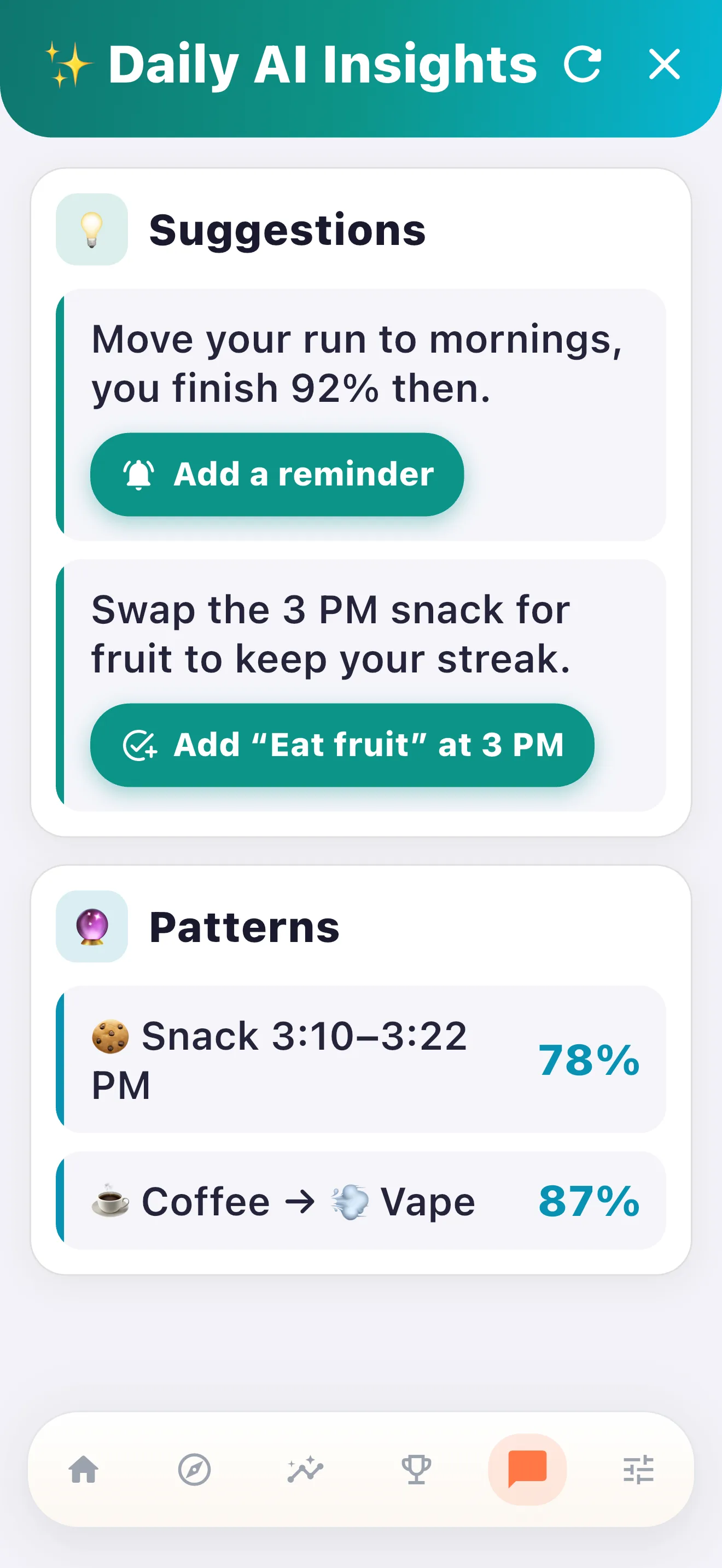
This 90-day arc is basically what HabitIt, the AI habit tracker, is built around. Its journey system runs as an automatic habit plan that carries a target across all three phases above and adjusts the daily number when a day gets missed. As a smart habit tracker, its pattern detection can also flag the specific days or contexts where a given habit tends to wobble, since danger points like day 21 tend to repeat in the data.
Common mistakes from misunderstanding the timeline
Quitting at day 10 because it doesn't feel automatic. It won't, not yet - day 10 is still deep in the initiation phase covered above, and every day-10 quit is really just someone acting on the wrong information about what those first two weeks are supposed to feel like.
Declaring success at day 21 and removing all structure. Day 21 is three weeks in - solidly inside the learning phase for most habits, still initiation for the complex ones. People who hit that mark and dismantle the accountability structure around it tend to watch the habit dissolve quietly over the next two weeks without ever figuring out why. The structure keeps the habit visible. Remove it too early and the habit just stops being real to you.
Comparing your timeline to someone else's. The Lally range is 18 to 254 days. If a friend built the same habit in 30 days and you're at day 50 still putting in effort, that gap probably just comes down to a more consistent cue or a simpler habit on their end. It isn't a personal failure on yours. Your 50 days are your 50 days.
Treating a 2-day skip as proof the habit didn't take. Lally's data is direct on this: missing a day or two didn't materially slow the automaticity curve. The idea that every missed day "resets" the habit is a streak-counter artifact - tracking-app folklore, basically, with nothing behind it in the actual research. A 2-day skip at day 40 doesn't return you to day zero. It returns you to day 38. Keep going.
The bottom line
Plan for 60 days at minimum, more realistically 90, and accept that the range is genuinely wide going in. Lally's research is about a narrower claim than "you'll succeed by day 66": a simple daily behavior with a consistent cue tends to reach automaticity around a 66-day median, across a small but real sample. Your habit may land well above or below that midpoint. Twenty-one days isn't enough for anything more complex than drinking a glass of water at a set time each morning.
The early repetitions matter more than a missed day here or there - more, arguably, than the exact 66-day figure itself. A consistent cue is one of the most useful things you can control: attach the behavior to a trigger you already fire reliably, and show up during initiation even when the execution is minimal. A missed day isn't a reason to quit.
If you've been searching for how long does it actually take to form a habit, trying to figure out whether the 21 days habit myth debunked content you've read is accurate, or just trying to understand how many days to build a habit research actually supports, here's the short version: it's longer than you've been told and more variable than any single number implies. Give it 90 days, and judge your progress against that instead.
Citations
- Lally, P., van Jaarsveld, C.H.M., Potts, H.W.W., & Wardle, J., "How are habits formed: Modelling habit formation in the real world," European Journal of Social Psychology, 40(6), 2010, 998-1009. onlinelibrary.wiley.com
- Maltz, M., Psycho-Cybernetics, Prentice-Hall, 1960.
Build your 90-day habit formation plan
Free 3-day trial of all features. After that the free tier covers basic journeys. No subscription required.


Get the Free Habit Formation Timeline Sheet
Drop your email and we'll send a printable plan you can fill in and track. Occasional updates (max 1 per 2 weeks).
Success! Now check your email to confirm your subscription.
We respect your privacy. Unsubscribe at any time.