How to Restart a Habit After Falling Off

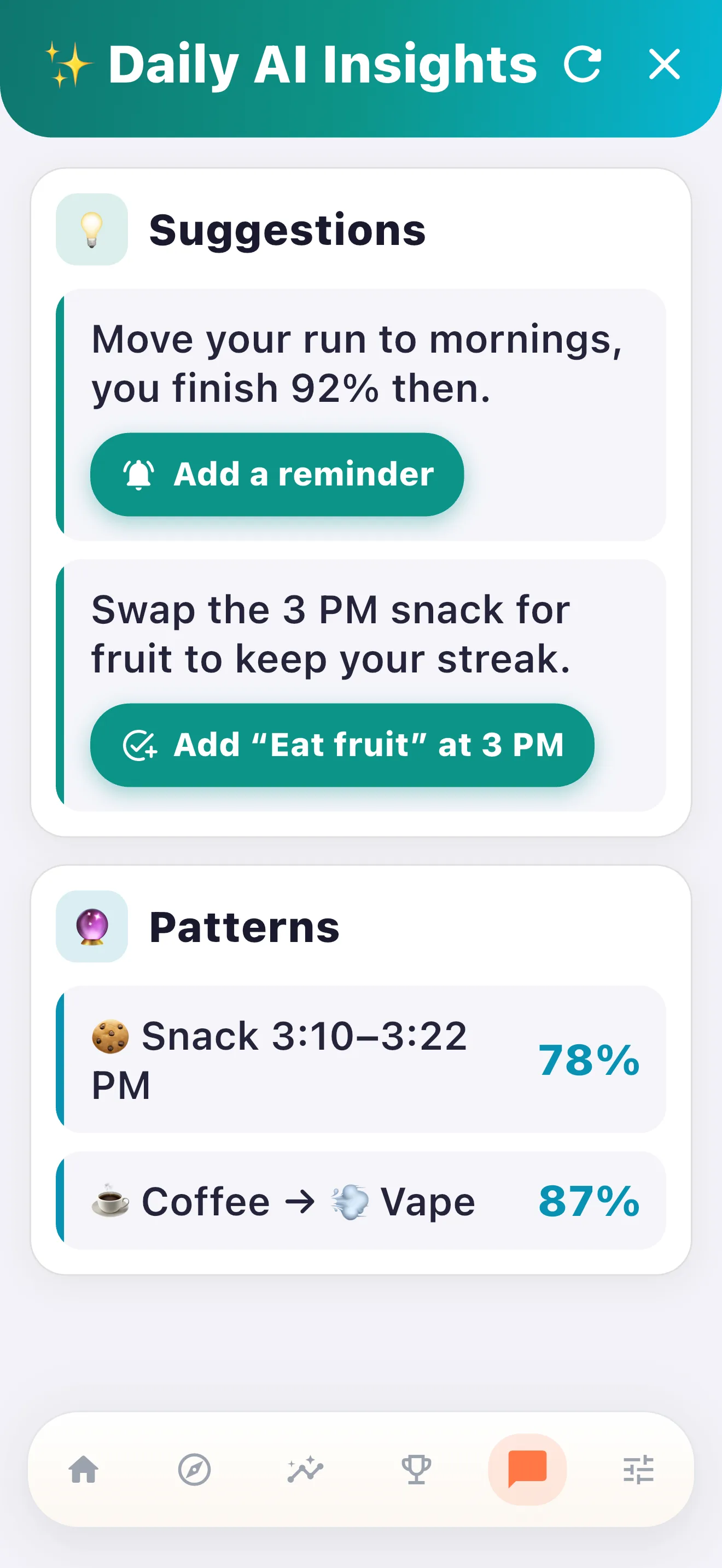
You were doing the thing. The workout, the meditation, the journaling, the run. Then a week happened. A bad cold, a work crunch, a trip, a stretch where everything went wrong. You missed Monday and figured you'd start again Tuesday. Tuesday became Friday. Friday became "I'll restart next Monday." That Monday was three weeks ago. The habit is gone, the streak is dead, and every time you think about restarting, you imagine going back to where you left off and the size of that feels impossible. Here's the part that matters: the habit didn't actually break. Your restart logic did. This is a four-step protocol that gets you running again without the all-or-nothing reset that kills most comebacks. An AI habit tracker with pattern detection will tell you which weekday your slips cluster on, which is half the restart problem already.
The pattern you already know
The arc looks the same every time. You start a habit. You hold it for a few weeks or a few months and it feels like an identity, like you're really doing this. Then life pokes a hole: a trip, an illness, a project, a heartbreak. You miss a few days. The longer the gap gets, the bigger the imagined cost of restarting feels. After two weeks of missing, restarting feels almost as hard as starting did the first time. After three weeks, it feels harder, because now you have evidence you couldn't sustain it before. So you don't restart. The habit dies, not because of the original gap, but because of the math your brain did about what restarting would require.
The original mistake is real but small. You missed days. Days happen. The bigger mistake is the all-or-nothing logic that says "I broke the streak, so it's broken." That logic is the actual habit-killer, and it lives in your head, not in the habit. Streak counters reinforce this logic; every app that resets your number to zero when you miss a day is selling you a fragile habit dressed up as accountability. The habits that actually hold over years aren't unbroken streaks; they're long arcs with occasional gaps that don't trigger the reset.
This post is HabitIt's Restart Protocol: a four-step method we developed from our own product philosophy and from watching how people actually recover habits inside the app. It isn't a clinical framework or a cited study; it's the approach we've found holds up. Each step fixes a specific failure mode in the standard "I'll restart Monday" mindset. The protocol assumes you've already accepted that you want this habit back. If you're not sure you do, decide that first. This one assumes the answer is yes.
Why most restart attempts fail
Resuming at the size that broke you, instead of a sustainable one, causes more second failures than anything else on this list. Someone running 5K three times a week who stopped 4 weeks ago still has their brain telling them 5K is the baseline, even though the fitness underneath it quietly slipped. The shoes go on, the 5K happens, every minute of it is miserable, and the next run doesn't happen for another week. The restart needed to be 1K, not 5K - the size that broke someone is almost never the right size to restart at, because fitness, motivation, and ritual have all adjusted downward together during the gap.
Two smaller mistakes finish off whatever survives that first one. Waiting for Monday, or next month, is the Monday fallacy: Mondays carry symbolic weight and feel like clean restart points, but the days between deciding to restart and the actual Monday are dead time the avoidance system uses to talk the whole thing out of happening - by Thursday the skepticism has set in, by Sunday there's a rationalization ready for why this isn't actually a great week to start. Running the next session within 24 hours closes that gap before it can widen. Doing a big restart speech in the head first is the other mistake: the internal apology, the "this time will be different," the journal entry about what went wrong - all of it sounds like commitment and is actually avoidance wearing a commitment costume. The day-4 wall is the same mechanism showing up in first-time habits; here it's just the restart version of the identical dynamic.
The four steps below handle both by force.
HabitIt's Four-Step Restart Protocol
No internal apology. No theory about why this happened. No promise that next time will be different. The narrative is the avoidance system trying to stretch the decision-to-restart window long enough for you to abandon it. Cut the narrative. The acknowledgment is one sentence: "I missed Y days and I'm starting again today." That's it. If you've been journaling, the entry for today is "Day 1 of the comeback. No backstory." This step exists explicitly to stop you from spending 30 minutes on a journal entry about why you fell off, then telling yourself you've done enough work for the day. The narrative is not the work; the restart is.
This is the step that matters most, and the one that's easiest to skip. If you were meditating 20 minutes a day when you stopped, restart at 5. If you were running 5K, restart at 1K. If you were journaling a page, restart at three sentences. The reasoning: your fitness/discipline/identity has slipped during the gap, and starting at the old size triggers the same failure pattern that caused the break. One thing that helps the restart stick faster is reframing the habit as an identity rather than a behavior - that's the subject of the identity shift post. The smaller restart size produces a successful first session, which builds momentum, which lets the size grow back over weeks. The bigger restart size produces a painful first session, which produces avoidance the next day, which produces another gap. Trust the small number.
The Monday fallacy is one of the most reliable ways a restart quietly dies. Deciding on a Wednesday to restart "on Monday" hands the avoidance system four days of dead air to talk you out of it, and in our experience most of those Monday restarts never actually happen. Deciding on a Wednesday to restart that same Wednesday closes the gap before it can widen. The dynamic is decay: the longer the stretch between deciding and acting, the weaker the urge to act tends to get. By the time Monday rolls around, the momentum is usually gone. The next session is the only thing that closes the gap, and the gap to that session is the variable you control. Today.
The reason most second restarts also fail is that people get cocky on day 3 or 4 of the comeback and decide they're ready to go back to the original size. They are not. The first week of any restart is the rebuild phase; the size has to feel almost too easy to make sure the habit holds. After 7 consecutive days at the small size, you can increase by 50% the following week. After 7 days at THAT size, increase again. By week 4 you're often back at or above the original size, but you got there through accumulated wins, not through a heroic single jump. This is the same logic as the original taper plans for quitting; here it's a taper UP from the broken size.
The Rule That Actually Matters
The sustainable size is non-negotiable for the first week, full stop. Deciding to restart meditation at 5 minutes and then, on day 3, "feeling like" doing 15 instead is exactly the move that breaks it again - the point of week 1 is reps, not duration, and going long on day 3 is precisely what triggers avoidance on day 5. Chain logic explains why: the chain hasn't reformed yet, so it can't be loaded with weight.
Three smaller things protect that rule once it's holding. The old streak counter is dead and shouldn't be revived even when the app offers a recovery option - the new streak starting at 1 today is healthy, since treating it as a continuation of the old arc keeps the old failure mental model alive, which is exactly why a calendar view often beats a streak counter for anything recovering from a gap. Staying quiet about the restart for the first 7 days matters more than it sounds like it should, since announcing it early triggers a premature identity claim that raises the cost of failure if week 1 doesn't hold - better to mention it after day 7, once the sustainable size has actually been held. Re-doing the original setup - trigger, anchor, environmental cue - in 10 minutes or less rounds it out; anything longer than that starts looking like procrastination wearing preparation's clothes, and replacement habits covers the same setup shape when the original was a quit-habit rather than a start-habit.
Running the AI habit tracker plan with an app
You can run this on paper. A note that says "restart day 1, small size" and a check-mark every day for 7 days. The reason paper restarts often collapse is that the user isn't physically opening the notebook each day; the restart fades the same way the original did. A phone tracker with a single tap-to-log keeps the daily compliance visible. The app handles the count, you handle the action.
Three things to look for in whatever you use. One, can you set a clear "sustainable size" target separate from your previous baseline, so the restart isn't fighting old data? Two, does it shrug off a slip in this fragile rebuild period instead of zeroing the new streak? Three, can it remind you of the sustainable-size rule for at least the first 7 days, because the temptation to oversize on day 3 is the most common failure mode?
If you're searching for how to restart a habit, a habit restart plan, or a broke-my-streak-now-what protocol that doesn't shame you, HabitIt was built around exactly this kind of recovery logic. You can rebuild any habit you fell off of in about ten seconds, free, no signup.
The Failure That Ends Most Second Attempts
Restarting at the broken size "to prove you can" ends more comebacks than anything else on this list. Meditation restarts at 20 minutes on day 1, the session is painful, day 2 gets skipped, and the whole thing gets declared a failure - except the proof being chased was never real proof, just stamina measured at the exact moment stamina had dropped. Real proof comes from week 2, not day 1, which is the entire case for restarting small in the first place.
A handful of smaller mistakes explain most of what's left. Waiting for the "right week" assumes right weeks exist, when every week has friction and the Monday in someone's head is just the avoidance system buying time. Doing a "soft restart" with no logging - easing back in "without making a big deal" - usually means not actually restarting at all, just hoping the habit picks itself back up on its own, which is exactly what a log exists to prevent, even if the only audience for it is the person doing the logging. Treating the restart itself as evidence of failure is its own trap, since long-arc habits that hold for years almost all have at least one gap with a clean restart in their history - the real diagnostic was never whether the streak broke, only how fast the next gap got closed. Restarting too many habits at once rounds it out: three habits breaking during the same gap creates a temptation to restart all three together "since it's happening anyway," but stacking three restarts triples the failure surface and tends to collapse all of them, which is as good a moment as any to audit which habits are actually worth restarting instead of assuming all of them are.
Beyond the restart
The first 7 days build the new rep. The next 30 build the new arc. Around day 30 of the restart, you'll notice the original habit feeling less like a comeback and more like just the habit again. The gap that felt enormous a month ago is now a story you tell, not a current event. The restart wasn't really about returning to the same habit; it was about retraining the response to slips so that the next gap (which will happen) doesn't trigger the same all-or-nothing reset.
The deeper version of this work is that the people who maintain habits over decades aren't the ones with the fewest gaps; they're the ones with the fastest restarts. A habit held for 10 years with five 2-week gaps in it is dramatically better than a habit held perfectly for 3 years and then abandoned. The streak counter rewards the second pattern. The actual outcome rewards the first. Day-4 logic applied across years: the restart is the habit. The original sessions are the byproduct. One related decision worth making at restart: how long to set the next target. Whether a 30-day plan or a longer commitment actually sticks depends more on the habit type than people think, and the restart moment is the right time to recalibrate.
Restart your habit today
Free 3-day trial of all features. After that the free tier covers the basic plan. No subscription required.


Get the Free Habit Restart Worksheet
Drop your email and we'll send a printable plan you can fill in and track. Occasional updates (max 1 per 2 weeks).
Success! Now check your email to confirm your subscription.
We respect your privacy. Unsubscribe at any time.