How to Floss Daily Without Forgetting
A new floss container gets bought with real intentions. It lasts one night. Six weeks later, at the checkup, the gum inflammation gives away what the patient just tried to deny. Flossing is the habit almost everyone endorses and almost nobody keeps, and motivation usually isn't why. Two things are wrong: where the floss lives, and the order it comes in relative to brushing. Fix both and the habit installs itself over 21 days. A smart habit tracker turns that window into a one-tap daily record.
Why flossing fails for almost everyone
Three reasons in order of impact:
1. The floss is in a drawer. Most people's floss lives in the medicine cabinet or a bathroom drawer, while the toothbrush sits out on the counter where it's impossible to miss. At the moment the trigger fires, the brush is in plain view and the floss is behind a mirror door. Brushing finishes, nothing reminds you, and the night ends there. Placement decides the outcome for the same person with the same good intentions.
2. Floss comes AFTER brush in the order. The standard advice is brush, then floss. A randomized controlled trial found the reverse order reduces more interdental plaque and leaves more fluoride behind between teeth, since the floss clears debris fluoride would otherwise have to fight through.[1] The habit-design case is just as strong: brushing produces a done feeling, and anything scheduled after that feeling reads as extra work. Flossing first sidesteps the done feeling entirely.
3. No anchor. Deciding to floss at night gives your brain nothing to grab. Tying it to the physical act of picking up the toothbrush does, because the brush is already in your hand every single night without fail. The vague version surfaces maybe twice a week, usually while you're already in bed.
One stupid trick (placement) + one reversal (order) + one specific anchor = habit installed. No willpower required.
The one stupid trick
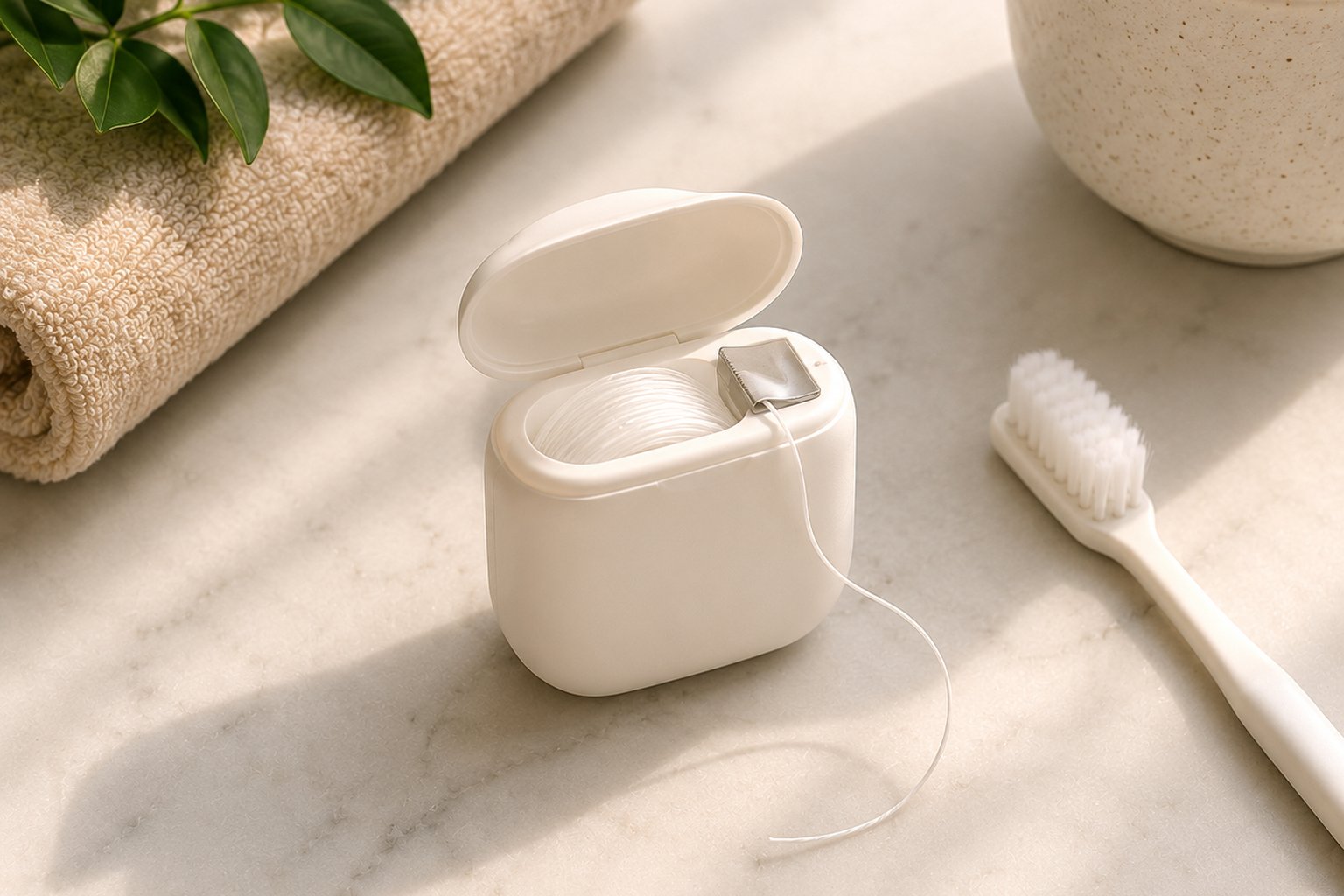
The floss container goes on top of the toothbrush, or directly next to it, in the open, permanently. Counter, never cabinet, never drawer. It should be touching the brush.
This sounds dumb, and it works better than almost anything else here. Reaching for the toothbrush at night, your hand passes straight through the airspace the floss occupies. Moving it out of the way to grab the brush is the contact that becomes the trigger. Digging through a cabinet drawer never generates that same moment, which is most of why this one change carries so much of the result.
The container doesn't have to be ugly. A small ceramic dish holding the floss looks like a deliberate choice, and a simple wood tray works too. If you live with a partner who hates counter clutter, offer the tray as the compromise. The placement itself stays.
The 21-Day Plan
The setup is the work. Move the floss to the counter today, and tonight, floss before brushing rather than after. Flossing runs about 60 seconds on top of the usual two-minute brush, so the whole routine only grows by a minute. Expect the first three nights to feel a little off simply because the order is unfamiliar - by night four it stops registering as different at all. Don't skip a night this week, and whatever else slips, keep the floss on the counter and the order reversed.
The test of whether the habit is real. Some night this week - a work emergency, exhaustion, whatever it ends up being - you're standing at the sink at midnight wanting to just brush and go to bed. The rule still holds: floss first. Even a 30-second pass counts. A skip here sends the habit back to week 1. Getting through the bad night without one is what locks it in place.
Travel is the second-biggest failure point. Solution: a small pack of floss picks lives in your toiletry bag year-round. The travel-version anchor is the act of opening the toiletry bag. For weekends: the anchor (brushing) shifts later but the order doesn't. Floss before brush at 1am Saturday is the same as floss before brush at 10pm Tuesday. Don't let the weekend become exception time.
The habit is installed. The floss-brush sequence has fused into a single event in your brain, and you stop thinking about it. Refill floss every 4-6 weeks. The next dentist visit will show the difference - less plaque, gums that don't bleed at the cleaning, nothing to lie about. Resist the urge to upgrade to a water flosser or fancy device for at least 90 days. Placement and order are what's carrying the consistency here, and no gadget changes either one.
The Four Rules That Make It Stick
1. Floss lives on the counter, touching the toothbrush. This is the entire structural fix. If you go back to storing it in the cabinet, the habit dies within two weeks. Permanent counter placement is non-negotiable.
2. Floss BEFORE brush, always. The reversed order is both better dentistry and better habit design. Brushing produces a done feeling that kills anything scheduled after it, so the floss sneaks in first, before that feeling has a chance to arrive. Don't revert to brush-then-floss.
3. The anchor is the toothbrush itself. Pick up the brush, pick up the floss - one motion cues the next. The brush works as the trigger because brushing is one of the most reliable habits adults have, one of the few that survives vacations, illness, and 1am bedtimes, and a new habit tied to it borrows all of that reliability for free. Habit stacking is the framework and flossing is its textbook example.
4. The bad-day version is a 30-second pass. When you're exhausted, do a quick pass between the front and back teeth, the rough places where food gets stuck. Better than zero, and it keeps the anchor alive for tomorrow.
Running the plan
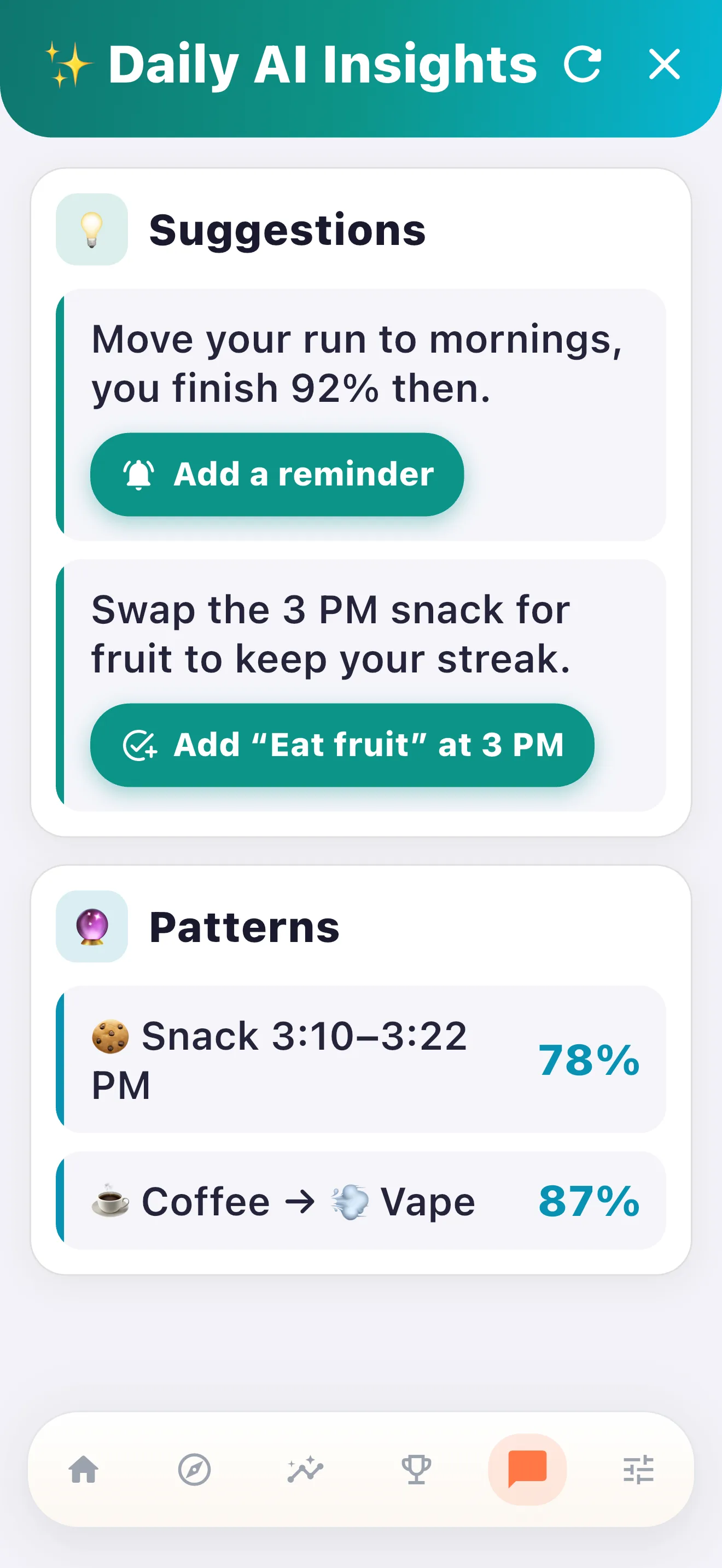
HabitIt, the smart habit tracker, turns this into a one-tap daily entry - yes or no. It's an automatic habit plan: skip judging thoroughness and log the bare fact that floss touched teeth. Technique catches up on its own over a few weeks, and once a few weeks are logged, pattern detection can flag which specific nights the streak tends to slip - usually the same late nights this plan already warns about.
Everything above is really one answer to the question of how to remember to floss every day: put the floss where your hand already goes and let brushing carry it. The vitamin habit post uses the same placement principle, and the morning routine post covers the broader anchoring framework.
Common failures
The most common one is moving the floss back into the cabinet to keep the counter tidy. The container has a lid. It's fine out in the open, and a small wooden tray makes it look deliberate if bare floss on the counter bothers you. The habit is worth more than the tidiness.
Some people revert to brush-then-floss after a few days because the reversed order feels wrong. That feeling is the old habit complaining, and it goes quiet by day 7. Others stall out on gear entirely - they decide to buy a water flosser first, and the habit ends up waiting two weeks for an Amazon box that was never the problem. Regular floss tonight beats better floss someday.
Two smaller ones. Flossing only the front teeth misses where gum disease starts, which is the back - if there's only 60 seconds available, that's where they go. And quitting outright after one missed night is a bigger threat to this habit than any technique problem. One skipped night is a data point, nothing more. Three skipped weeks is the real failure, and restart logic applies without guilt.
Beyond the 21 days
The deeper point: the cabinet is where habits go to die. Moving the floss from cabinet to counter is the entire mechanism by which most flossing failures get fixed, and the same move works for vitamins, journals, dental picks, sunscreen - anything you're supposed to do daily that lives behind a door stops existing the moment the door closes.
A smart habit tracker keeps the growing streak visible long after 21 days have passed, which ends up being better proof that placement and reversal worked than any dentist lecture ever was.
Gum disease is increasingly linked to cardiovascular risk, and it's a major driver of tooth loss later in life.[2] Sixty seconds a night is a small price against either outcome, and the cost only goes up the longer it's deferred.
If you've been meaning to floss for years and never made it past three nights, the issue was placement and order. Move the container tonight. Reverse the order tomorrow. Hold for 21 days. The next dentist visit will tell you everything you need to know.
A note on flossing well
Installing the habit is the hard part. Technique is easy to fix, and fixing it matters, because sloppy technique makes the whole ritual feel less rewarding than it should. Five quick points:
Use enough floss. Pull off about 18 inches. Wrap most of it around the middle finger of one hand, leaving about 2 inches between your hands, and unwind clean sections as you move between teeth so the same dirty stretch never works two gaps. The common mistake is pulling off 6 inches total, which means by tooth four you're just relocating bacteria.
Hug the tooth. Sawing back and forth through the gap does nothing. Slide the floss down, curve it into a C-shape around the tooth, and move it gently up and down against the side, just below the gum line. That's where the plaque lives.
Don't snap the floss. Hard downward pressure cuts into the gum and causes bleeding. Slide the floss in gently with a side-to-side motion until it's past the contact point. Gums may bleed slightly the first week even with good technique. That's the inflammation settling down, and it fades within a week.
Floss picks are fine. String floss edges out picks for thoroughness, but the gap between them is small, and it matters a lot less than whether flossing happens at all. Every night with a pick does more for your gums than twice a week with string. Pick whichever one gets used.
Water flossers are good for some people. If you have braces, implants, bridges, or specific dental work that makes string flossing hard, a water flosser is a genuine upgrade. For most adults with normal teeth, regular floss is at least as effective and a tenth the cost. Don't let shopping for one become the reason you're not flossing tonight.
If you're flossing every night for 21 days and your gums still bleed after 14, that's a sign of inflammation that needs more than flossing alone - book the dentist appointment you've been putting off. The blood is information, and it's worth acting on.
Citations
- Mazhari, F., Boskabady, M., Moeintaghavi, A., & Habibi, A., "The effect of toothbrushing and flossing sequence on interdental plaque reduction and fluoride retention: A randomized controlled clinical trial," Journal of Periodontology, 89, 2018, 824-832. aap.onlinelibrary.wiley.com
- American Heart Association, "Periodontal Disease and Atherosclerotic Cardiovascular Disease: A Scientific Statement," Circulation, 2025. ahajournals.org
Build your flossing plan today
Free 3-day trial of all features. After that the free tier covers the basic plan. No subscription required.


Get the Free Flossing Plan
Drop your email and we'll send a printable plan you can fill in and track. Occasional updates (max 1 per 2 weeks).
Success! Now check your email to confirm your subscription.
We respect your privacy. Unsubscribe at any time.