How to Quit Chewing Tobacco: A 6-Week Taper Plan

Chewing tobacco and dip deliver nicotine differently than cigarettes. A cigarette lasts 5-7 minutes. A dip or chew held in the mouth for 20-30 minutes delivers nicotine continuously over that whole window, and the peak blood levels take longer to drop afterward. That longer hold time is why generic quit-smoking advice never quite fits. The plan below was built for dip and chew specifically. It's a 6-week taper that accounts for the higher per-session dose and the oral fixation layered on top of it, and it plans around the places dipping actually happens most: work breaks and the seventh inning of a ball game. It runs on a schedule, which is more reliable than willpower on a bad Tuesday.
The pattern you already know
You reach for the can without deciding to. Getting in the car does it. So does the ten minutes before a meeting when your nerves run a little high. The hand moves about half a second after the trigger fires, and by the time you notice, the pinch is already in. A few years of daily use grooves the habit that deep.
The pharmacology of smokeless tobacco is worth understanding specifically because it's different from cigarettes in ways that matter for quitting. A cigarette delivers a fast spike of nicotine. Absorption through the lungs is nearly immediate and the rush is noticeable, then it drops off within 30-40 minutes. A dip or chew held for 20-30 minutes delivers nicotine through the mucous membrane in a slower, more sustained way. The peak is less dramatic. It lasts longer, and the blood level takes longer to drop back down.[2] That extended exposure window is part of why smokeless tobacco users often report a physical dependency that feels different from what smokers describe, even without the same "hit" sensation.
The math makes it concrete. If you're doing 8 dips a day, each one a 20-minute hold, you're getting continuous nicotine exposure for roughly 2 hours and 40 minutes daily. For comparison, a pack-a-day smoker (20 cigarettes, each about 6 minutes) is actively smoking for about 2 hours. Total exposure time lands in a similar range. The delivery profile is different, and the physical ritual is far more involved for dip. Packing and placing the pinch takes a few seconds. Holding it in for twenty minutes while spitting the whole time (please don't swallow) is the part that actually eats the clock, and it's a lot more tactile behavior sitting on top of the nicotine dependency than a cigarette ever asks for.
People who quit cigarettes by switching to dip often find dip harder to quit later. That makes sense: you've maintained the nicotine dependency while adding a more complex physical ritual and a slower delivery that produces a longer craving window when you go without. This plan works backward through that - the taper reduces the nicotine load first, then the oral replacement handles the physical ritual, so you're never trying to solve both at once.
Why most attempts fail
1. Assuming a dip taper behaves like a cigarette taper. Nicotine withdrawal generally peaks around day two or three and eases over the following weeks, and that holds for both cigarettes and smokeless tobacco.[1] What's genuinely different for dip is the baseline going in. Nicotine clears slowly from the blood after a chew or dip, and a heavy daily user ends up carrying a higher sustained nicotine level than someone getting a similar total dose from quick cigarette hits.[2] Cutting that baseline in one jump lands differently as a result. That's the real reason a generic quit-smoking timeline doesn't map cleanly onto dip - the exposure pattern going in is shaped differently, not the withdrawal length itself.
2. No plan for the oral fixation. The hand-to-mouth part is genuinely half of the habit. After a few years, the reach-pinch-place sequence runs on its own, wired to the same stress and boredom moments that fuel the craving itself. Cold turkey leaves that sequence completely unaddressed. Watch what actually takes down someone who has already cleared acute withdrawal. They're in the car, the hand drifts toward the cupholder where the can usually sits, and the can isn't there. The cue fired and nothing answered it.
3. No taper math. Cutting back gradually, with no numbers attached, lasts about two days before the habit volume creeps back. The habit keeps firing at its usual frequency, and without a defined daily target every craving becomes a negotiation you have to win on the spot. Write the schedule down. Eight a day this week. Six next week, four the week after that. It's harder to talk yourself out of a target that's already sitting on paper.
The 6-week plan
Count your actual daily dip count for 3 days without trying to reduce anything. Just measure. The real number usually lands 2-3 dips above your guess, because a few of them are so automatic they barely register. Once you have it, target a 20% reduction from baseline - at 8 dips per day, that means 6-7. Get there by stretching the gap between dips by 30 minutes per session and leaving the sessions themselves alone, which keeps the daily structure of the habit intact while the frequency drops. Start using a non-tobacco product (herbal chew, nicotine lozenges, or a nicotine pouch at half your usual strength) as a direct substitute for one dip slot per day. One slot this week. Two next week.
Day 15: 5 dips. Day 19: 4 dips. Day 23: 3 dips. Day 27: 2 dips. The 4-5 day intervals matter because they give your body time to adjust to each new level before the next drop, which keeps the withdrawal manageable at every step. At 2 dips per day the total daily nicotine load is low enough that cravings typically start weakening on their own, no longer getting refueled every few hours. The hard part of this phase is context. Your social and situational triggers are all still fully active, the same ones flagged back in week one, and the physical substitutes need to be staged in those exact places, because home was always the easy venue anyway.
Replace the remaining dips with a layered substitute: nicotine lozenges for the chemical itself, and gum or sunflower seeds for whatever your hands and mouth are actually missing. The point of this week is to separate the oral behavior from the nicotine delivery so each can be dealt with on its own. Relapses after week 5 almost always trace back to stopping everything at once, which leaves the oral fixation fully active with nothing to answer it. Don't do that. Keep the oral substitutes in place even as the nicotine content drops.
Because you've tapered down to 1-2 dips per day, withdrawal at this point should be mild, just a couple of days of irritability. That's the entire point of the preceding 5 weeks - most of the adjustment already happened, in small increments, spread out where you could absorb it. The oral fix replacements stay in place for another 30 days after week 6. The oral habit loop has its own momentum independent of the nicotine, and pulling the replacements early opens a hole the tobacco knows how to fill.
The four rules
1. Count every dip, including the ones you barely notice. The automatic reach-and-place during a TV binge or a long stretch of highway is exactly what kills the taper math, because an uncounted dip means your baseline is wrong and every target built on it is wrong too. The first week of counting is mostly an exercise in noticing. That alone is useful.
2. The oral component needs its own replacement. Sunflower seeds or gum, whichever fits the context, needs to be picked in advance and physically present before you need it. Keep the seeds in the car and the gum in the work bag, staged wherever the craving actually shows up. Deciding what to substitute after the craving has already arrived means making a decision under stress, and the old behavior wins those about every time.
3. Tell the people in your social dip context. If you dip during breaks with the same coworkers, or at games with the same group, tell one person you're quitting. Telling one person quietly shuts down the reflexive offer before it reaches you at the exact moment you're most likely to accept it. Social context shapes a lot of quit outcomes either way, and a "want one?" from a coworker on a break carries far more risk than any evening alone at home. Reduce the ambient offer rate in advance.
4. A slip is not a restart. Say you dipped on day 28. Tomorrow's target is one less than today's, or the same, your choice, and the plan carries on from wherever you actually are. What the slip hands you is a map of the weakest point in your replacement system - almost always one specific context where the substitute wasn't staged. Fix that context. Keep going. Resetting to day 1 after every slip guarantees you never get through the hard weeks, since the hard weeks are exactly when slips happen.
Running the plan with HabitIt
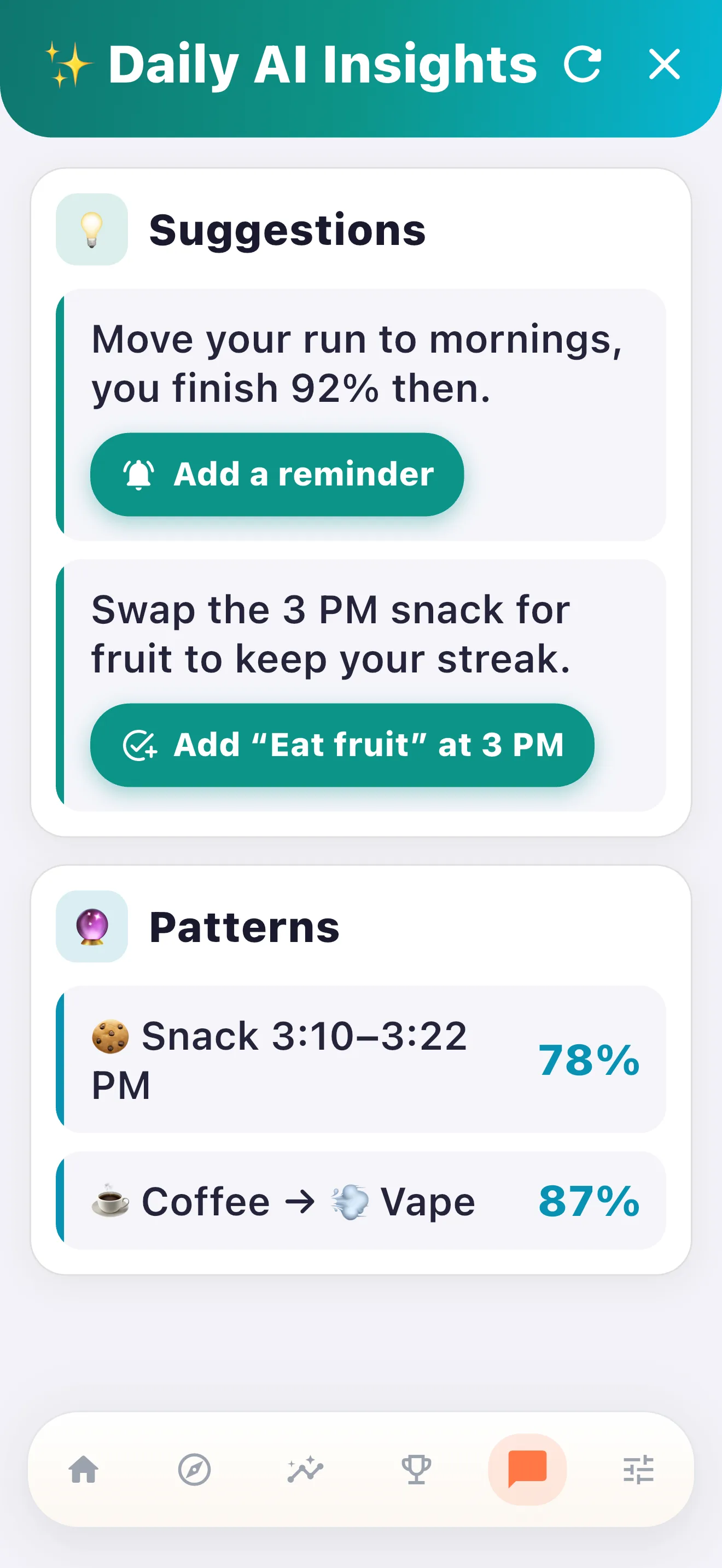
Set "dips today" as the tracked quit habit in HabitIt, the smart habit tracker, with a starting count matching your measured baseline. The journey view is built as an automatic habit plan - each day's target is sitting there when you open the app, so you're not recalculating which week you're in or whether today is a 5-dip day or a 4-dip day. You're just checking and logging.
The slip-recalibration feature is where this actually pays off. Log a count above target and tomorrow's target adjusts to one step down from what you actually did, which is the same move rule 4 asks you to make - the app just does the arithmetic for you and skips the guilt. Once a few weeks are logged, HabitIt's pattern detection can also flag which contexts your slips cluster around, so you know which staged substitute isn't holding up before it becomes a pattern.
The closest pre-built journey in HabitIt is the quit smoking plan - the taper structure is the same shape, and you can set the starting unit to "dips" and the starting count to your baseline number. A cold-turkey path exists in the app too, for anyone who prefers it. The 6-week taper exists because spreading the withdrawal out in small steps is usually easier to sit through, one week at a time. The journey builder handles the day-by-day targets, so the quit dip schedule isn't living in a spreadsheet somewhere. Use the notes field to log which substitute you used and whether the context trigger fired. By week 4 that log tells you exactly which replacements are worth keeping and which ones you're just carrying out of habit.
Common failures
The failure that outranks all the others, by a wide margin, is underestimating the oral fixation. People quit the nicotine and ignore the mouth habit, then relapse within a couple of months because the physical trigger keeps firing with no answer. The substitute is half the quit.
A close cousin of that one is buying the sunflower seeds and the gum and then leaving them in a kitchen drawer. The trigger fires at the loading dock or the back porch, wherever the habit usually lives - and if the substitute isn't within arm's reach right then, the tobacco is.
Then there's the cigarette borrowed from a friend to get through a rough craving, which is fairly common among dip users who have smokers around. It can feel like harm reduction in the moment. What it actually does is maintain the nicotine dependency while installing a second delivery mechanism with its own habit loop, a steep price for one bad afternoon. The oral substitutes exist precisely for those moments.
Timing trips people up too. Withdrawal is real and it makes stress feel worse in the short term, so a taper started during a brutal month at work stacks the irritability of weeks 5 and 6 on top of everything else. You don't have to delay indefinitely. Just go in knowing what the hard window will feel like, so ordinary withdrawal doesn't get misread as the plan failing.
And finally, cold turkey after years of daily use. Dropping straight from 8 dips a day to zero means the acute withdrawal lands at full strength all at once, which is genuinely unpleasant in a way that makes the quit significantly harder than it needs to be - plenty of cold-turkey attempts die in the first few days for exactly that reason. The 6-week taper spreads that same total adjustment out across six weeks. What's left at the end is a couple of days of feeling off, usually gone by the following weekend.
Beyond the taper
The months right after the quit are when most relapses happen. Contextual triggers, the same ones flagged earlier in this plan, keep firing with real force for a couple of months after the last dip, even though the nicotine itself is long gone. Plan on keeping the oral substitutes in place through that whole window. Day 7 is when you'll feel fine and want to drop them; our recommendation is to hold off until you're closer to the two-month mark.
Which substitutes stay and which go? Nicotine lozenges are the one that actually matters here: bring them down over roughly the same timeline the tobacco itself took, since they're still delivering nicotine even after the dip is gone. Sunflower seeds and gum can stay indefinitely, since neither is harmful. Herbal chew works too, as long as it's genuinely nicotine-free - some brands have started blending nicotine pouches into their herbal mixes, so check the label before you trust it.
There's also the quiet health payoff. Smokeless tobacco use carries measurable oral cancer and gum disease risk, and people who've quit show meaningfully better outcomes on both than people who keep using.[3] The exact timeline for smokeless tobacco specifically hasn't been mapped out as cleanly as it has for cigarettes. The tissue changes take time to reverse either way - worth remembering on day 11 of the taper when the car trigger fires for the sixth time on a Tuesday commute. If you're weighing the taper approach against cold turkey in a more structured way, cold turkey vs taper covers the evidence comparison directly. And for the broader nicotine-quit framework that applies to cigarettes as well, the cigarette taper plan is the same underlying structure adapted for the different delivery profile.
Citations
- National Cancer Institute, "Tips for Coping with Nicotine Withdrawal and Triggers." cancer.gov
- Hatsukami, D.K., Gust, S.W., & Keenan, R.M., "Physiologic and subjective changes from smokeless tobacco withdrawal," Clinical Pharmacology & Therapeutics, 1987. pubmed.ncbi.nlm.nih.gov
- IARC, "Smokeless Tobacco and Some Tobacco-specific N-Nitrosamines," IARC Monographs on the Evaluation of Carcinogenic Risks to Humans, Vol. 89. ncbi.nlm.nih.gov
Build your 6-week quit dipping plan today
Free 3-day trial of all features. After that the free tier covers the basic taper. No subscription required.


Get the Free Quit-Dipping Taper Schedule
Drop your email and we'll send a printable plan you can fill in and track. Occasional updates (max 1 per 2 weeks).
Success! Now check your email to confirm your subscription.
We respect your privacy. Unsubscribe at any time.