How to Quit Smoking Cigarettes Without Cold Turkey: An 8-Week Taper Plan

Cold turkey works for a small share of the people who try it unaided, and if you've already found that out the hard way, you don't need another lecture about willpower. A structured cigarette taper reduces both how often you light up and how much nicotine each cigarette gives you, which spreads the withdrawal curve out across weeks so no single one has to carry all of it. Below is the 8-week protocol and the pharmacology it's built on. Three specific triggers cause the bulk of relapses, and they get their own section further down. A smart habit tracker with an automatic daily plan runs the taper so the only thing you check is today's cigarette number.
Why "just quit" rarely works for smokers
Research on unaided quit attempts puts the success rate somewhere in the low single digits, commonly cited around 3-7% depending on the study. Out of every 100 smokers who decide tonight to be done by morning, only a handful are still smoke-free a year later. Most relapse inside the first week, and a large chunk of those relapse within 72 hours.
None of this makes you weak-willed. Your brain is just doing what brains do under chronic nicotine. Somewhere around a few months of pack-a-day smoking, the number of nicotinic acetylcholine receptors up in your head roughly doubles, and quitting overnight leaves all those extra receptors sitting empty and firing off alarm signals your body reads as urgency. Cravings hit first, then irritability, then a restlessness that's hard to put a name to, and for a lot of people a hollow feeling in the chest that just won't lift for the first week or two, no matter what they try.
Most quitters read those signals as a craving for a cigarette and conclude they have a willpower problem. What's underneath is a few thousand extra receptors unbinding at once and yelling for the input they're used to. It's pharmacology doing what pharmacology does.
Why cigarettes taper well
Here's the useful bit: cigarettes happen to taper well compared with most other nicotine products, and the dose curve is why. Each cigarette delivers a sharp peak of nicotine within about seven minutes, then declines over the next couple of hours as the body clears it. Your blood nicotine has natural valleys between cigarettes. Those valleys are when receptors briefly empty and start downregulating. Spacing your cigarettes farther apart, even before changing the total number, gives those valleys more time to do their work.
This is the opposite of vape pharmacology, where the constant low infusion never lets receptors clear at all. Smokers who taper tend to find the receptor side settles faster than expected, and by the later weeks the remaining fight is mostly about the ritual itself, the hand motion and the specific break in the day it fills. Cigarettes cooperate with a gradual approach in a way vapes and other constant-dose products just don't.
The three levers you can pull
Every cigarette taper combines some mix of these three controls:
- Frequency - cigarettes per day. The simplest variable to control and the one most plans focus on.
- Concentration - milligrams of nicotine per cigarette. Light and ultra-light brands are rated at 0.6-0.9 mg versus a regular cigarette's 1.0-1.5 mg. The rating comes with a real caveat: smokers often compensate for a lower-rated cigarette with deeper or more frequent puffs, which is part of why regulators pulled the old "light" labeling system. Switching still helps here, mostly because this plan pairs it with a hard daily cap, so there's no room to compensate your way back to the same total dose.
- Ritual length - how much of each cigarette you smoke before putting it out. Stopping at the last third drops daily nicotine intake by a meaningful amount, even though the count on paper stays the same.
The 8-week plan below pulls all three levers in sequence, one at a time. Pulling two at once is a common way home-made tapers stall out, since the body can't keep up with the rate of change and you end up crashing into a craving cliff somewhere around day 10.
The 8-Week Taper Protocol
What follows is a structured taper built on the receptor-adaptation principles above, scaled to a pack-a-day baseline of about 20 cigarettes. Smoke half a pack, or a pack-and-a-half? Just scale the daily caps proportionally and keep the same percentages.
Pack-a-day smokers often discover the real count is closer to 22-26 cigarettes than 20 once they log each one, since you can't taper a number you've been rounding. While you're logging, watch for the same three contexts most cigarettes cluster around: the first one in the morning, the one that follows a meal, and whichever one tends to ride along with coffee or a drink. Decide now, while nothing's on fire, what replacement habit fills each of those three windows - week 6 is a bad time to be improvising this under pressure.
Don't reduce the daily count yet, just enforce a 45-minute gap between cigarettes, which is enough on its own to force the receptor valleys described above to kick in. Oddly, enforcing the gap alone tends to drop the count a little too, since a chunk of those cigarettes turn out to be pure habit once you can't reach for one on autopilot.
Cap at 16 cigarettes per day. The morning cigarette and the post-dinner one are usually the hardest to cut this early, so keep them for now. Cut the "I'm bored" and "everyone else is" cigarettes first.
You're now at 60% of baseline, and this is usually the first week real cravings show up for real. They tend to peak in the afternoon and ease off within about five minutes if you leave them alone. Cold water on your face works for some people. A short walk or a piece of gum works for others. Pick one ahead of time so you're not scrambling to decide while the craving is already running.
You're under half your baseline now. Sleep gets weird for about five nights and then improves, noticeably enough that a lot of people mention it unprompted. The smoker's cough fades around the same time, and taste sharpens by the end of the week, salt and bitterness first.
The nicotine difference here is real even with the compensation caveat from earlier - about 0.7 mg per cigarette on lights versus 1.2 on regulars. Hold the daily cap at 8 during the switch. Don't move two levers at once.
Your daily nicotine is now down to roughly 25% of baseline, and the receptor side has done most of its rebalancing by this point. Managing what's left is mostly a habit-and-ritual problem at this stage. This is exactly where the replacement rituals from Phase 1 start earning their keep, so if you skipped picking one back then, do it this week.
You're down to three cigarettes a day now, and each one gets smoked only to the midpoint before you put it out. That shortens the ritual and drops the nicotine per cigarette to roughly 40%, while the body mostly just finishes its cleanup work in the background at this point.
Drop to one cigarette a day, typically the morning one, for four days. Then zero. The last cut is usually easier than the run-up to it feels like it'll be, since the receptor side has mostly stopped driving the process by this point. What's left by week 8 is a morning routine that no longer happens to include a cigarette.
An app that does the math
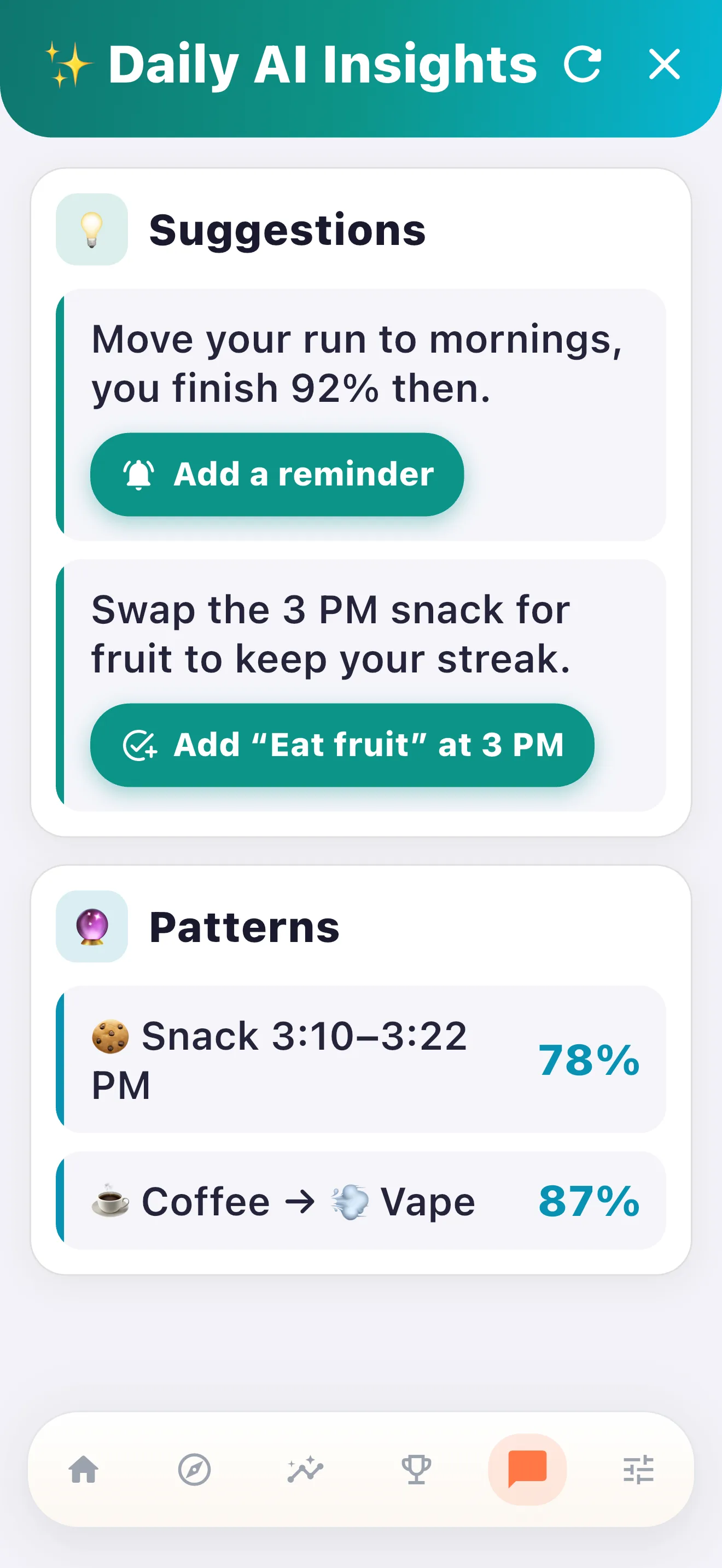
HabitIt's journey system auto-builds the cigarette taper schedule from your starting count and target quit date. It logs each cigarette in one tap and tracks the cost saved per week. It also recalculates automatically on a hard day, no streak guilt, no starting over.


The Craving Window Is Shorter Than It Feels
One of the more useful facts in any quit attempt: an unaddressed nicotine craving, one where you don't smoke and don't argue with it in your head, peaks within a couple of minutes and mostly fades within about five. In the moment it feels like it'll go on forever. It won't.
Cold water on your face and wrists helps some people ride it out, and so does stepping into a room that's a different temperature entirely. A brisk walk or a quick set of pushups works for others. A piece of strong-flavored gum works too, if you keep some within reach. What tends to backfire is scrolling your phone, since the dopamine hit can end up reinforcing the craving itself, and reaching for sugar isn't much better, since it just builds its own association with the cigarette. Arguing with the craving doesn't do much either. Telling yourself you shouldn't want it usually just makes the wanting louder. Your brain is allowed to want a cigarette, it just doesn't get to drive.
The Three Trigger Traps
Look, three specific contexts cause most late-stage relapses. Get through these three cleanly and the rest of the quit is mostly downhill.
The morning cigarette binds receptors that have been empty for 6-8 hours of sleep, which makes it the most pharmacologically rewarding cigarette a lot of smokers have all day. Replace it with a strong coffee and five minutes outside, no cigarette, every single morning of the taper. Get that smoke-free version of the morning running on its own first, before you try to pull the actual cigarette out of it.
The drinking cigarette is a harder trap, because alcohol loosens the exact part of your reasoning that's been holding the line all week. Nicotine and alcohol activate overlapping reward circuits, so a cigarette during a drink lands stronger than the same cigarette would sober. The first several social drinking events of the taper are where a lot of otherwise-successful tapers quietly fall apart. Tell one person you're tapering before you go out, and give yourself permission to leave a couple hours early if the night turns into a fight you don't want to have.
Then there's the stress cigarette. Stress is the most commonly cited reason people relapse, and the mechanism behind it is simple: cortisol makes nicotine receptors more sensitive, so a cigarette lands harder chemically right when you're least equipped to say no to it. Have a non-smoking stress release ready before the taper starts, something like a short walk or a breathing pattern you already trust. It needs to already be a reflex by week 3, or stress will win that argument every time.
The Cost Math
A pack-a-day habit in the United States runs roughly $7-12 a day, or $2,500-4,400 a year, and that's just the cigarettes. Add another $1,200-1,800 a year in higher health insurance premiums, plus lighters, gum, and the extra cleaning bills on cars and clothes, and the real total often lands well above $5,000 a year. People tend to underestimate how motivating that number is until they watch it climb day by day - for a lot of people, the quit starts feeling real right around the moment the savings tracker rolls past $100 in week 2. HabitIt's cost tracker runs that curve in real time against each cigarette you skip, which sounds gimmicky right up until you've watched it work.
When NRT helps and when it doesn't
Patches, gum, lozenges - nicotine replacement therapy comes in a few forms, all delivering the nicotine with the smoke and the hand-to-mouth ritual stripped out. A Cochrane meta-analysis of NRT trials found roughly a 50-60% bump in quit rates over unaided attempts[1]. Layer a structured behavioral taper on top of that, and you get a further real boost, even though nobody's cleanly isolated an exact multiplier for that specific combination.
The right time to introduce NRT is usually around Phase 3 (week 3-4), if your taper has stalled there. The patch delivers a steady low dose that keeps the receptor side calm while you work on the behavioral side, and then you taper the patch dose itself once the behavior is under control. A pharmacist or primary care doctor is the right person to ask about dosing specifics, since options and timing vary by health history.
Where NRT goes wrong is when people treat it as the whole plan and skip the behavioral taper entirely. The patch handles the pharmacology fine. It does nothing for the ritual side of it though: the hand-to-mouth motion, and the cigarette that shows up at every party no matter how much nicotine is already in your blood. Stop the patch and leave all of that unaddressed, and the behavior is still sitting there when the patch comes off. NRT belongs on the ranked list of non-cold-turkey approaches as a genuinely useful add-on. It rarely carries a whole quit by itself.
The same trap shows up with pouches. Quitting cigarettes by going all-in on ZYN just changes the delivery method, and the dependence rides right along with it. If that's the corner you've painted yourself into, the taper approach works there too - here's the nicotine pouch version of this plan.
What success looks like
- Week 2: the morning cough quiets down. Sleep gets noticeably worse for 4-6 nights, then noticeably better.
- Week 4: taste returns, and food starts tasting like something again. It happens gradually enough that you might not clock it until someone asks why you're suddenly finishing your plate.
- Week 6: chest tightness eases up, and walking up stairs gets noticeably easier.
- Week 12: resting heart rate drops 5-15 bpm and skin clears up. Cravings, when they show up at all, are down to less than once a day and easy enough to wave off without much thought.
- Year 1: coronary heart disease risk drops to roughly half of what it was as an active smoker[2].
- Year 10: lung cancer risk drops to roughly half of a continuing smoker's, and stroke risk keeps declining toward a never-smoker baseline over this same stretch[2].
"Quitting cigarettes runs on two different clocks - about eight weeks of biology, then six months or so of psychology after that. The taper just keeps you pointed at both of them long enough for it to matter."
Why Track a Cigarette Quit With an App
A cigarette taper is a great fit for app tracking, mostly because the unit is so clean: one cigarette, one number. You could do the math on paper and it would work fine. Where an app earns its keep is everywhere else. It recalculates automatically the day you slip, so you don't have to redo the schedule yourself. The cost-saved counter climbing toward $200 by week 4 does its own quiet motivating for a lot of pack-a-day smokers, and the time-since-last-cigarette counter turns the next cigarette into a conscious decision each time.
You will slip somewhere in the 8 weeks. Almost everyone does, and the tool you want is one that doesn't treat a bad day like the whole project collapsed. If you've been looking for a quit smoking taper app, a cigarette reduction tracker app, or just a gradually quit smoking app that handles day-by-day adjustment without demanding overnight perfection, HabitIt's journey system rebuilds tomorrow's plan from wherever you landed today. A slipped day costs a few days of progress and nothing more than that.
Build your cigarette taper plan today
Free 3-day trial. After that the freemium tier covers your full quit journey. No ads, no streak guilt.
Get the Free Quit-Smoking Taper Plan
Drop your email and we'll send a printable plan you can fill in and track. Occasional updates (max 1 per 2 weeks).
Success! Now check your email to confirm your subscription.
We respect your privacy. Unsubscribe at any time.
Want the app to do the scheduling? HabitIt builds you a quit smoking habit tracking plan that cuts your daily count and recalculates when you slip.
Citations
- Hartmann-Boyce, J., Chepkin, S.C., Ye, W., Bullen, C., & Lancaster, T., "Nicotine Replacement Therapy Versus Control for Smoking Cessation," Cochrane Database of Systematic Reviews, Issue 5, Art. No. CD000146, 2018. cochranelibrary.com
- U.S. Department of Health and Human Services, "Smoking Cessation: A Report of the Surgeon General," 2020. cdc.gov