How to Stop Snacking: A 30-Day Reset Plan
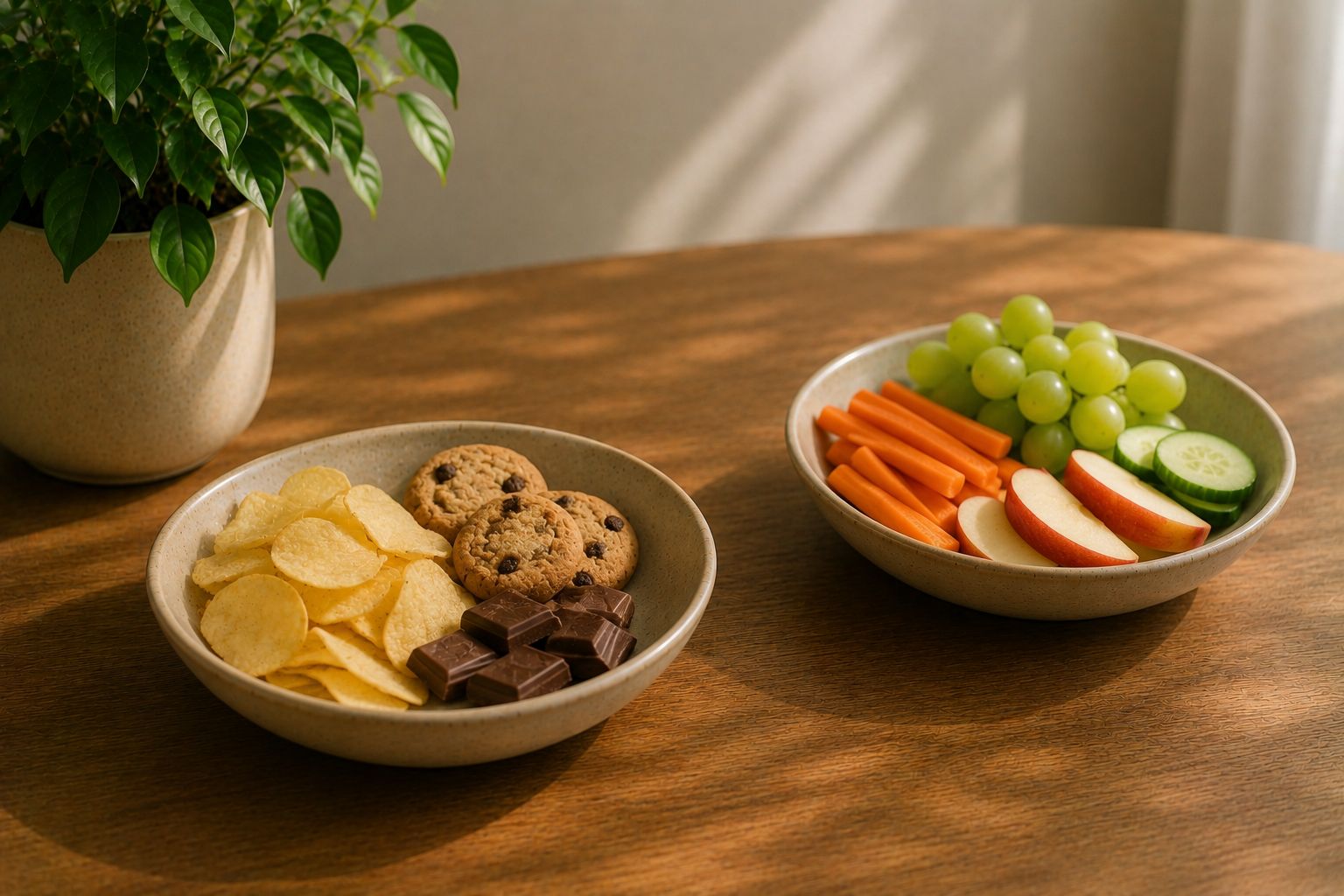
You finished lunch at 1pm. By 2:30 you were standing in front of the kitchen counter eating a handful of trail mix you didn't decide to eat, while watching something on your phone. At 4pm you opened a granola bar at your desk during a Slack message. At 9pm you brought a bowl of chips to the couch. You weren't hungry at any of those moments and you'd answer "I don't really snack that much" if anyone asked. Most snacking isn't a willpower failure or a hunger problem. It's a habit that piggybacked onto your screens and your unstructured afternoons, and breaking it takes a structural reset, not more discipline.
The pattern you already know
The snacking habit usually looks like this: three or four small "I'm not really eating" moments scattered across the afternoon and evening, almost always paired with a screen. You're watching something while you eat the chips. You're on your phone while you eat the granola bar. You're scrolling Reddit while you eat the leftover halloween candy at 10pm. The eating is almost incidental to the screen activity; your hand is moving food to your mouth and your attention is somewhere else entirely. By the time the bag is empty you don't remember actually tasting most of it.
This is exactly why willpower-based "I just won't snack" approaches fail. The behavior isn't conscious; your hand is reaching for the food before your mind weighs in. You can't will yourself out of a reflex that happens below the level of intention. What you can do is interrupt the cue: the screen, the unstructured time, the access to easy food, the empty stomach from a too-light meal. Break the cue and the reflex doesn't fire. The plan below interrupts cues in the order they matter.
This isn't a calorie-counting plan or a no-sugar challenge. The goal isn't to perfectly never eat between meals; it's to make snacks conscious choices instead of unconscious reflexes. After 30 days, most people who hold the plan are at 0-1 snacks a day on most days, and the few they have they actually wanted and remember tasting. The cut sugar plan is the related project; running them in parallel is reasonable but harder.
Why "I'm going to stop snacking" attempts collapse
Three reasons, in order:
1. The meals are too light. Most chronic snackers are under-eating at actual meals. Breakfast is a granola bar; lunch is a salad; the body responds with 3pm hunger you interpret as "afternoon snacks are normal." Fix the meals first and the snacks often half-disappear without effort. Three real meals with real protein and fat will get you from one meal to the next without the snack reflex firing.
2. The screen IS the cue. Hand-to-mouth eating is paired with hand-to-screen scrolling almost universally. When the screen comes on, the snack reflex fires. The fix isn't to stop the screen; it's to stop eating in front of the screen. All food at the table, no exceptions. This single rule, held for a month, cuts snacking dramatically because most snacking required the screen-mouth pairing to happen at all.
3. The snacks are visible. If the chips are on the counter, you'll eat the chips. If the granola bars are at eye level in the pantry, you'll grab one. Stocking willpower-test snacks in convenient places guarantees the snack will be eaten on every willpower-poor afternoon. Hide them, donate them, or stop buying them entirely. Out of sight is not perfect but it's most of the way there.
The plan handles all three by force.
The 30-Day Plan
This assumes a baseline of about 4 snacks a day (a fairly heavy snacker). If you're at 2-3, run it over 3 weeks instead of 4. If you're a binge-snacker who eats 6+ episodes in a single sitting, the structural problem is deeper and the replacement-habits framework is the right prior post to read first.
Three meals means breakfast with protein, lunch with protein and fat, dinner that's actually a dinner. The snacks-cap matters less than the meals-floor; if the meals are right, the snack cravings drop on their own. The cap at 3 is half-credit work. Track each snack honestly: time of day, where you were, what you were doing. This data is what week 2 uses. Most people are surprised to find 70% of their snacks happen at three specific times (mid-afternoon, post-work transition, late-evening couch).
The screen-eating rule is the load-bearing change this week. From day 8 onward, food is only consumed at a table (kitchen, dining, even a desk that's not actively being scrolled). The TV is off. The phone is face-down or in another room. If you want to eat the chips, you bring them to the table, sit down with them, and eat them while doing nothing else. Approximately 60% of habitual snacking does not survive this rule because the snack was never really wanted; it was the screen-mouth pairing firing.
At breakfast, you decide what your one snack will be and when. The decision happens with a clear head, not at 3pm when you're tired. The pre-committed snack is the only one allowed. For any other craving, you wait 20 minutes; about 80% of cravings fade in that window because they were boredom or thirst, not hunger. If you're still genuinely hungry after 20 minutes, drink water first, then if still hungry, you've already eaten today's allowed snack so you reach for fruit (which isn't on the snack count). Most snackers find by mid-week 3 they don't even want the planned snack and skip it without effort.
The sustainable cruising altitude. Snacks become a deliberate occasional thing (a piece of dark chocolate after dinner, a real treat at a coffee shop) rather than a daily pattern. The chip-bag-while-scrolling habit is fully unwound. Three real meals carry you through the day. The thing to watch this week is the false-confidence trap: you feel great, you "earned" a couple snacks at the office, you re-pair eating with screen-time "just on weekends," and the whole pattern slowly reassembles. Hold the rules at week 4 to lock in the new default.
The Four Rules That Make It Stick
1. Food at the table, every time. The single most important rule on the list. The screen-mouth pairing is what drives most chronic snacking; breaking it does most of the work. No food at the desk while working, no food on the couch while watching, no food in bed while scrolling. If you want the food, you sit at a table and eat the food. The doomscrolling post covers the screen side of this; food is the other side of the same coin.
2. Three real meals, not three light ones. Under-eating at meals creates 3pm hunger that drives snacking. A salad for lunch is not a meal; a salad with chicken and avocado and a slice of bread is a meal. Protein + fat + fiber, three times a day, makes the snack cravings drop on their own. People who try to "lose weight" by under-eating at meals end up netting more calories from snacks; the math is brutal but consistent.
3. Don't buy the test foods. The willpower battle starts at the grocery store, not at 3pm. Chips, cookies, processed snacks: don't bring them home. The kitchen is willpower-poor by 3pm; the grocery store is willpower-rich by Saturday morning. Make the decision when willpower is high. If you don't buy it, you don't eat it. The replacement-habits framework applies - keep fruit and nuts visible, hide everything else.
4. The 20-minute craving rule, every craving. A real hunger doesn't fade in 20 minutes; a habit craving does. When a non-mealtime urge to eat hits, drink water first, then wait 20 minutes. About 80% of cravings disappear in that window because they were boredom, thirst, low-grade anxiety, or screen-mouth pattern firing. The ones that survive are real hunger, and those get a planned snack or a real meal earlier than usual.
Running the Plan With an App
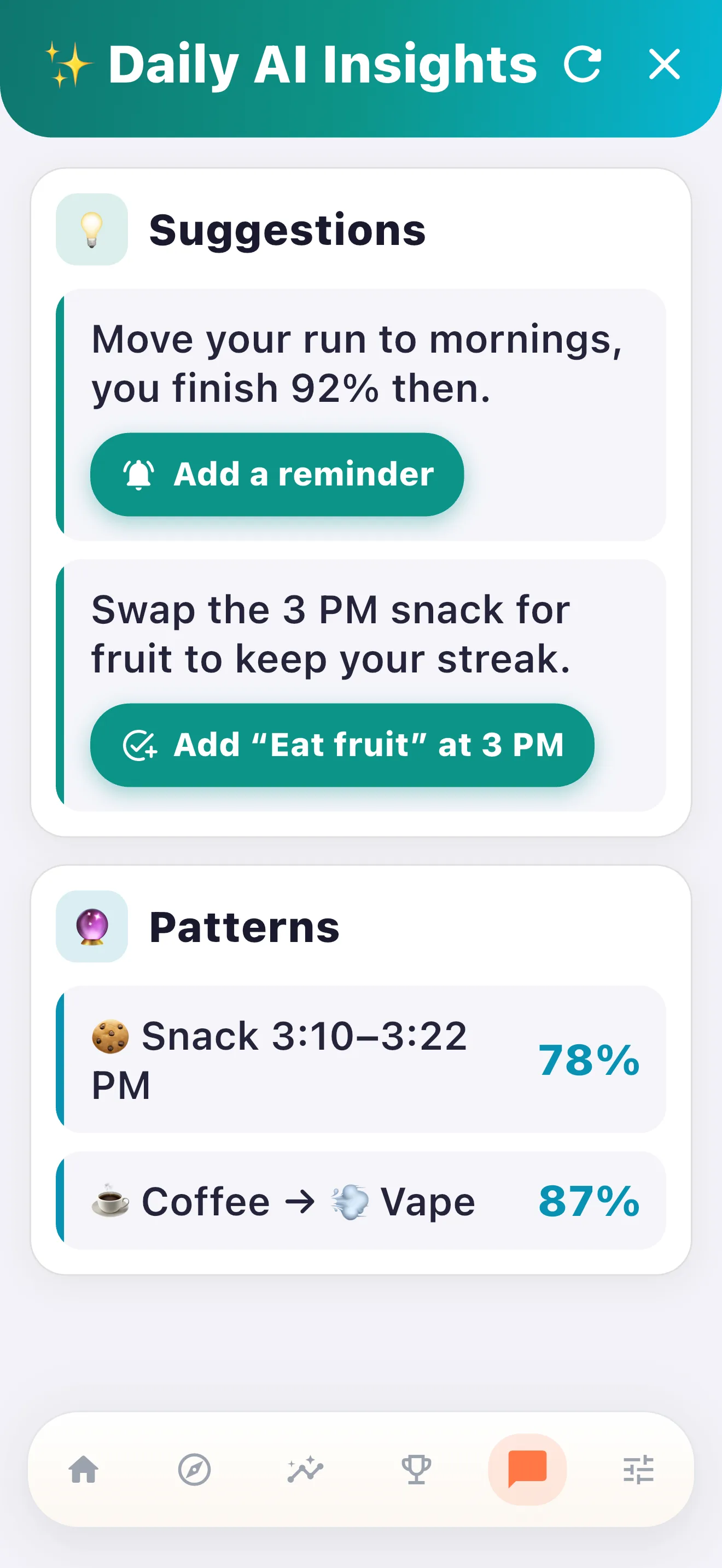
You can absolutely track this on paper with a daily snack tally. The reason paper tracking for snacking specifically tends to fail is that snacks are often unconscious, so by the time you remember to log it's tomorrow morning and the data is unreliable. A phone tracker with one-tap log captures snacks in real-time, which is when the data is accurate. Logging the snack itself also adds a 3-second pause before eating it, which catches maybe a quarter of the snacks you would have otherwise eaten on autopilot.
Three things to look for in whatever you use. One, can you log daily snack counts with a clear weekly cap that steps down (3, 2, 1, 0-1)? Two, does it tolerate a slip without zeroing your streak, because the all-or-nothing reset is corrosive for food habits? Three, can it remind you of the 20-minute rule at the times you usually snack (mid-afternoon, post-work, late evening)?
If you're searching for how to stop snacking, a stop snacking app, or a 30 day no snack plan, HabitIt was built around exactly this kind of structured behavior reset. You can build a stop snacking automatic habit plan in about ten seconds, free, no signup.
Five Ways the Plan Still Falls Apart
"Healthy snacks" loophole. Almonds and a granola bar are still snacks. Most snackers who try to switch to "healthy" snacks just maintain the same eating frequency with different foods, and the habit reflex stays intact. Snacks count regardless of nutritional value. If you genuinely need fuel between meals, the meal is too small.
Drinking smoothies and protein shakes between meals. Same problem as healthy snacks. A 400-calorie smoothie at 3pm is a meal you've labeled as a drink to avoid counting it. If it has calories and you consumed it between meals, it counts. Drink water between meals.
Eating at the table but still with the phone. The table rule doesn't work if the phone is on the table. The screen is the cue, not the location. Phone in another room while eating. If you can't eat without your phone, that's the diagnostic that the habit is screen-driven and the phone-off rule is doing the actual work.
Quitting in December. Holiday food environments make this plan brutal. The kitchen is full of test foods, the social context normalizes constant grazing, and meal timing falls apart. Pick a four-week window outside November-December. The plan can absolutely include planned holiday meals; it just shouldn't START in the worst month of the year.
Treating one slip as full failure. You ate the chips at 3pm. That's one slip. The next day resumes the plan. The all-or-nothing reset is what makes most food-habit attempts collapse around the first social event. The restart logic applies the same way it does to any other habit.
Beyond day 30
The first 30 days break the cue. The next 30 build the new default. Around day 50 you'll notice you stopped reaching for snacks at the times that used to be automatic. Your relationship with the kitchen has changed; food is for meals, not for ambient browsing. Most users report sharper afternoon energy (no sugar-crash from the 3pm granola bar), better sleep (no late-night couch eating), and a clearer sense of when they're actually hungry versus just bored. Most also drop 4-8 pounds in 90 days without intentionally tracking calories.
The deeper effect is that the snack-on-autopilot pattern was probably eating 400-700 calories a day you weren't experiencing as food. Removing it doesn't feel like deprivation because you weren't really enjoying those calories in the first place; you were eating them while looking at a screen. People who hold this plan for a year describe an almost embarrassing feeling at the end: "I can't believe I was eating that much without noticing." That's the diagnostic that the habit was real, the calories were real, and the reset worked. The cut sugar plan is a natural next move if you want to keep tightening the food side without going extreme.
Build your stop snacking plan today
Free 3-day trial of all features. After that the free tier covers the basic taper. No subscription required.


Get the Free 30-Day Stop Snacking Plan
Drop your email and we'll send a printable plan you can fill in and track. Occasional updates (max 1 per 2 weeks).
Success! Now check your email to confirm your subscription.
We respect your privacy. Unsubscribe at any time.