How to Stop Stress Eating: A 30-Day Reset

Stress eating has almost nothing to do with hunger - if you were hungry, a glass of water would take the edge off. What's running is a coping loop. Stress arrives, the brain reaches for the thing that worked last time (food), the stress drops for a few minutes, and the loop gets reinforced. The plan below never asks you to ban food or grind through on willpower. It interrupts the loop at the trigger point, swaps in a coping behavior that also works, and repeats that often enough for the new response to become the automatic one. Thirty days. Four phases. No calorie counts.
The pattern you already know
The 3pm slump hits, or the work email lands badly, or you cross the threshold into your apartment after a brutal day and the first thing you do - before you even put your bag down - is open the kitchen cabinet. You weren't hungry at 2:45pm and you're not hungry now. But there's this specific "I just need something" feeling that has nothing to do with your stomach.
That feeling is the stress-eating trigger, and it fires reliably in specific contexts - usually a certain time of day, a certain kind of stressor, or a transition like the end of work, the end of a hard phone call, or late at night when the day's debris piles up. What you're after is the brief window of relief that eating delivers while you're doing it. The food is just the delivery mechanism. The stress activates the loop, the loop delivers temporary relief, and that relief is real enough to reinforce the behavior every time. Which is why willpower doesn't touch it.
The weird part is you often feel worse immediately after - which creates a secondary loop. The stress eating generates guilt, and that guilt is itself just more stress feeding the same loop back into a craving. If you've ever eaten something, felt bad about it, and then eaten more, that's the secondary loop running. From the inside it reads as a character flaw. Under the hood it's a behavioral loop that never got interrupted.
Actual hunger behaves differently. It builds gradually, it'll settle for almost any food, and it goes away once you eat. Stress eating shows up out of nowhere, usually when your stomach has no complaints, and it wants one specific thing - almost always something high in salt, fat, or sugar. Elevated cortisol specifically increases the pull toward that category of food.[1] Being full doesn't reliably shut it off either. The signal underneath is a request for relief from a source the brain already trusts.
Willpower-based attempts fail because they try to break the loop by denying the destination. But the pressure is still there, the trigger still fires, and eventually the restriction snaps. You need a new destination. A lock on the kitchen door just concentrates the pressure behind it.
Why most attempts fail
1. Treating it as a food problem. Restricting the food without touching the stress state means the pressure builds until the restriction breaks. You probably know this already - you've eaten a salad at lunch and still torn through half a bag of chips at 10pm, because the stressor driving the behavior was fully intact the whole time. What stops stress eating is a replacement coping behavior. Diet rules just give you a second thing to fail at.
2. Going too broad. A blanket resolution to stop stress eating loses to the pattern every time, because the pattern is specific and the resolution is fog. Most stress eating patterns are anchored to 2-4 contextual triggers, and until you can name yours there is nothing concrete to interrupt. The audit week at the start of this plan exists to hand you that data before you try to change anything.
3. Shame as the intervention. Feeling bad after a stress-eating episode doesn't reduce the behavior. It often increases it - guilt is itself a stressor, and stress hormones are exactly what drives the pull toward the same food in the first place.[1] The natural response to a bad night is a wave of self-criticism that feels like accountability and functions like fuel. Self-monitoring without judgment is harder than it sounds, and it is the actual mechanism here. Treat the log like archaeology.
The 30-day plan
Every time an episode happens, write down the time, what set it off, what you ate, and where your stress sat on a 1-10 scale. The goal is a map of your specific trigger loop before you try to interrupt it. Don't judge the entries or try to eat less yet. Just observe. Expect to land on 2-3 main trigger contexts - usually one around a specific work pattern, one at a specific time of day, and one tied to an emotional state like loneliness, irritation, or overwhelm. By day 7 you'll be able to name them.
A healthier snack doesn't count here. You want an actual alternative to eating - a 5-minute walk, or three deep breaths and a 2-minute pause, or a glass of water plus a deliberate 5-minute check of something unrelated (your inbox doesn't qualify). Prepare it in advance and make it available in the context where the trigger fires. If your main trigger is the 3pm slump at your desk, the replacement has to be something you can do at your desk at 3pm. The week 2 rule is simple. When the trigger fires, run the replacement for 5 minutes before anything else. If you still want to eat after those 5 minutes, eat.
For every trigger, log whether you did the replacement, whether you ate anyway, and how stressed you felt afterward. This week is hard because the replacement feels insufficient compared to food. That's expected - food has been the coping tool long enough to have a real pharmacological edge, and the 5-minute walk doesn't drop cortisol as fast as chips do. The goal this week is the behavioral loop itself, built even imperfectly. Relief catches up later. Every time you do the replacement first (even if you still eat after), that's a rep. You're building a new groove in the same spot where the old one is worn deep.
Which ones did you skip or abandon mid-attempt? Abandon the replacements that never held up in real conditions and double down on the ones that did. The 5-minute walk that you did 5 out of 7 days is infinitely more valuable than the meditation app you opened once. By now the pause-before-eating is getting shorter before it becomes automatic for at least one of your trigger contexts. Close the month by identifying which one trigger context is still unresolved - that's next month's work. One at a time is fine - that's how this works.
The four rules
1. Log the episodes without judgment. The log is a data tool, not a shame record. An entry that says you ate the whole bag of chips at 11pm is useful - it tells you where the 11pm trigger lives and what context produced it. Quit logging because it feels bad and you lose the data, and the data is everything in this plan. Without it you're fighting a shape-shifting opponent in the dark, and that's not a contest you win.
2. Replace, don't restrict. Every time you successfully do the replacement before deciding whether to eat, that's a win - regardless of what you eat after. The behavior you're building is the replacement itself. After enough reps it starts to satisfy the coping need on its own, without the food following it, but that takes the full first three weeks and the sequence matters. Establish the replacement before you worry about the food at all.
3. Address the stress underneath. If the stress eating is anchored to a single structural stressor - a job that's genuinely too much, a depleting relationship, a living situation with no room to decompress - the plan will reduce the coping behavior but it won't eliminate the pressure that drives it. Stress eating is a symptom. The plan treats the symptom and that's genuinely worth doing - but the underlying stressor still needs attention on a longer timeline than 30 days.
4. A slip is data. You stress-ate on day 16. Write down what triggered it and what replacement you would have done instead. The plan doesn't reset. The slip becomes the next lesson - specifically, it usually points at a trigger context that wasn't fully covered in your Week 1 audit, or a replacement behavior that doesn't work in that context. Fix those two things and keep going from day 17.
Running the plan with HabitIt
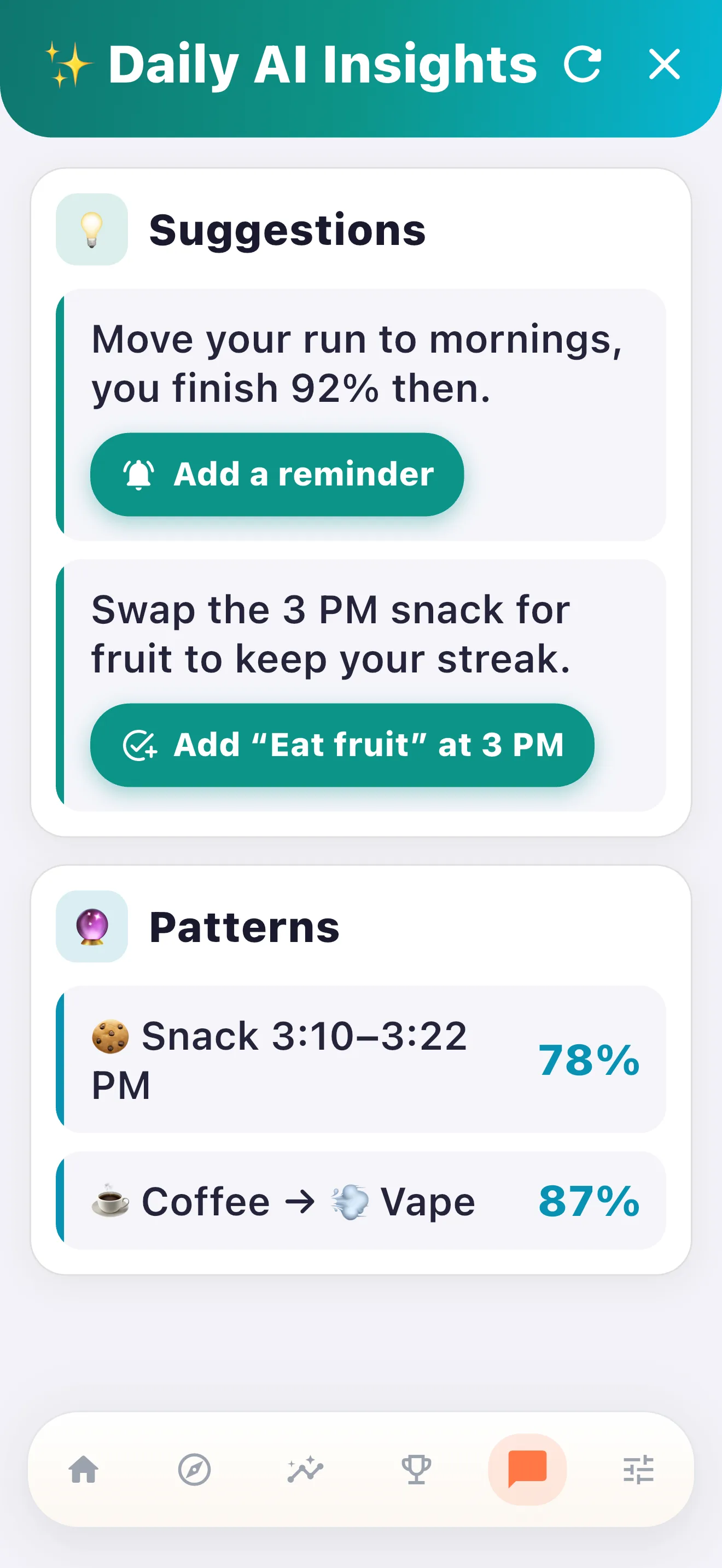
Set "stress eating episode" as a tracked quit habit in HabitIt, the smart habit tracker, with a starting count of however many episodes per week your audit reveals. It builds an automatic habit plan that steps the daily target down gradually across the month, which looks like a diet from the outside but is really a measurement - the step-down only holds if the replacements are doing their job. Log the trigger context in the notes field every time you complete (or skip) the replacement, and once a few weeks are in, HabitIt's pattern detection can flag which contexts your episodes cluster around, so you're not pattern-matching from memory alone.
The journey view is what makes the 30-day structure visible. You can see at a glance whether week 3 is trending better than week 2, which is exactly the kind of feedback that gets the replacement done at 3pm. Vowing to try harder tomorrow is easier, but tomorrow doesn't have a target. Today does.
HabitIt's stop snacking plan is the closest pre-built journey for this - you can customize the trigger tracking from there. If your episodes cluster at night, set the tracking window to evenings and use the notes to log what the day looked like before the episode. The pattern usually emerges within a week. Across the full 30 days, the quit journey's gradual step-down keeps the daily target front-of-mind without turning the log into a food diary. And when you do slip, the recalibration feature adjusts tomorrow's target - most apps would zero your streak and call it a day.
Common failures
The biggest one has come up twice already because it deserves it: restricting the food and skipping the replacement. The restriction-and-snap cycle is why so many people conclude they have no willpower around food. The willpower was fine. It was pointed at the wrong lever the whole time.
The log has its own failure mode. Record only the bad episodes and it turns into a shame document you quietly stop opening. Log the wins too - a trigger that fired and got answered with the walk instead of the food - because those are the entries that show you which replacements work.
Context mismatch kills more replacements than lack of effort does. A 20-minute meditation is a fine coping behavior and a useless one in an open-plan office at 3pm, while taking the long way to the bathroom and breathing for 2 minutes works almost anywhere. Match the replacement to the environment where the trigger fires, and be honest about what you'll do in front of coworkers.
Skipping the audit week feels efficient and quietly wrecks everything downstream, because you end up picking replacements for triggers you haven't fully identified yet. This is why generic advice like drinking water when you're stressed keeps failing people - it might be the right replacement for one of your triggers and completely wrong for the other two.
And then there's week 3. It is consistently the hardest week in this type of plan - the novelty of the new behavior has worn off and the new loop hasn't established itself yet, so a bad stretch here reads like proof the whole thing is broken. It's expected. Hold the structure and check week 4 before drawing conclusions.
Beyond 30 days
Something does shift after 30 days, though the stress itself is still there and the triggers still fire. What changes is the gap between the trigger and the food. It starts at zero, with the hand reaching for food in the same second the trigger fires, and by day 30 it's usually 2-5 minutes for the triggers you've actively worked on. The replacement lives inside that gap, and with more reps the pause stops feeling like a pause at all.
The underlying coping need is a different story. Stress eating exists because stress is real and your nervous system needs somewhere to put it, and the 30-day plan only changes which behavior receives it. If you plateau in month 2, it usually means a new trigger context has appeared that wasn't in your original audit (a new job stressor, a change in your living situation, a seasonal pattern you haven't seen before). Repeat the audit week for the new context and build a replacement specifically for it.
The longer game is that by month 3 the replacement behaviors have started to address the stress more directly - walking drops cortisol, deep breathing activates the parasympathetic system - so the coping itself is improving and the displacement was just the opening move. The 30 days gets that started but doesn't complete it on its own. For the food side of this - particularly breaking the junk food craving cycle that stress eating usually runs on - the junk food quit plan picks up where this one leaves off. And for the snacking specifically (different pattern from stress eating, but they often overlap), how to stop snacking between meals covers the environmental design side that this plan doesn't.
Citations
- Dallman, M.F., et al., "Chronic stress and obesity: A new view of 'comfort food,'" Proceedings of the National Academy of Sciences, 100(20), 2003, 11696-11701. pnas.org
Build your 30-day stress eating reset plan
Free 3-day trial of all features. After that the free tier covers the basic taper. No subscription required.


Get the Free Stress Eating Trigger Log Template
Drop your email and we'll send a printable plan you can fill in and track. Occasional updates (max 1 per 2 weeks).
Success! Now check your email to confirm your subscription.
We respect your privacy. Unsubscribe at any time.