Why Cold Turkey Fails for Quitting Vaping (And What Actually Works)
Somebody told you to just stop vaping, so you did, and by day two you were miserable enough to buy a new pod at the gas station. That's not a character flaw. Your brain built a physical dependency on nicotine, and physical dependencies don't care how much you meant it this time. Below is a schedule built around that biology instead of against it, plus the reasoning behind each step. A smart habit tracker with an automatic daily plan runs the puff-step-down so withdrawal stays mild.
The 95% failure rate nobody talks about
Most of the hard numbers on unaided quit attempts come from cigarette research, not vaping specifically, and they land somewhere in the low single digits, commonly cited around 3-7%. Nobody's run the exact same study on vapes yet. But the receptor biology underneath both habits is the same, and as you'll see below, vaping's dosing pattern might make the unaided version even harder to pull off. Ask around and you'll hear the same story on repeat: quit cold turkey on a Monday, buy a new pod by Thursday, sometimes by Tuesday. This comparison digs into the fuller picture across substances if you want it, including where the research on tapering versus cold turkey gets genuinely murky.
Nicotine binds to receptors in your brain, and chronic exposure drives those receptors to multiply, with some studies showing several-fold increases within just weeks of regular use[1]. Quit overnight and all those extra receptors sit empty, and they get loud - cravings and irritability tend to show up first. Anxiety usually follows, and for a lot of people it settles into a hollow feeling in the chest that won't lift no matter what you try.
That craving gets misread constantly as "I really want to vape," filed away as a discipline problem. What's happening underneath is thousands of receptors going unbound at once, all demanding their usual input at the same time. Discipline has almost nothing to do with it; the receptors don't know what a New Year's resolution is.
Why Vaping Is Often Harder to Quit Than Cigarettes
Here's a number that surprises people: a pack-a-day cigarette habit works out to somewhere around 16-24 mg of nicotine a day. A heavy vape habit can land anywhere from 10 mg up to 60 mg, depending on the pod strength and how many puffs you're taking a day (200 to 600 isn't unusual). So the "vaping is basically the same as smoking" line people repeat can be wildly off in either direction, and on the high end, it's not close.
The shape of the curve matters even more than the total dose. A cigarette gives your brain a spike, then a real trough, then another spike a while later. A vape barely gives you a trough at all, since the next puff is always a few seconds away if you want it. Nicotine never gets the chance to drop low enough for receptors to clear, so a smoker's brain gets the up-and-down rhythm it can adjust to, and a vaper's brain sits in something closer to a flat, constant hum.
That's the part your well-meaning friend who quit cigarettes doesn't get when they tell you to just push through it. Their receptors had somewhere to come down to between hits. Yours haven't had that luxury in however long you've been vaping.
The Nicotine Taper Protocol
The protocol below takes those same receptor-adaptation principles and applies them to e-cigarettes specifically. It works on the same idea as a caffeine taper: drop dose slowly enough that receptor downregulation can keep up with the reduction.
A vape taper really runs on three levers, and the protocol below pulls them one at a time on purpose. Frequency, plain puffs per day, moves first because it's the easiest lever to track and the fastest to feel working. Concentration (the mg/mL strength of the juice) and session length (how many puffs land in one sitting) do the finer work later, once frequency has already come down.
Plenty of disposable vapes have indicator lights that blink per puff, or you can count manually for one full day and extrapolate from there. The number that comes back is almost always 30-50% higher than whatever you guessed going in. While you're counting, pay attention to when the puffs cluster: the morning drive is the classic trigger, though for plenty of vapers it's the post-meal puff instead, or a boring stretch of TV or scrolling that somehow always ends with a puff in hand. Whichever one is yours, that's the window where reduction will hit hardest, and where replacement habits matter most.
If your baseline is 400 puffs a day, cap it at 320. Use whatever counter is already in your pocket, a phone tally or HabitIt's quick-log both work fine, and stop the moment you hit the cap. Sessions stay the same length; you're just stopping sooner in the day.
This is the first week real cravings tend to show up, usually in the afternoon. They pass faster than they feel like they will (more on that below). Cold water on your face works well here. A short walk or a handful of ice to chew on works too, if splashing your face isn't practical wherever you are.
You're now at less than half your baseline. Frequency is doing most of the work at this point, since your brain has already started pruning receptors. Sleep gets weird for about five nights, then improves noticeably.
Disposable vapes come in multiple strengths, and switching down is the same move as going from full-cream to skim milk in your coffee taper: you keep the ritual and drop most of the drug. Hold the puff cap at 160 a day during the switch and don't reduce both axes at the same time.
Your nicotine intake is now down to about 25% of baseline, and the receptors have largely normalized. What's left at this point is mostly psychological: the hand motion and the small pause it gives you. A replacement ritual, chewing gum or a short walk, earns its keep here.
Some refillable pods come in 0% nicotine but keep the same flavor and throat-hit, which lets you keep the ritual while dropping the dose entirely. If a 0% device leaves you unsatisfied, that's a sign it's still the nicotine you're chasing. Step down to 1.5% instead as a bridge.
The variable now shifts from puffs to sessions per day. Six sessions the first few days, then four, then two, then just a morning one, then none at all. The last cut is usually the easiest, since the brain hardware has mostly stopped driving the process by this point.
An app that does the math
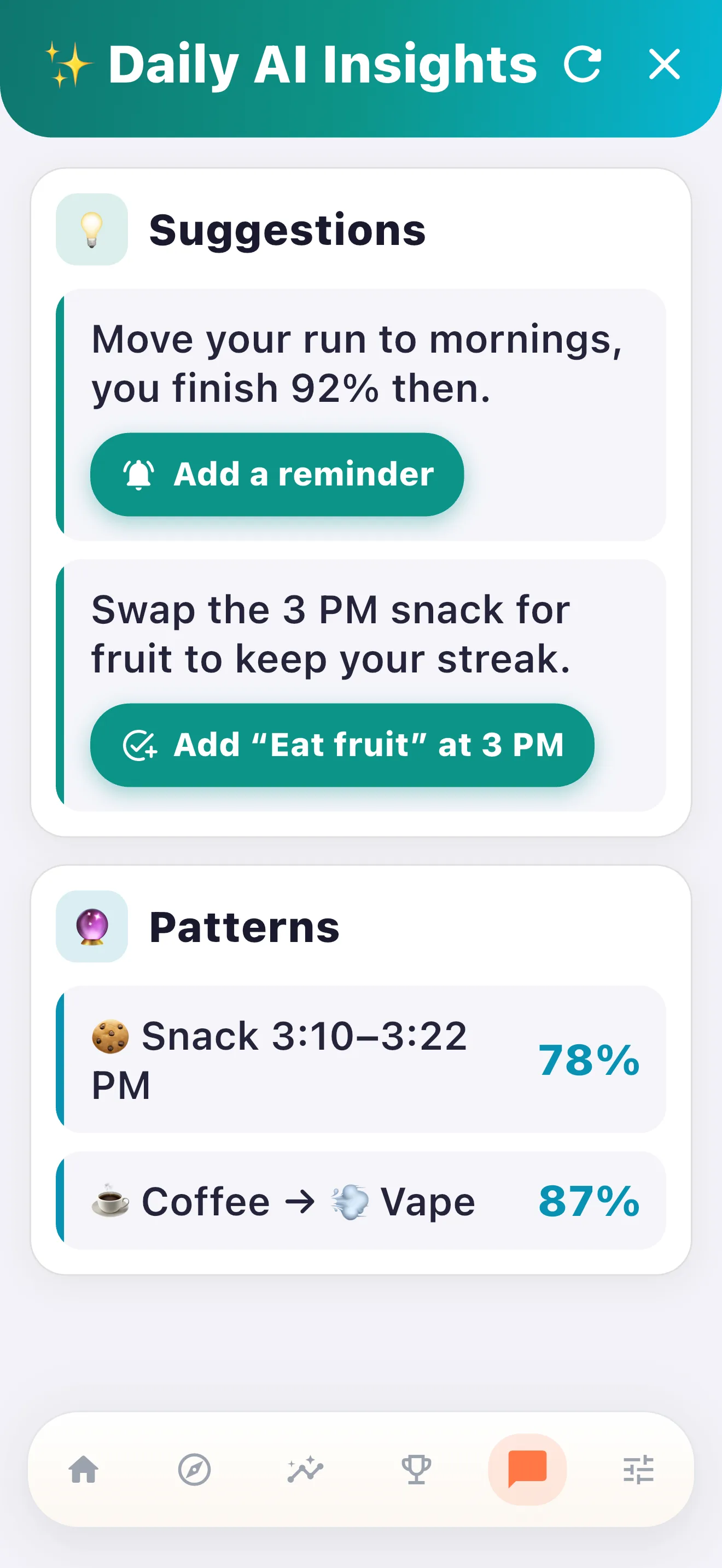
HabitIt's journey system auto-builds the taper schedule from your starting puff count and target end date. It logs your daily total in one tap and recalculates when you have a hard week. No streak guilt.


The Craving Window Is Shorter Than It Feels
Nicotine craving research consistently finds that an unaddressed craving, one where you don't vape and don't engage with it mentally, peaks within a couple of minutes and fades within about five. In the moment it feels endless, which is exactly the trick of it, since five minutes is roughly the length of a phone call you'd forget having by tomorrow.
Cold water on your face and wrists helps a lot of people ride it out. So does a brisk walk, or just a quick set of pushups if you're somewhere you can do them. Calling someone works too, mostly because it moves your attention somewhere else entirely, and stepping outside into a different temperature does something similar. Doomscrolling tends to backfire, since the dopamine hit can end up reinforcing the craving itself, and so does reaching for sugar, which builds its own association with the craving right alongside it. Arguing with the craving doesn't do much either; it's allowed to be there, you just don't have to act on it.
The Friday Night Problem
A lot of vape relapses happen at social events with alcohol. Alcohol on its own lowers inhibition enough to make the decision easier, and watching everyone else vape all night doesn't help either, especially given how much nicotine and alcohol already lean on the same reward pathway in the brain. The first several weekend events of a taper tend to be where relapse risk peaks, by a wide margin.
A few things help. Planning the replacement before you arrive helps a lot, since a specific drink in your hand prevents the idle hand-to-mouth motion that usually triggers a vape in the first place. Telling one person you're tapering gives you a witness, and that alone changes how the night goes. On the early weekends, leaving around the two-hour mark helps too, since hour three is typically where things start to slip.
When to Use Nicotine Replacement Therapy (NRT)
Patches and gum deliver nicotine straight into the bloodstream or through the cheek lining, no inhaling required, and lozenges work about the same way. They're useful when your taper stalls, usually somewhere around the 30% mark, because they let you decouple the chemical dependence from the behavioral ritual. Hold a patch dose steady while you eliminate the behavioral pattern, then taper the patch itself.
A pharmacist or primary care doctor is the right person to ask about dosing specifics for this. A Cochrane meta-analysis of NRT trials found roughly a 50-60% bump in quit rates over unaided attempts[2], which is a real enough effect to be worth the conversation. Pairing NRT with a structured behavioral taper adds a further real boost on top of that, though the research doesn't cleanly isolate one exact multiplier for that specific combination.
A lot of people don't fully quit nicotine; they relocate it, and the most common landing spot right now is pouches. If you've already swapped your vape for ZYN, the taper logic here still holds, just measured in pouches. We wrote a separate walkthrough on quitting nicotine pouches if that's where you've ended up. The same step-down logic also works for tapering off weed, which a lot of people pick up after quitting vaping for the evening wind-down and then need a separate plan for a year later.
What Success Looks Like
Sleep is usually the first thing to notice, and it gets rough before it gets better: expect four to six bad nights around week two, then a real improvement after that. By week four the morning cough tends to disappear, and food slowly starts tasting like something again, a change that's easy to miss while it's happening and obvious in hindsight once it's done. Chest tightness that built up quietly over months of vaping tends to ease off by around week six.
Resting heart rate is usually down 5-15 bpm by week twelve. Skin looks clearer around the same time, and cravings have dropped to less than once a day, easy enough to ignore when they do show up. Give it six months and the dopamine baseline has mostly rebalanced; idle moments stop asking for anything.
"Quitting nicotine runs on two different timelines: about 90 days for the biology, six months or so after that for the psychology. The first one is easy to plan for; the second one sneaks up."
Why Track a Vape Quit With an App
A vape taper is a good fit for app tracking because the unit, puffs or pods, is countable and the schedule is mathematical enough to automate. A spreadsheet can handle that math well enough on its own, and it can even remind you to log if you set an alarm for it. What a spreadsheet won't do is total up the money saved as you go (HabitIt's cost tracker often shows quitters $200-$500 saved by week six) or rebuild tomorrow's plan the moment a slip happens instead of just sitting there broken.
You will slip at some point, almost everyone does, and you want a tool that doesn't treat that like the whole project just collapsed. If you've been searching for an honest comparison of the apps built for quitting vapes, or a nicotine taper app that actually handles the gradual quit day by day, HabitIt's journey system rebuilds tomorrow's plan from wherever you are. A slip like that usually costs a few days of momentum, nothing more, and the next day's plan already accounts for it.
Build your vape taper plan today
Free 3-day trial. After that the freemium tier covers your full quit journey. No ads, no streak guilt.
Get the Free Quit-Vaping Taper Plan
Drop your email and we'll send a printable plan you can fill in and track. Occasional updates (max 1 per 2 weeks).
Success! Now check your email to confirm your subscription.
We respect your privacy. Unsubscribe at any time.
Prefer the app to handle it? HabitIt builds a quit vaping habit tracking plan that steps your puffs down day by day.
Citations
- Benowitz, N.L., "Nicotine Addiction," New England Journal of Medicine, 362(24), 2010, 2295-2303. pubmed.ncbi.nlm.nih.gov
- Hartmann-Boyce, J., Chepkin, S.C., Ye, W., Bullen, C., & Lancaster, T., "Nicotine Replacement Therapy Versus Control for Smoking Cessation," Cochrane Database of Systematic Reviews, Issue 5, Art. No. CD000146, 2018. cochranelibrary.com