Top 9 Apps to Quit Smoking in 2026
The typical quit-smoking app tracks a streak. Day 1, day 2, day 47 - then one bad evening, the counter drops back to zero, and the whole quit feels like it went with it. The apps that help hold a taper schedule, absorb a slip without theater, and stay useful past the first withdrawal week. These 9 are ranked by exactly that.
Quick comparison
| App | Best for | Price | Platform |
|---|---|---|---|
 HabitIt HabitIt |
AI builds your plan and recalibrates when you slip with automatic pattern detection | Free + Premium | iOS + Android |
 Smoke Free Smoke Free |
Quit date tracking with money saved counter | Freemium | iOS & Android |
 Quit Now! Quit Now! |
Milestone badges and health timeline | Freemium | iOS & Android |
 Kwit Kwit |
Gamified quit journey with craving logs | Freemium | iOS & Android |
 QuitNow QuitNow |
Community support and achievement system | Freemium | iOS & Android |
 Nope - Stop Smoking Nope - Stop Smoking |
Minimalist craving panic-button | Freemium | iOS & Android |
 MyQuit Coach MyQuit Coach |
NRT taper guidance from American Lung Association | Free | iOS |
 iQuit iQuit |
Simple countdown to quit date | Paid | iOS |
 Cessation Nation Cessation Nation |
Peer community for quit accountability | Free | iOS & Android |
How we compared these
We checked each app's current App Store or Google Play listing in July 2026 for price and free-tier limits, then ranked primarily on whether it supports a taper schedule or only streak counting, how it handles a slip, and whether the free tier is genuinely useful or just a demo. Apps that reset to zero on a slip or paywall the core tracking function lost ground. Prices and free tiers change often, so verify before you pay.
The 9 apps
1. HabitIt
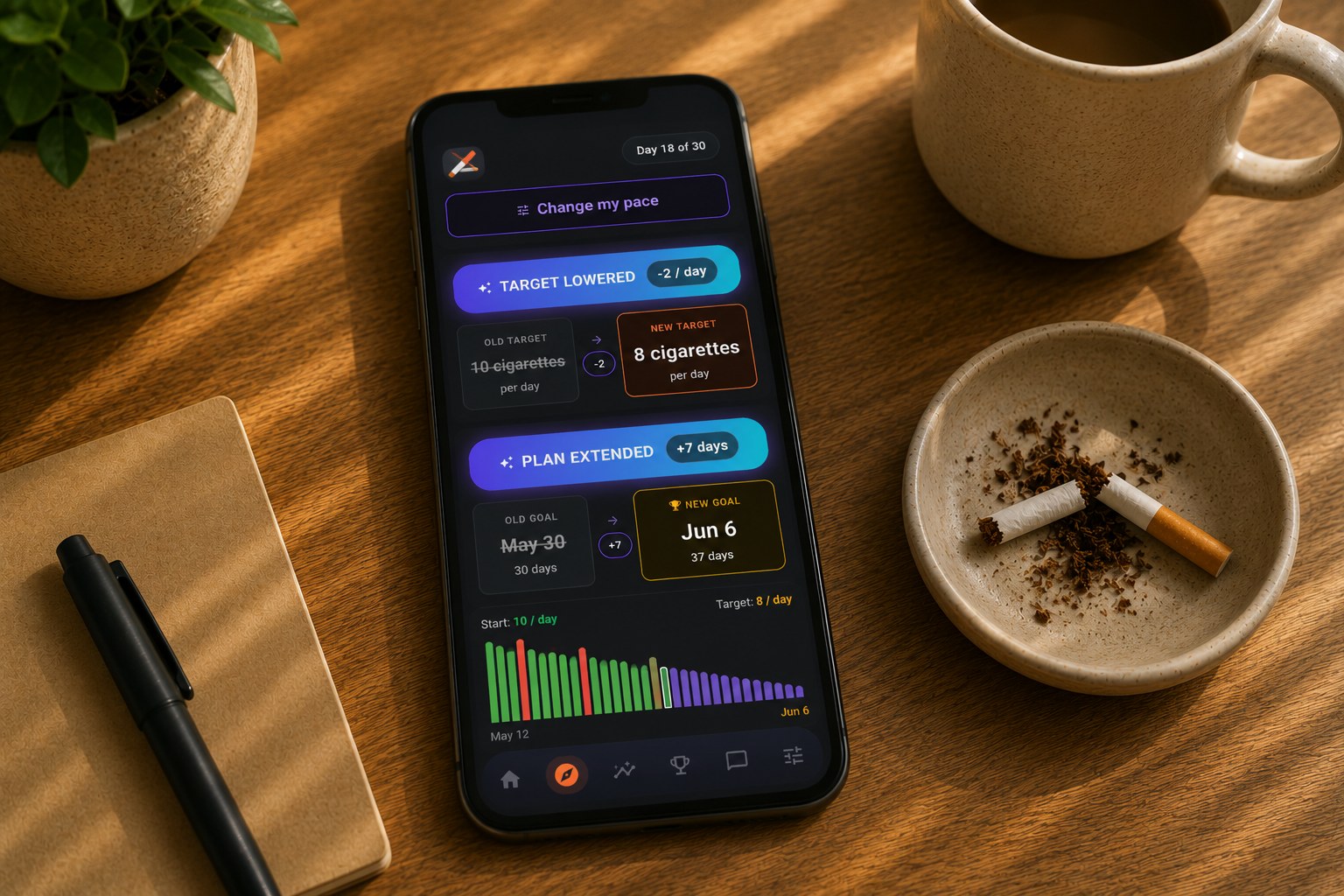
If you're at 15 cigarettes a day, HabitIt, the AI habit tracker, sets you up with a daily reduction target that drops you to zero over 8 weeks through its quit-smoking plan builder. The structure is simple. Today's target sits on your phone, you log each cigarette as you smoke it, and by 3pm the app knows where you stand. When you go over - and at some point you will - tomorrow's target shifts slightly to absorb the slip and keep the quit date in reach, since it's an automatic habit plan rather than a fixed streak. No reset, no guilt screen. Available on iOS and Android. The free tier covers the full taper core; you don't need a subscription to build or follow the plan.
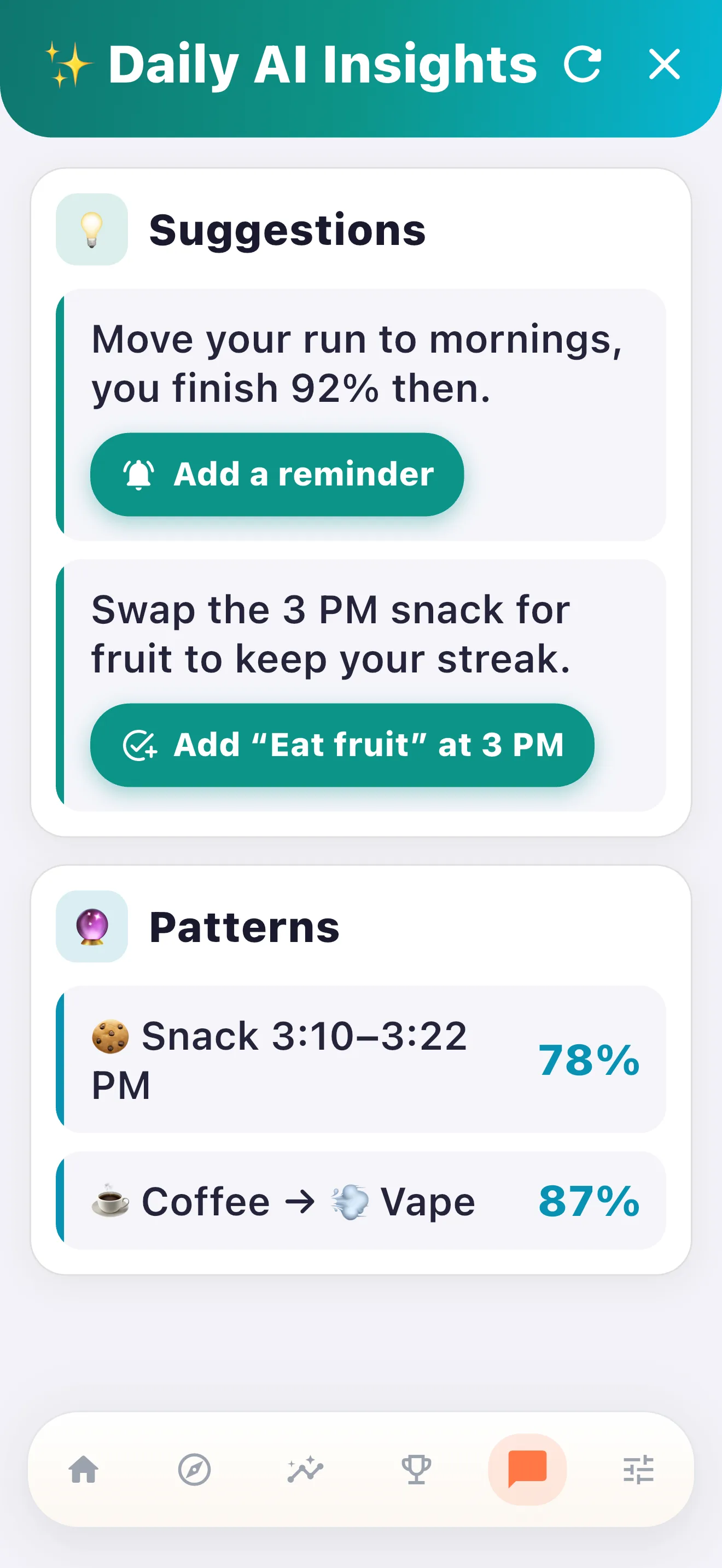
Cigarette urges attach themselves to specific moments. The after-breakfast one, the post-lunch smoke break, the one that appears when a call runs long or a meeting goes sideways. As a smart habit tracker, HabitIt's pattern detection picks up on those clusters once they're in the log. "Your smoking rate doubles on high-stress days and clusters between 12-2pm" gives you two windows to work with - a plan for lunch, and something ready for when a stressful call ends, before the urge has already made the decision.
2. Smoke Free
Smoke Free's strongest feature is the health milestone timeline. Twenty minutes after your last cigarette, heart rate and blood pressure start dropping. By 12 hours, carbon monoxide levels are back to normal. At 24 hours, heart attack risk starts falling.[1] Smoke Free surfaces these milestones as you hit them, which hits differently when you're in the cravings window and need a reason to hold. The money saved counter is also genuinely motivating - if you were buying a pack a day, the dollar amount climbs fast enough to feel real. There's a craving log where you can note duration and intensity, which matters for identifying your personal trigger patterns over time. Paid tier adds coaching content and deeper analytics. The free version is solid.
3. Quit Now!
No subscription wall, and that alone earns Quit Now! its spot here. A lot of quit-smoking apps are technically free to download and then lock the useful features behind a monthly fee; Quit Now! is genuinely free in the ways that count. It tracks cigarettes not smoked, money saved, and life regained using WHO estimates on smoking-related life loss - the "life regained" number starts small and builds in a way that compounds psychologically over weeks. It's not fancy - no taper math, no craving-response training baked in. If you're doing a cold-turkey attempt and want to track the motivational numbers without paying $8 a month, Quit Now! does that cleanly.
4. Kwit
Kwit goes full gamification. Your quit journey evolves a character, unlocks achievements, and turns the quit into something closer to a mobile game than a health tracker. For a specific kind of person - usually younger users who grew up with mobile games as a motivational frame - this works surprisingly well. The game loop gives you something to check in on beyond the raw count, which reduces the psychological weight of the quit itself. Less useful if you're doing a pharmacological taper and need precise dose tracking; the app doesn't have the granular daily-reduction math that taper-first apps carry. Pick it if the game element is genuinely motivating for you. Skip it if that sounds exhausting.
5. QuitNow (NovaDT)
QuitNow has the cleanest interface on this list outside of HabitIt. The tracker is simple, the stats are clear, and it doesn't try to do too many things. The community board is the differentiator: there's a social feed where users post updates on their quit, and you can engage with it or ignore it depending on your temperament. If social accountability is a driver for you - if telling someone about your quit makes you more likely to hold it - the community component adds real value. And when the feed starts to feel like obligation pressure, you can turn it off and use the tracker on its own. Good balance of features for a free app.
6. Nope - Stop Smoking
Completely different frame from the taper approach. Nope is built around refusal training: when you feel a craving, you tap "Nope" and the app logs it as a win. The number that grows is refusals - a library of times you said no, which does something different in your head than watching a cigarette count fall toward zero. Use it alongside a taper app. If you're mid-taper and having a rough day, opening Nope and logging three refusals in a row can get you through the afternoon. Standalone, it suits cold-turkey attempts better than structured tapers, since there's no daily reduction math baked in.
7. MyQuit Coach
Built with National Cancer Institute backing and available free from Smokefree.gov. The framework is evidence-based in a way commercial apps aren't required to be - actual cessation researchers developed it, and nobody on that team was optimizing for daily active users. The interface shows its public-health-program origins and lags the commercial options in polish. But the quit plan structure is solid, the coping strategy library is comprehensive, and it doesn't have a subscription asking you for money every time you open it. If you distrust the commercial apps or want something built on public-health evidence with no venture money behind it, this is the pick.
8. iQuit
iQuit strips out nearly everything - no gamification, no social feeds, no character to evolve. You set your start date, you set your daily target, and you log. The app gets out of the way. For some people - especially those who found the other apps too stimulating or too gamey or just too much - the right intervention is something exactly this minimal. If complexity has caused you to abandon previous quit-tracking attempts, iQuit's stripping-down is a feature, not a limitation. Available on iOS.
9. Cessation Nation
The community component is the strongest on this list by a significant margin. Cessation Nation is built around a forum structure where you can find other quitters at the same point in their quit - day 4, week 3, month 2. That specificity matters. Someone who is on day 4 right now knows exactly what day 4 feels like, so the support lands where generic encouragement slides off. Smoking is also deeply social - a lot of it happens with the same two coworkers at the same door at the same times of day - which means social accountability works differently for smoking than it does for, say, quitting sugar. The community replaces some of that social infrastructure. Not for everyone; the forum format is older-internet in its vibe. For the right person, it's the best tool on this list.
- Best structured taper: HabitIt
- Best health-milestone timeline: Smoke Free
- Best free, no subscription wall: Quit Now!
- Best gamified motivation: Kwit
- Best community + clean interface: QuitNow (NovaDT)
- Best refusal-training approach: Nope - Stop Smoking
- Best evidence-based, non-commercial: MyQuit Coach
- Best stripped-down minimalist: iQuit
- Best deep community accountability: Cessation Nation
How to use a quit-smoking app that holds
The app is not the quit. An app is a container for a plan, and with nothing inside it, it can't do much for you. So build the taper schedule first, then put it into an app that can hold it and track it daily. In practice that starts from your current daily count - say, 15 cigarettes. A taper plan drops that by about 20-25% per week, so week one is 12, week two is 9, week three is 7, and so on through an 8-week arc that ends at zero. That schedule is the plan. The app holds it.
The daily target matters more than the streak counter. This is the conceptual break from most quit-smoking apps, which track "days clean" as the primary metric. Days clean is a binary measure that treats a single cigarette on day 46 as a complete restart. Daily target tracking treats the same event as a data point: you smoked one today when your target was zero, so tomorrow's plan recalibrates slightly. The quit is still on track. The psychological difference between those two frames is enormous, especially in the first two weeks when slip probability is highest.
Handling slips well is a skill, not a personality trait. When you go over your daily target, the move is to note it and let the app absorb it. Leave the quit date alone, and skip the failure speech. Look at what was happening when the slip occurred - time of day, who you were with, what you were feeling - and write it down. That's a craving trigger. Next time that configuration shows up, you have one more second of warning than you did before.
Stacking with NRT is not cheating. Nicotine replacement therapy and a taper app work the same quit from two sides. Patches handle the baseline nicotine the body is used to, while the app carries the daily ritual and the psychological structure. Together they cover more of what makes smoking hard to quit than either does alone. The full protocol is in the quit smoking taper plan post.
If what brought you here was a search for the best free quit smoking app, the short answer is that HabitIt covers the taper and the slip-handling on its free tier, and each of the other eight is here for one specific thing it does better than the rest.
Common failures with quit-smoking apps
Downloading the app but not setting a plan. The most common failure mode, by a wide margin. People download a quit-smoking app on a motivated Tuesday, open it once, and don't touch it again because there's nothing inside it telling them what to do today. The app needs a real taper schedule loaded into it before it can help. That takes about ten minutes the first time. Skipping that step makes the app useless; it's just an empty container sitting in your dock.
Using only the app without NRT or behavioral support. Apps are behavioral infrastructure; they track what you're doing and make the plan visible. They don't address the chemistry side of nicotine dependence. If you're smoking a pack a day, the first week of a cold-turkey attempt involves real withdrawal symptoms: headache, irritability, difficulty concentrating. An app alone doesn't blunt that. NRT patches can. Using both is the move for heavy smokers. The app without the chemistry support is a plan without the fuel.
Treating a slip as failure. One cigarette at a wedding on day 46 is a data point about weddings, and an app that answers it by zeroing a 46-day counter is teaching you the wrong lesson. The "I already failed, may as well finish the pack" spiral is what ends most quits, and it usually starts at the reset screen. Note the trigger and keep the plan running.
Quitting the app on day 10 because you "feel fine." Days 8 through 14 are the deceptive window. The worst withdrawal is over, you're on a short streak, and the app starts to feel like unnecessary overhead. This is exactly when the behavioral architecture needs to stay in place, because the triggers haven't gone anywhere - they're just dormant. The cravings that come back at week 6 ride on habit and setting - the drive home, the friend who still smokes at the same bar - long after the chemical pull has faded. Without the app still running, there's nothing holding the structure when those show up. Stay on the app for at least 30 days past your quit date.
The "right" app on this list depends on your approach. If you're doing a structured taper, HabitIt is the tool built for it. If you're doing cold turkey and want the motivational numbers, Quit Now! covers that free. If you need community, QuitNow or Cessation Nation have it. If you want evidence-based without commercial intent, MyQuit Coach is the pick. For a full overview of the approaches themselves - not just the apps - the methods comparison post covers what the clinical literature says about each.
Citations
- American Cancer Society, "Health Benefits of Quitting Smoking Over Time." cancer.org
Build your quit smoking plan today
Free 3-day trial of all features. After that the free tier covers the basic taper. No subscription required.


Get the Free Quit-Smoking Plan
Drop your email and we'll send a printable plan you can fill in and track. Occasional updates (max 1 per 2 weeks).
Success! Now check your email to confirm your subscription.
We respect your privacy. Unsubscribe at any time.