Top 10 Ways to Quit Smoking Without Cold Turkey

Cold turkey works for about 3-5% of smokers at the 12-month mark. The 95% who slip aren't weak; they're using the wrong tool for a habit with real chemistry and a hard daily ritual. Below are the 10 best non-cold-turkey approaches, ranked roughly by clinical 12-month abstinence rates. Most are free. Three need a prescription. None of them work alone; the ones that hold combine two or three of these into a stack, with a structured taper at the center. Read it like a menu, not a ranking. Whatever stack you pick, run it inside an AI habit tracker with an automatic daily plan so the taper math doesn't live in your head.
The list
1. Structured nicotine taper
Pick a defined quit date. Measure the current daily count. Cut it by 20-30% a week until the last week holds at a low dose, then quit on the date already picked. That's the whole method, and it needs no doctor. Gradual versus abrupt quitting is genuinely contested in the research: some trials show abrupt doing slightly better, a 2019 Cochrane review calls the two roughly equal. What a taper beats isn't a well-supported abrupt quit. It's the totally unaided kind, the one that works for maybe 3 to 8 people out of 100 at twelve months. Structure is the real advantage here, not some proven multiplier over cold turkey. The full week-by-week version lives in the quit smoking taper post. Add a patch (#3) and the odds improve further.
2. Varenicline (Chantix)
Varenicline partially blocks nicotine receptors, so a cigarette during a quit attempt delivers less of a hit, and cravings drop too. Trial data puts twelve-month abstinence somewhere in the high teens to mid-20s percent, roughly two-and-a-half to three times the odds of placebo. Strongest single drug on this list, by a real margin. The catch: vivid dreams, some nausea, and a small but real risk of mood changes. One doctor visit, then about 12 weeks of use. It sits at #2, not #1, because the drug alone, with no taper or behavioral plan running underneath it, holds worse than the same drug paired with one.
3. NRT patches
A patch on the skin, worn all day, delivering a steady dose of nicotine with none of the smoke. Start at the strength matching current use, step it down over 8 to 12 weeks. Cochrane's pooled data puts the patch at roughly 1.6 times the unaided quit rate, the number behind the "almost doubles your odds" line common in public health materials, and it climbs further paired with a taper. What a patch can't touch is the ritual: the hand-to-mouth motion, the break outside, the after-dinner cigarette. That part still needs the taper or the behavioral piece running alongside it. Over the counter almost everywhere. Cheapest reliable option on this entire list.
4. NRT gum
For the craving windows a patch doesn't fully cover. Chew, park it between cheek and gum, and it's working in 2 to 4 minutes. It does something a patch can't, too: occupies the hand and mouth, which for plenty of smokers was half the actual habit. Works best as a supplement to a patch rather than the only intervention. Chew during the moments cigarettes used to happen; chewing constantly just relocates the habit to gum instead of removing it.
5. NRT lozenges
Same nicotine, dissolved instead of chewed. Easier on the jaw, easier on a sensitive stomach, discreet enough for a meeting or a flight. Same job as gum: a craving spike, handled in the moment, rather than an all-day baseline. Pair with a patch or a taper.
6. Bupropion (Wellbutrin / Zyban)
An antidepressant, sold as Wellbutrin for depression and Zyban for quitting smoking, same molecule either way. Twelve-month abstinence in trials lands around 15 to 20%, below varenicline but real, and it's a genuinely good fit for smokers also dealing with depression, since one prescription is doing two jobs at once. Insomnia and a small seizure risk at higher doses are the trade-offs. Like varenicline, it holds better with a behavioral plan underneath it than it does running alone.
7. Cognitive-behavioral therapy (CBT) and counseling
This one goes after the trigger, not the chemistry. A therapist or a structured workbook walks through the specific moments smoking happens, the thought that shows up right before, and what to do instead. Alone, results are modest. Paired with NRT or varenicline, it roughly doubles either one's solo rate. Chemistry mostly fades by month three. The trigger-response loop doesn't, not without something addressing it directly, which is what CBT is for. Group sessions cost less than individual ones, and most state quit-lines run this free by phone.
8. Quit-smoking apps
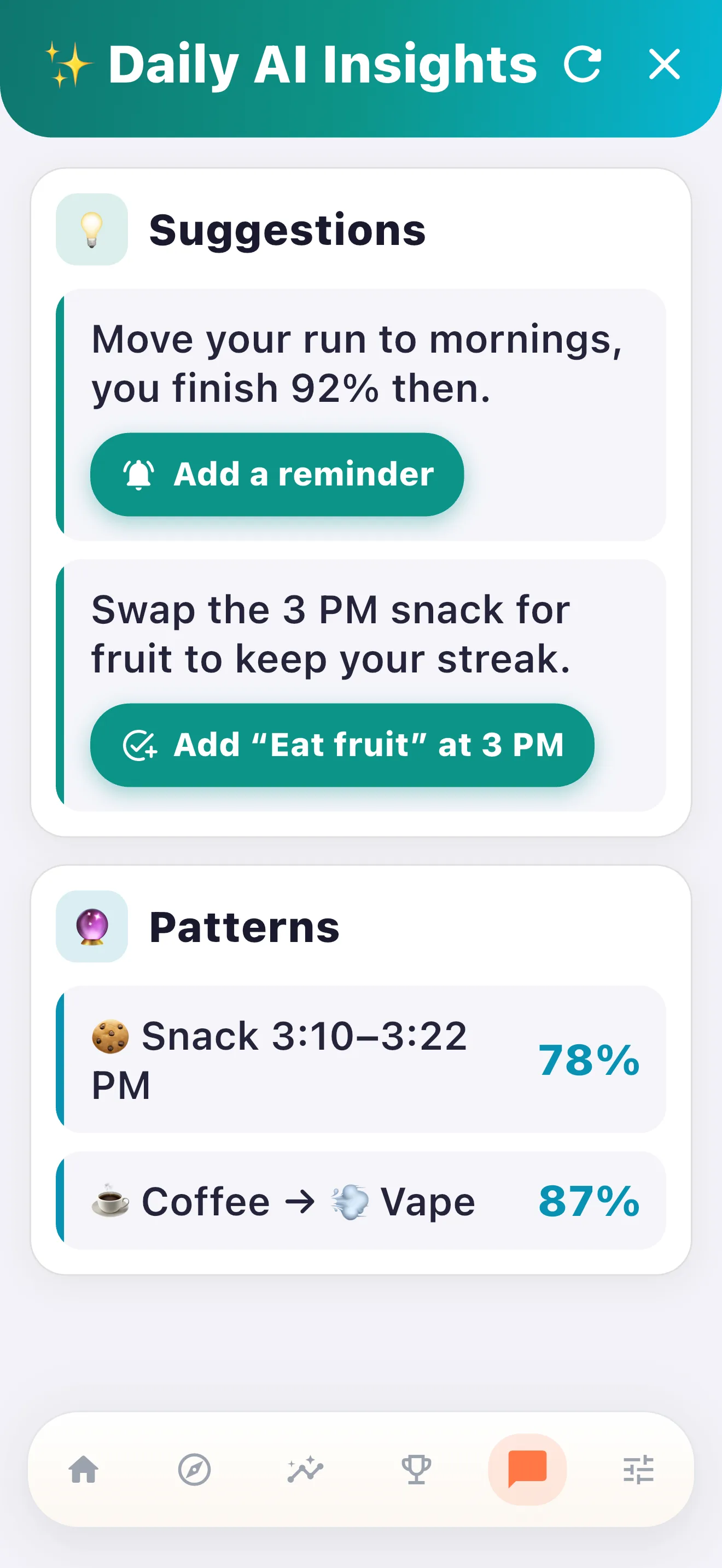
HabitIt's own category, worth saying upfront since the ranking here could look self-serving otherwise. An app's real job is three things: holding the taper schedule so today's number lives on a phone instead of in your head, logging cravings so a pattern becomes visible, and recalculating after a slip instead of zeroing a streak over it. Alone, an app is a modest tool at best. It's not a substitute for NRT, a prescription, or counseling. Paired with one of those, it earns its keep by catching the daily tracking people are bad at doing in their heads, which is exactly where plans quietly die between week two and week six. Apps to quit vaping compares specific options, and the quit-smoking app roundup ranks nine of them by how they handle tapers and slips specifically.
9. Hypnotherapy
Mixed, and that's being generous. A subset of people find it genuinely useful for the identity side of quitting. Randomized trials mostly show a small bump over placebo, nothing more. Worth a session or two if tapering, NRT, and an app have already been tried and didn't hold. Not the place to start.
10. Acupuncture
Weakest evidence here, full stop. Meta-analyses put its effect close to placebo. It stays on the list because placebo effects are real, and a weekly appointment gives some people an accountability anchor that has nothing to do with needles. Last resort. Not a first or second move.
How to stack these
Most heavy smokers get poor results running any one of these alone. A pack-a-day quit meant to hold long-term needs at least three mechanisms working together: a taper for the ritual, a patch for the chemistry, an app for the daily tracking neither of the first two covers. That's under $30 a week in NRT, and each of the three clears cold turkey's roughly 3-8% unaided baseline on its own, let alone stacked together. Add varenicline if a doctor's on board and the odds climb further. Running just one of these and expecting it to hold is the single most common way this whole approach fails.
Lighter smokers, under 10 a day, or the social-only kind, need less. A taper plus an app usually covers it; NRT might be more chemistry than the habit actually requires. Heavy daily use calls for the full stack. Weekend-only smoking mostly needs the behavioral piece and fewer chances to light up in the first place.
Search terms like ways to quit smoking without cold turkey or quit smoking methods ranked by what actually works all land here. A quit-smoking plan takes about ten seconds to build at a quit smoking habit tracking plan, free, no signup, and it handles methods #1 and #8 automatically.
Common failures when picking from this list
Picking only one method. This is the big one. Stacked interventions beat single ones across decades of data, consistently. Quit with NRT before and slipped? The next attempt adds a taper. It doesn't swap NRT for a different solo method. Replacement habits cover the behavioral piece most solo attempts never touch.
Treating a prescription like a silver bullet. Chantix and Wellbutrin both work, and both work better with a taper underneath them. Skip the behavioral side, expect the pill alone to carry it, and relapse rates climb.
Reaching for hypnotherapy or acupuncture first. Try a structured taper or NRT before either of those. They're reasonable third or fourth attempts. Not where anyone should start.
Dropping the patch on day 14 because things feel fine. Day 14 is exactly when the body has adjusted, which is the point, not the finish line. Stop then and withdrawal starts right as the taper was supposed to be finishing it off. Hold the protocol the full 8-12 weeks. The day-4 wall hits a patch quit too, for anyone not braced for it.
Not telling a single person. The quietest failure mode on this list, and maybe the most common. Smoking is social as often as it's chemical. Three coworkers on the same break schedule matter to a quit attempt. Tell one of them, not for support exactly, just so the lighter doesn't casually appear at 10:30am.
Beyond the list
Quit-smoking research has produced something like 30 distinct methods over 50 years. Maybe five of them have real evidence behind them. The rest is noise, which is the actual reason this list stops at ten instead of thirty: the bottom half here, hypnotherapy, acupuncture, and the herbal alternatives that didn't even make the cut, are weak-evidence side bets, not core moves. Lead with the top six. Stack two or three. Give it 12 weeks.
The first 90 days are mostly chemistry. The next 270 are mostly identity. Methods one through seven above handle the chemistry window. CBT is really the only one built for what comes after, once the patches are gone and the cravings are closer to memory than sensation. Varenicline plus a taper gets someone through the chemistry. CBT, or something as simple as a daily one-line journal, gets them through the part after that. Even a one-line-a-day journal built around the quit can do real work here, over months.
The prescription options have one real bottleneck: the appointment. Most primary care doctors can write either script in fifteen minutes, and a lot of insurance covers both with no copay, given what smoking costs the healthcare system down the line. State quit-lines run free telehealth visits with a prescribing clinician if a copay or an office visit is the actual obstacle. The pharmacology here is more within reach than most people assume. Making the appointment is the only hard part.
A meta-point about evidence rankings on this list: the order is roughly by 12-month abstinence rates from randomized clinical trials, with the prescription options slightly outperforming the OTC ones on average. But the right tool for you isn't necessarily the highest on the list; it's the one that matches your specific failure pattern. If you've previously quit, made it to week six, and slipped on a social trigger, you don't need a stronger chemistry intervention. You need the CBT or community piece you skipped. Read your own quit history before picking the methods; the gap in your last attempt is where your next attempt should add.
Build your quit smoking plan today
Free 3-day trial of all features. After that the free tier covers the basic taper. No subscription required.


Get the Free 10-Method Stack Worksheet
Drop your email and we'll send a printable plan you can fill in and track. Occasional updates (max 1 per 2 weeks).
Success! Now check your email to confirm your subscription.
We respect your privacy. Unsubscribe at any time.