How to Quit Social Media: A 30-Day Detox Plan
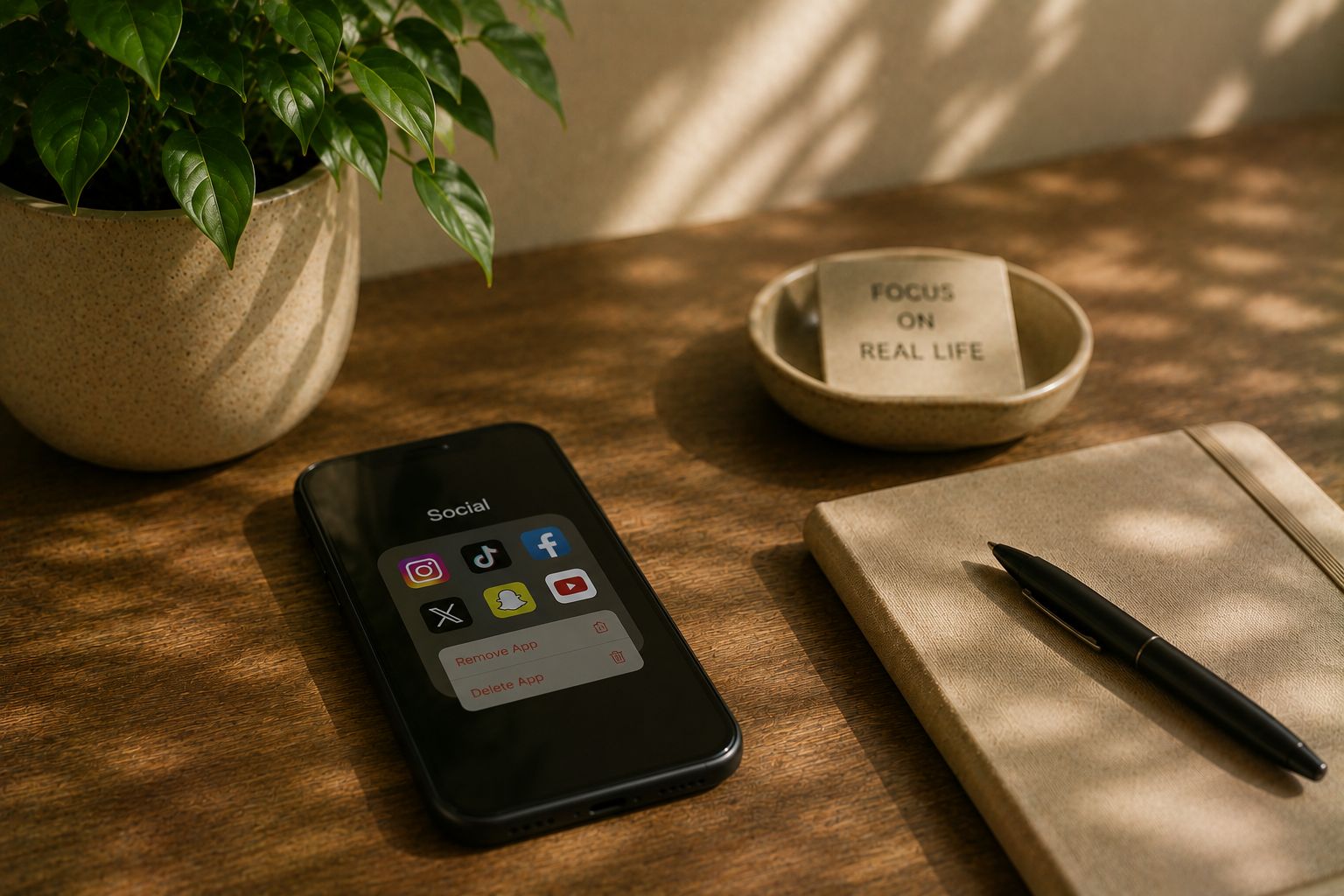
Your screen time report said 4 hours yesterday, and you know two of those were Instagram, TikTok, and X across dozens of short opens of the apps you didn't decide to open. You've tried "less screen time" before; it lasted four days. The actual problem isn't willpower or that you love these apps; it's that the apps were engineered for compulsive opens with infinite scrolls and notification triggers stacked specifically to defeat your willpower. A 30-day detox that doesn't try to out-willpower them, that closes the access points layer by layer, and that gives you something to do in the empty scrolling slots is what actually breaks the loop. An AI habit tracker with an automatic daily plan handles the day-by-day step-down for you.
The pattern you already know
You open Instagram at a red light. You open TikTok in line for coffee. You check X first thing in the morning before your eyes are fully open. None of these openings were decisions; they were reflexes the apps trained over years of small dopamine hits. The combined daily time wasn't a single sitting; it was dozens of micro-sessions, each 30 to 90 seconds, scattered across your day. You don't remember the last hour you spent on social media because you didn't experience it as an hour; you experienced it as scattered small openings you didn't even count.
Cold-turkey quits on social media fail for a specific reason most people don't name: the social part. Your friends are there, your group threads reference posts you didn't see, the wedding photos are on Instagram, the new job announcement was on LinkedIn. Going completely dark cuts a real source of social connection, and after about 5-7 days of cold turkey, the FOMO + isolation + boredom stack and you reinstall. This isn't weakness; it's the social-fabric tax the platforms have built around themselves on purpose.
This post is the structured-detox version. You're not necessarily trying to delete social media forever (though you can if you want). You're trying to taper from 3-4 hours of fragmented daily scrolling down to either zero or a deliberate 15-30 minutes a day at chosen times. The taper handles the chemistry/dopamine side; the access reductions handle the friction side; the replacement ritual handles the social-and-boredom side. All three are required.
Why most quit-social-media attempts fail by day 4
Deleting the apps but leaving the accounts intact is the single most common failure pattern, and it's usually what dooms the rest before day four gets a chance. Instagram comes off the phone Sunday night. By Tuesday it's back open in the phone's browser "just to check one thing," which turns out to be just barely usable enough to keep using. By Thursday the app is reinstalled because the browser felt clunky and there's suddenly "a real reason" to check. It's the same shape as quit-Amazon attempts: the platforms are built to survive exactly this kind of willpower contest, which is why the app itself has to actually leave the phone, not just get demoted to a browser tab.
Two smaller gaps usually finish the job. Not planning for the social cost is one - friends will text about something they saw on Instagram, the group chat will reference a meme nobody outside it saw, and that disconnection is real information loss, not just addiction talking. Without a plan for it, day 5 usually ends in a re-install "to stay connected." Telling two close people ahead of time and asking them to text directly instead of assuming the feed was seen closes that gap before it opens. Not filling the evening is the other one: two hours a day of scrolling disappearing leaves a real block of time, the brain pattern-matches that emptiness to "open app," and a passive replacement like TV just fires the same dopamine pattern from a different app. The doomscrolling post covers why the replacement has to actually engage hands and attention, not just fill silence.
The plan below handles both gaps by force.
The 30-Day Plan
This assumes a baseline of about 3 hours/day of social media use, which is on the high end of the roughly 2.5-hour global average and typical of a heavier daily user. If you're at 4-6 hours, run the plan over 6 weeks and add a "screen time data export" reality check at the start. If you're under 1 hour/day, you don't really need a quit plan; you need a targeted block on the one app that's eating you.
Instagram, TikTok, X, Facebook, LinkedIn, Reddit, anything with an algorithmic feed. All deleted from the phone. The browser versions still work (you can post if you need to), but the friction of opening a browser is ~10 seconds instead of 1 second, which is exactly enough to make most micro-opens not happen. Cap at 2 hours/day total across all platforms. Track honestly via your phone's screen-time report. The replacement ritual installs this week too: a specific 1-hour evening activity that fills the slot.
Cold Turkey, Freedom, LeechBlock, or any equivalent. Block Instagram, TikTok, X, etc. except during two daily windows (commonly noon for 30 minutes, 8pm for 30 minutes). Outside those, the browser blocks the site. This is the chemistry step: limiting WHEN you can use breaks the always-available expectation that keeps you reaching reflexively. Cap total social use at 1 hour. The replacement ritual now runs in the time you used to fragment-scroll throughout the day.
Deactivate, not delete. Deactivation lets you come back if you want; deletion is permanent for some platforms. The deactivation removes the account from the feed and stops the recommendation algorithm from learning from you, which removes a big chunk of the pull-back mechanism. Pick the one platform you've been opening most (often Instagram or TikTok). Cap total social at 30 minutes/day from the other accounts you keep. By this point the replacement ritual is well-established and the empty evenings feel less empty.
The sustainable cruising altitude. Two paths: full zero (no social at all, for users who want a clean break and have replaced the social-connection need with direct text/call), or weekly check-in (one 30-minute window on Sundays to scroll, like a controlled relapse). Both work; the choice depends on whether the cravings have faded by day 21-25 or are still active. If still active, full zero is safer; if mostly gone, the weekly check-in is fine.
The Rule That Actually Matters
Treating re-install as a real decision, not a reflex, is the load-bearing rule here. The biggest failure pattern by far is re-installing the app "just for one thing" and then never deleting it again - every re-install resets the access the entire plan is built to remove. If something genuinely needs doing (posting, messaging someone), the browser handles it with the friction intact. The app itself stays off the phone for the full 30 days regardless of how clunky that makes the one-off task.
Three smaller things back it up. The replacement ritual has to occupy the same slot the scrolling used to fill - lunch or the 8-10pm window, most commonly - with something that actually engages hands and attention (reading, cooking, a walk, a real phone call) rather than a passive stand-in like TV that fires the same dopamine pattern from a different screen; replacement habits covers why the active/passive distinction matters so much here. Telling two people and asking them to text directly is the most underrated step, since it's what actually prevents the FOMO-driven relapse around day 5 - the real friends will reach out, and the rest of the feed was mostly acquaintances and algorithm anyway. Watching for lateral moves to "less bad" platforms matters too: quitting Instagram and doubling YouTube time, or quitting TikTok for Reddit, is the same total dopamine consumption wearing a different app icon, which is why the cap has to apply to every algorithmic feed at once, not just the one platform that got deleted first.
Running the AI habit tracker plan with an app
You can absolutely track this through your phone's built-in screen-time report. Apple's Screen Time and Android's Digital Wellbeing both show daily totals and per-app breakdowns; the data is good. The reason a separate tracker helps is that it adds a daily-check ritual and a weekly cap that the OS doesn't naturally enforce. You can also use the OS-level "App Limits" feature to hard-cap your daily allowance, which is the technical implementation of weeks 1-3 of this plan.
Three things to look for in whatever you track this with. One, can you log daily total social-media time with a clear weekly cap? Two, does it tolerate a slip without zeroing the streak, because there will be slips? Three, can it remind you of the replacement ritual at the times you used to scroll?
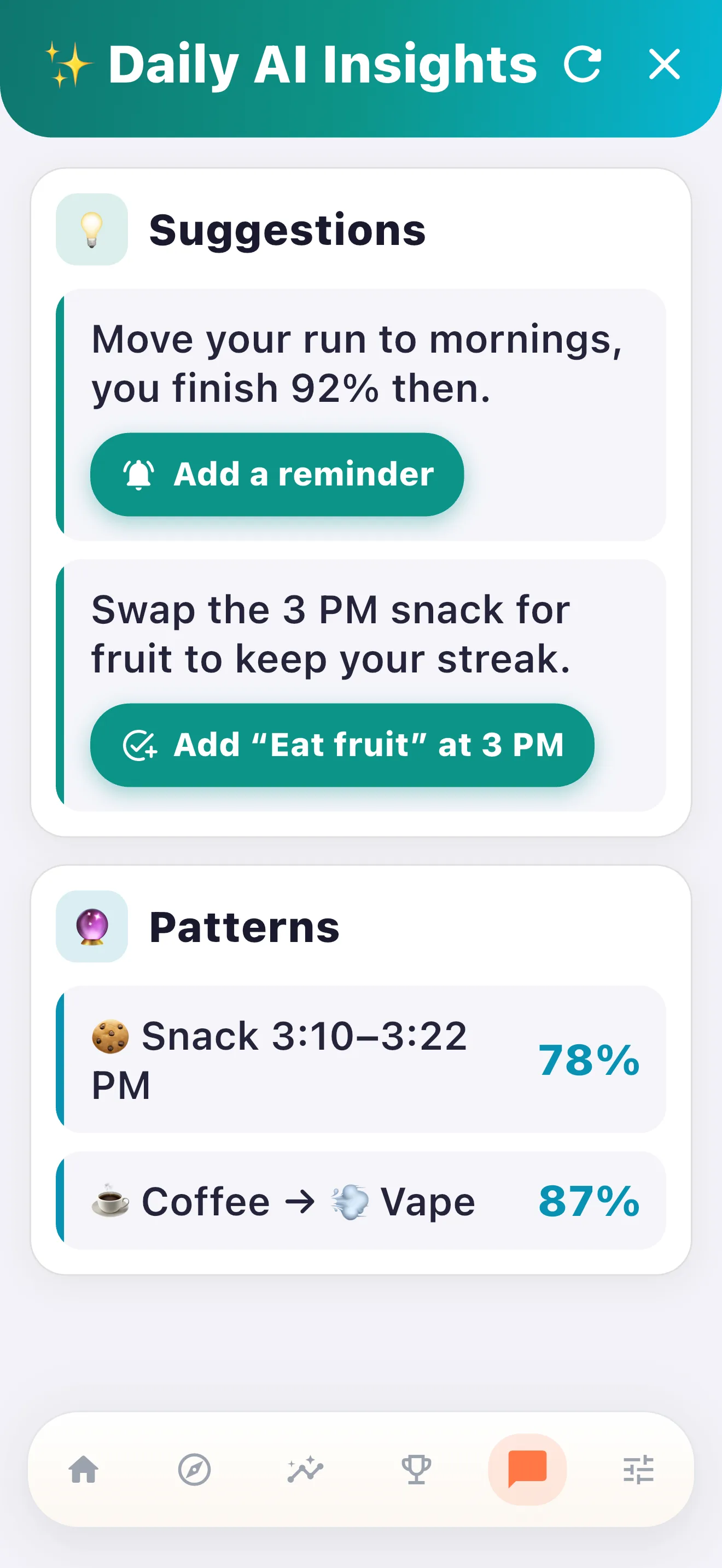
If you're looking for a how to quit social media plan, a 30 day social media detox app, or a way to quit social media without becoming a phone-free hermit, HabitIt was built for exactly this kind of structured wind-down. You can build a quit social media habit tracking plan in about ten seconds, free, no signup.
The Failure That Ends Most Attempts
Re-installing the app for "one quick thing" ends more of these detoxes than everything else combined. The thing itself was quick; the re-installation was permanent. The rule that actually holds: if one thing needs doing on social, the browser handles it, the tab closes, and the app stays off the phone regardless.
A handful of smaller drifts explain most of what's left. Replacing scroll time with other passive consumption - YouTube, Netflix, podcasts running while something else gets scrolled - keeps the same dopamine pattern alive under a different label, since the replacement needs hands-and-attention engagement, not just different content; the impulse-spending dynamic carries over here too, where empty slots fill themselves with whatever's available. Starting in December is mostly a timing problem, since holidays, family gatherings, and life updates all spike social use at exactly the moment willpower is lowest - fall or spring gives the plan an actual chance. Going full cold-turkey without a social-cost plan backfires because friends keep posting and assuming it got seen, and the disconnection that builds over a week is what the two-person notification rule exists to prevent. Quitting one platform and starting another - "off Instagram, but just on TikTok now" - is the same dopamine pattern under a different brand, which is why the cap has to apply to total social use across every platform rather than the one that got deleted first, a trap the doomscrolling post covers from the other direction.
Beyond day 30
The first 30 days train the brain that social media isn't always available. The next 30 train the new default. Around day 50 you'll notice you stop reflexively reaching for your phone in queue lines or at red lights. The pattern weakens because it stops getting reinforced. Most users report that by month three, their total social-media time settles into either zero or a deliberate 15-30 minutes a couple times a week, with months between platform binges.
The honest meta-point is that quitting social media isn't really about social media; it's about reclaiming the small-time-block attention that was getting fragmented across the day. The accumulated effect of those 80 micro-opens isn't just hours lost; it's the cognitive cost of constant context-switching that makes everything else feel harder. Users who hold the quit for a year describe better focus on their actual work, longer attention spans for books and conversations, and more presence with family. Those are the real outcomes; the time-saved math is the surface. If you want the longer-term focus side as a separate project, the morning routine post covers chaining attention-friendly habits as the foundation.
Build your quit social media plan today
Free 3-day trial of all features. After that the free tier covers the basic taper. No subscription required.


Get the Free 30-Day Social Media Detox Plan
Drop your email and we'll send a printable plan you can fill in and track. Occasional updates (max 1 per 2 weeks).
Success! Now check your email to confirm your subscription.
We respect your privacy. Unsubscribe at any time.