How to Quit Sports Betting: A Self-Exclusion Plan

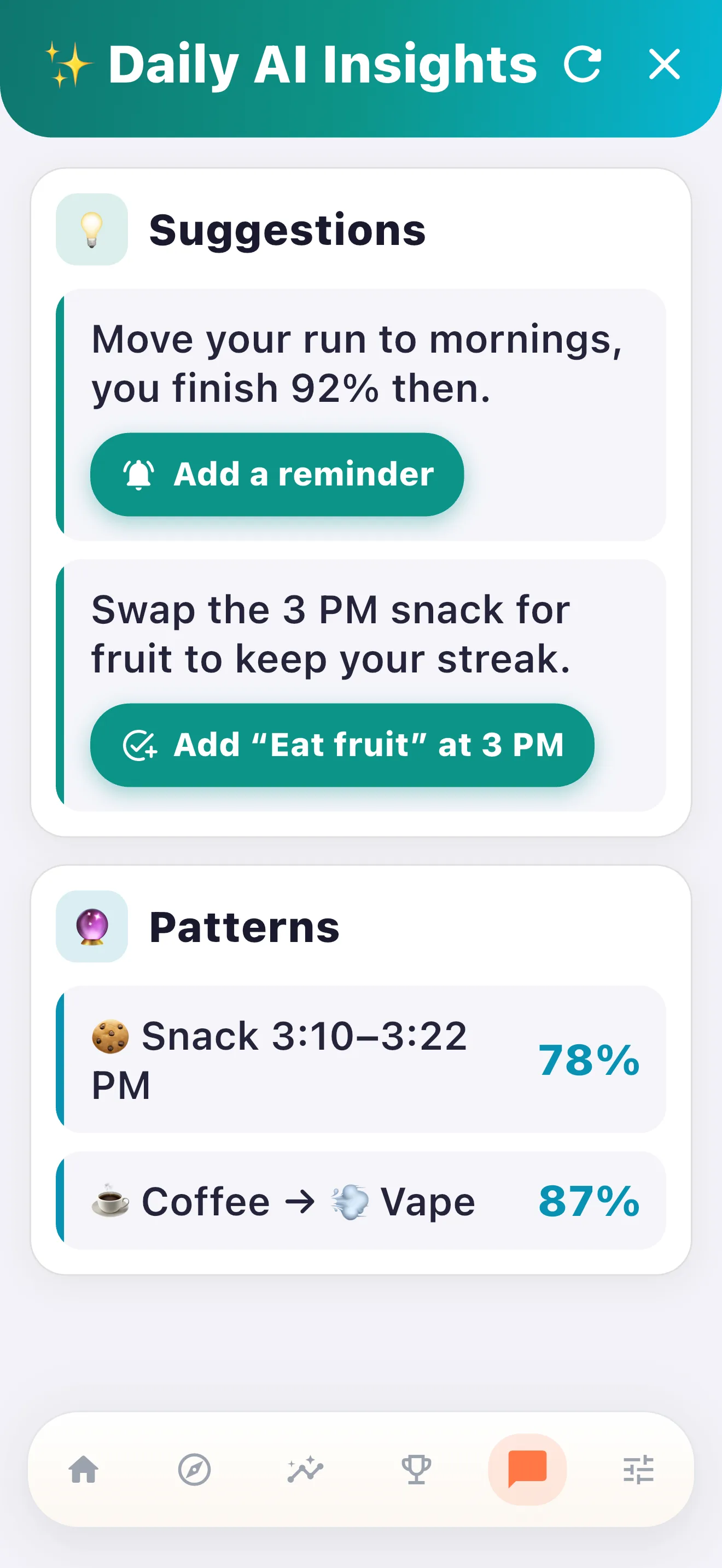
You opened DraftKings during a commercial break in 2023 because everyone in the group chat was on it. Two years later you have four sportsbook apps on your phone, a Sunday ritual built entirely around live-betting an NFL slate, and a vague sense that the parlay you lost on a Tuesday night for $200 was somehow going to be the one that hit. Sports betting addiction has exploded since legalization rolled across the US, and the apps are engineered with the same dopamine architecture that broke social media a decade earlier. Below is a 30-day plan that uses self-exclusion lists, bank-level blocks, and a replacement game-day ritual to actually break the loop. This is not a willpower post. An AI habit tracker with an automatic daily plan runs the step-down so each day has a target, not a vibe.
The pattern you already know
You started small. A $20 parlay on the Super Bowl, a $10 prop bet during the playoffs. It was fun, mostly losing but the small wins felt huge, and after a few months you had four apps installed and a Sunday slate that ran from noon to midnight. The bets got bigger, the losses got bigger, and the chase-loss math started feeling like a strategy rather than what it actually is: the most predictable trap in gambling. By month 18 you'd probably crossed the line where you tell yourself "I'll quit after I get even," which is the line you don't get back across alone.
The reason cold turkey on sports betting doesn't work for most people is that the trigger isn't the app, it's the game itself. The game starts Sunday at 1pm whether you delete the app or not. The push notification from your group chat. The bar TV showing the spread on a chyron. The Twitter feed full of bet recommendations. Every Sunday you're in a media environment engineered to remind you that everyone else is in on a thing you're trying to stop being in on. Willpower fights that environment 17 hours a day and loses by week two.
This post is the environmental version. You don't quit by sheer will; you quit by removing access through layers the system can't easily reverse. Apps off the phone. Self-exclusion enrolled at the state level (which is a legal block, not a personal one). Banking access restricted. Plus the part nobody talks about: a replacement game-day ritual so Sunday doesn't feel empty. This is the gambling cousin of the impulse spending reset and the doomscrolling taper, scaled up because the financial stakes are higher.
Why most quit-betting attempts collapse
Uninstalling the apps and stopping there is the single most common failure pattern, and it rarely survives a full week. Deleting DraftKings and FanDuel from the phone Tuesday morning feels like progress, but by Sunday afternoon both are usually reinstalled, because the friction to do that is 30 seconds and the trigger is a 4pm game spread showing up everywhere else. An app-only quit is a soft block on a system built to route around soft blocks.
Two gaps in that soft block explain most of what happens next. Skipping state self-exclusion is the bigger one: every state with legal sports betting runs a self-exclusion list, and enrolling means sportsbooks are legally required to block betting for whichever duration gets chosen (typically 1 year, 5 years, or lifetime) - the only intervention on this list the company can't undo from a phone at 4pm on Sunday. Most people skip it precisely because it feels heavy, which is exactly why it's the load-bearing step. Not planning Sunday itself is the other gap: even with apps deleted and accounts excluded, the game is still on, the group chat is still buzzing, and an empty time block will find its way to betting indirectly - prediction markets, sweepstakes apps, social-bet apps running the same dopamine architecture with no self-exclusion list covering them. The replacement ritual exists specifically to close that second gap.
The plan below handles both by force.
The 30-Day Plan
This assumes a starting baseline of 4-6 bets a week. If you're betting on every game, every day, run the plan over 6 weeks and add a Gamblers Anonymous meeting alongside week 1. If you're at 1-2 bets a week, the plan can be tighter (skip ahead to week 3 directly).
DraftKings, FanDuel, BetMGM, Caesars, ESPN BET, anything else. All deleted from the phone. You can still bet from desktop browser; the goal is the 90-second friction increase. Cap at 3 bets, half your usual. The empty Sunday slot is now a problem you've created on purpose, and you need a plan for it before the games start. Install the replacement ritual on day one: a specific 4-hour activity for Sunday afternoon. A long walk, a project at home, anything that puts you somewhere other than in front of a screen with games on. This is non-negotiable starting Sunday week 1.
Every US state with legal sports betting has a Voluntary Self-Exclusion Program (VSEP). Google your state name plus "sports betting self-exclusion" and you'll find the form. You pick a duration (usually 1 year, 5 years, or lifetime) and submit. Once enrolled, sportsbooks operating in your state are legally required to refuse your bets and freeze your accounts. This is the move that does most of the work in the whole plan. Once enrolled, even if you re-download an app, you can't place a bet. Cap drops to 1 bet this week, on a game you've already decided on by Friday.
Most major banks now have a "block gambling transactions" toggle in the app or website. Turn it on. This is your last-line defense against an out-of-state sportsbook or an offshore site bypassing the self-exclusion. The block is usually 48-hour reversible, which means even if you turn it off in a moment of weakness, you have to wait two days for the change to take effect. That cooling-off period catches most relapse attempts. Bets this week are zero. The replacement Sunday ritual runs in full this weekend.
By week 4 the access points are all closed. The remaining problem is the trigger system: betting-content creators in your feed, the group chat that's still posting parlays, the YouTube channel that does Sunday previews. Mute or unfollow every betting-related account on social. Leave the gambling-side group chats or tell the friends in them you're sitting out and mute. The triggers don't disappear; they fade as the social-and-media environment around you stops constantly poking the urge. This is the sustainable cruising altitude.
The Rule That Actually Matters
Enroll in self-exclusion in week 2 or the whole plan collapses. Every other step here - app uninstalls, bank blocks, the replacement ritual - is a softer form of friction that a determined Sunday can eventually route around. Self-exclusion is the only one with actual legal teeth, and the entire plan is built around that one step doing the real work. Skip it and everything else is just willpower wearing a structure.
Three things matter once that keystone is in place. The Sunday replacement ritual is non-negotiable even on the days it feels pointless - the whole noon-to-midnight block has to be deliberately filled with something (a long walk, a house project, anything that isn't a screen with games on) or the empty hours pull back toward betting, which is why replacement habits carry so much of the load here. Telling one person matters more for this habit than most others, since sports-betting carries more visible shame than most quits and the social context - group chats, bar nights - is half the trigger to begin with; "I'm taking 30 days off betting, don't text me parlays" is enough. Chase-loss thinking is the trap that undoes all of it: the instinct to place one bigger bet to win back what a slip already cost is exactly how a single bad Sunday turns into real financial damage, when the actual move is to let the slip be one data point and pick the plan back up the next day.
Running the day-by-day habit plan with an app
You can track this on paper. A weekly bet count, a daily check-in on triggers, a Sunday-ritual log. The reason paper plans collapse for this habit specifically is that betting is itself app-mediated; the people quitting it are phone-native. A phone-based tracker keeps the same engagement loop the betting apps used, just pointed at the right metric. The tracker measures bets-not-placed instead of bets-placed.
Three things to look for in whatever you track this with. One, can you log weekly bet counts with a clear cap (3, 1, 0, 0)? Two, does it tolerate a slip without zeroing the streak, because you might have one and the chase-loss spiral is what makes a slip into a relapse? Three, can it remind you of your Sunday ritual at the time you'd normally open a sportsbook app?
If you're searching for a quit sports betting app, a how to stop sports betting plan, or a sports betting addiction plan that doesn't just say "ask for help," the structure above is yours to start with. You can build a stop impulse spending habit tracking plan in HabitIt that covers the betting count and the weekly cap in about ten seconds, free, no signup. For the heavier addiction side, the resources at 1-800-GAMBLER or your state's problem-gambling hotline are the next step beyond what an app can do.
The Failure That Ends Most Attempts
Skipping self-exclusion because it feels heavy causes more relapses than anything else on this list. Apps get uninstalled, bank blocks get set up, the ritual gets run, and self-exclusion gets quietly skipped because enrolling in it feels like admitting something bigger than a habit. It's the one step a determined Sunday afternoon genuinely can't undo, so skipping it leaves a hole in the plan exactly the size of a re-download.
A handful of smaller failures account for most of what's left. Switching to offshore sportsbooks or prediction markets like Polymarket and Kalshi is the most common workaround once state self-exclusion actually kicks in - the bank-level block in week 3 catches most of it, but the rule genuinely has to cover all paid prediction-and-wagering, not just licensed sportsbooks, or the loophole just moves. Going to the bar to "just watch" tends to fail for a more environmental reason: the TV is showing the spread, the bartender is mid-parlay, friends are ordering bets through the table app, and the day-4 wall shows up hardest in exactly that kind of high-trigger room, which is reason enough to watch games somewhere without active betting infrastructure for the first six weeks. Treating a slip as proof the quit failed is its own trap - a Monday night bet means a Monday night bet happened, not that Tuesday's plan is void, and reading more into it than that is the chase-loss spiral talking, not the data. Telling no one rounds out the list: sports-betting addiction lives inside a social context of friends, group chats, and bar nights, and the silent version of this quit is consistently the lowest-success one, since the friend who knows is the one who stops sending Monday's parlay.
Beyond day 30
The first 30 days handle the access. The next 90 handle the identity. Day 60 is usually where the Sunday ritual stops feeling like a workaround and starts feeling like Sunday. The urge to check spreads fades around day 45-60 because the trigger environment has been muted long enough that the dopamine pathway weakens. Most users who hold the plan through 90 days report the cravings are mostly memory by month four, with occasional spikes around major events (Super Bowl, March Madness) that they can ride out without re-engaging.
The deeper accounting comes at month six when you total what you spent and lost in the year before the quit. Most people are surprised by the number. The honest accounting is what keeps the quit holding through year two, because the math of "what would happen if I started again" stops being abstract. If you want help with the financial-pattern side after the betting itself is paused, the impulse spending reset covers that adjacent territory. The 72-hour rule from there is also the right move for the rare "just one bet" urge that still shows up at month three.
Build your quit sports betting plan today
Free 3-day trial of all features. After that the free tier covers the basic taper. No subscription required.


Get the Free 30-Day Quit Betting Plan
Drop your email and we'll send a printable plan you can fill in and track. Occasional updates (max 1 per 2 weeks).
Success! Now check your email to confirm your subscription.
We respect your privacy. Unsubscribe at any time.