Top 8 Morning Routine Habits That Actually Stick
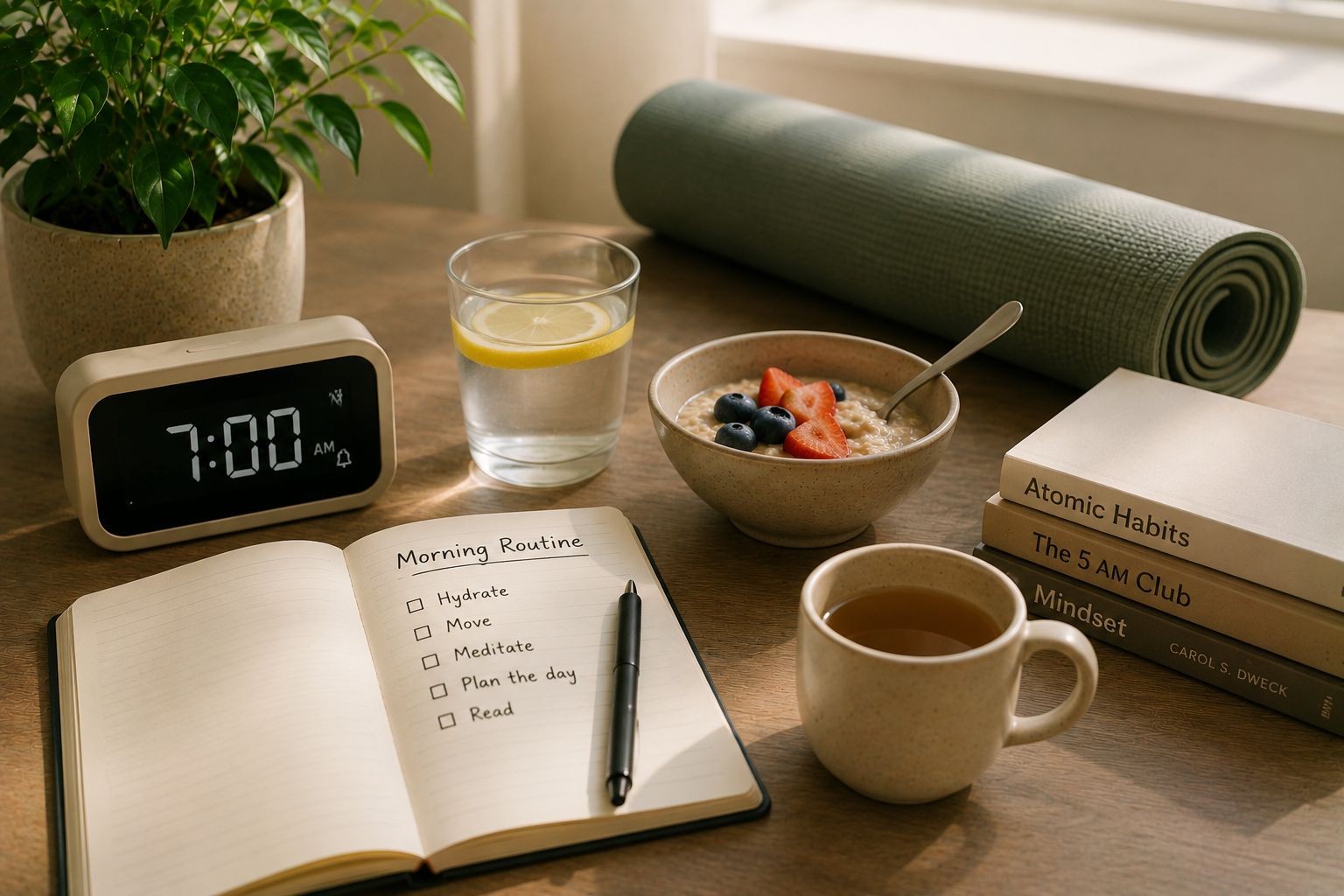
Every morning routine listicle is a Huberman/Hormozi/Hollywood fantasy: 5am cold plunge, an hour of journaling, 20 minutes of meditation, two hours of deep work, a green smoothie, a sun walk, kettlebells. Reads like an inspirational poster, holds for about 4 days. The 8 habits below are the opposite list: ranked by how often they survive a bad night's sleep, not by how good they sound on a podcast. Pick 2 or 3 of these, chain them together, and you'll have a morning routine in 6 weeks. Pick all 8 and you'll have nothing in 6 weeks.
How these are ranked
The rank order isn't "best habits" in some abstract sense. It's "habits most likely to still be running 6 months from now." That's a different list, and four things decide a habit's spot on it. Size of the minimum version matters most: a 30-second version survives a bad day in a way a 20-minute version never will. Equipment and setup are next; anything requiring a special mat, app, or ingredient adds a failure point that a bare-hands habit doesn't have. Existing trigger strength counts too, since a habit riding on something already happening (coffee, waking up) needs no willpower to remember. And sleep-dependence is the last filter: a habit that only works after a full night's rest is a habit that quietly stops running the first rough week. Rank high on all four and a habit sits near the top. The bottom of the list is still useful, just more fragile against exactly those four failure points.
Note that aspirational habits aren't on the list. Cold plunges, hour-long workouts, 30-minute meditations, ice baths, sun-staring at 5:30am. Those work for some people for some seasons; they collapse during normal life with normal sleep. If you've never built a morning routine before, none of those are the right start. Use the 8 below.
The list
1. Drink water before coffee
The most under-rated habit here, mostly because it sounds too boring to matter. After 7-8 hours asleep, the body is mildly dehydrated, and that dehydration produces almost the exact same fatigue signal as needing caffeine. Sixteen ounces of water on waking, before the coffee, clears that fatigue mechanically and makes the first hour noticeably more functional. It costs 60 seconds, needs nothing but a glass, and rides on a trigger that's already there: the walk to the kitchen for coffee. That combination is what earns it the top spot. A bad-sleep morning is exactly the morning this one matters most.
2. Make the bed
Admiral McRaven and Jordan Peterson both made this one famous, but the mechanism underneath the meme is real: finishing one small task before the day starts produces a small dopamine hit that primes whatever decision comes next. Thirty seconds, no equipment, and it survives even a rough morning because it's nearly automatic once installed. Second place instead of first because the trigger is weaker (the bed sits in a different room than the coffee), even though durability is just as high. Small impact in any single instance. Consistent for years, though.
3. Five minutes of stretching
Five minutes, not fifteen. Size is the whole reason this survives a sleep-deprived morning: small enough to hold, and the payoff (a looser spine, some activation, a mood lift) is real regardless. Pick 4-5 stretches and run the same sequence daily so the brain files it as one unit instead of a fresh decision every time. A few skipped days doesn't break it, since the anchor (post-coffee, pre-shower) holds strong. Five minutes is still more fragile than thirty seconds, which is exactly why it sits below the first two. The 5-minute daily stretch plan has a tested sequence worth just running without thinking about it.
4. Two minutes of journaling
One to three lines, nothing more. Size is the entire reason this one works: Julia Cameron's original "morning pages," three full pages, asks for a lot more time, and most people who try that version stop within the first couple of weeks. Two minutes survives because it asks for almost nothing. Anchor it to the first coffee: open the notebook, write a line or two, close it. Plenty of people who stick with this end up calling it the highest-impact thing they do all morning, and yet it lands at #4, not #1, because nothing forces it the way coffee forces the water habit, and the perceived effort still feels bigger than it is. The one-line-a-day journaling plan covers the install in more detail.
5. Ten minutes of reading
This beats habits that sound more important on paper, because of what it replaces: scrolling a phone the moment your eyes open, probably the single most damaging morning habit most people have. Ten minutes with a book instead of ten minutes in a feed resets the day's attention pattern before the day even starts. Put the book next to the coffee maker and start reading when the brew starts. What holds this back from a higher slot is setup: it only works if there's an actual book somewhere you actually want to read, which is more friction than the first four ask for. Skip it without guilt on a tight morning.
6. A short walk outside
Ten minutes is plenty. Light on the eyes in that first hour after waking anchors circadian rhythm and, oddly enough, improves sleep that same night. Movement also just opens a day differently than sitting does; people who do this report sharper focus well into late morning. What knocks it down the list: bad weather kills it, a high-rise with no easy outdoor access kills it, and a tight commute kills it too. Best suited to anyone working from home or with a flexible enough morning to step outside at all.
7. Brief meditation
Sixty seconds up to ten minutes. Despite genuinely strong research behind meditation in general, this sits near the bottom for a specific reason: nothing about a morning naturally cues it, and it carries more "this feels silly" resistance than anything else on this list. Most attempts at morning meditation fail not because the practice doesn't work, but because there's no concrete moment that triggers it, plus real internal pushback the first few tries. The 60-second start approach is built to get around both problems. For anyone who's already failed at meditation once, this is the version worth trying again.
8. A real breakfast
Protein, fat, something with fiber. Eggs and avocado. Yogurt with nuts. Oatmeal with peanut butter. Not a granola bar, not coffee with sugar, not nothing. Last on this list because it's also the highest-friction install here by a wide margin: shopping, prep, a plate, dishes after. Worth the friction anyway, since a real breakfast heads off the 11am crash and meaningfully cuts into afternoon snacking. Anyone who can manage this plus two more from the top seven has a routine that holds.
How to pick 2-3 from this list
Don't try to install all 8. The whole point of this ranking is that morning routines fail because people try to do too much at once. Pick by the following rule: 2-3 habits, including #1 (water) and one of #2-#4 (make bed, stretch, journal), plus optionally one of #5-#7 (read, walk, meditate). Skip #8 unless you genuinely want it; "real breakfast" is the highest-friction install and most people get away with a smaller breakfast without much cost.
Starting from zero, with no morning routine at all? #1 and #2 together take under 90 seconds combined and are nearly impossible to fail, so start there. Already got coffee as the one fixed thing in the morning and nothing else? Journaling or reading both anchor cleanly onto a cup that's already happening. A wake-up time that shifts around week to week points toward the short walk, since fixing circadian rhythm matters more than anything else in that situation. And for anyone dealing with morning anxiety specifically, meditation jumps ahead of the rest of the list, ranking aside.
Once you've picked 2-3, chain them into a sequence. The first habit anchors the second, the second anchors the third, and the whole sequence becomes one named unit ("morning chain") rather than three separate things you have to remember. Habit chains are the framework. The full morning routine post covers the chain-building process step by step.
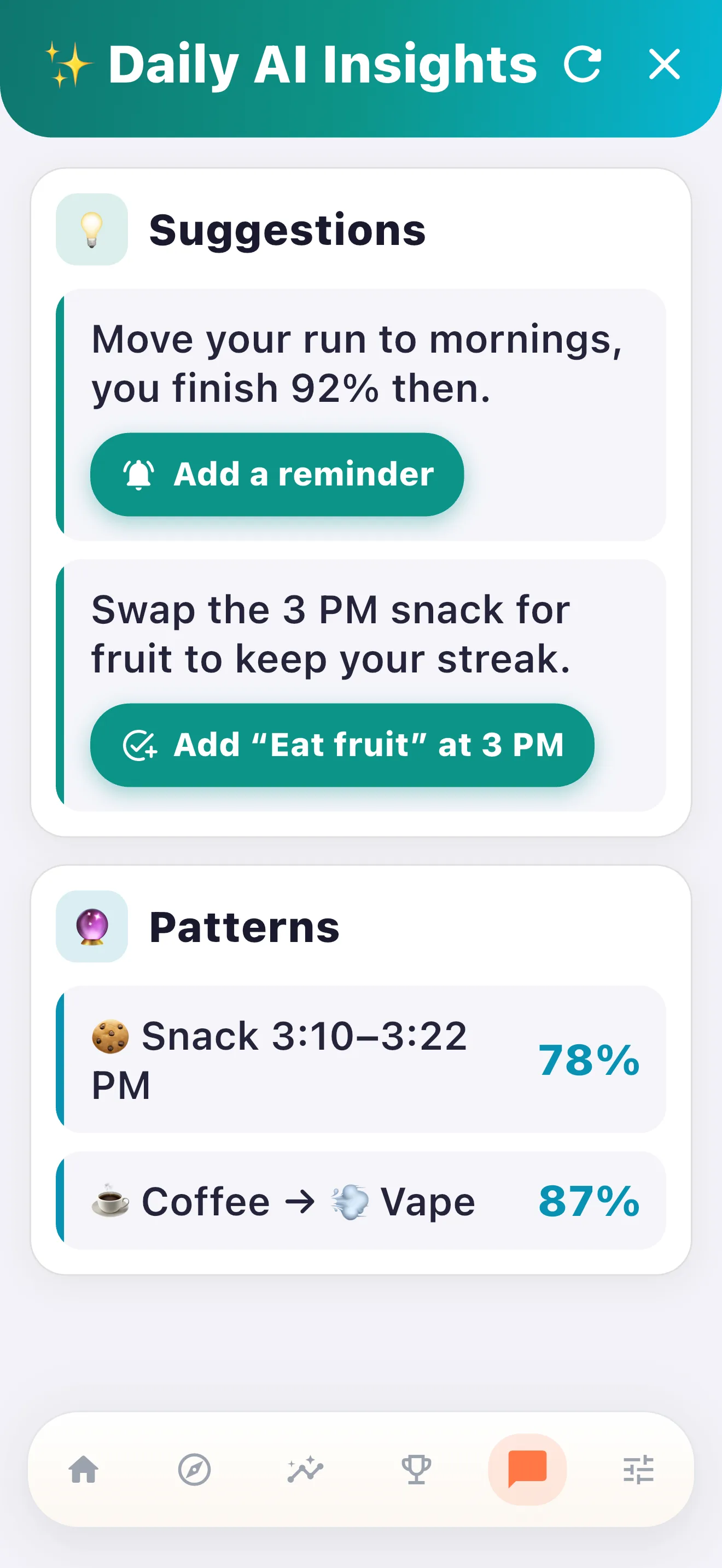
If you're looking for the best morning routine habits 2026, morning routine habits that stick, or a simple morning routine list that isn't aspirational nonsense, this is the honest version. Build a plan with 2-3 of these in HabitIt in about ten seconds, free, no signup.
Common failures when building from this list
Trying to install five or more at once. By far the most common mistake here. Monday morning arrives with plans for all eight; by Thursday there's nothing left, because five new habits stacked together land somewhere close to five times as hard as one, not five times as good. Two or three habits. Hold for six weeks. Then add.
Someone who's never journaled before doesn't open with meditation, journaling, and a workout stacked on day one. The aspirational habits go last here, not first. Prove that the smallest habit on this list, water or the made bed, actually holds before anything harder joins it.
Mondays are already the most cognitively loaded day of the week, which makes them a bad day to start something new. Tuesday or Wednesday, once the week already has some momentum going, tends to work better. The habit restart post covers this same Monday fallacy in more depth.
Skipping the anchor is the quiet failure mode. Every habit on this list rides on something already happening: waking up, coffee, the kitchen. Strip that anchor away and the habit simply stops firing the third time sleep is bad. Anchor everything, always.
One bad week of skipped mornings doesn't kill a routine by itself. What kills it is restarting the following Monday at full strength instead of at the smallest possible version. The restart protocol applies here exactly like it does everywhere else.
Beyond the list
The honest meta-point on every morning routine listicle is that the routine is the byproduct, not the goal. The actual goal is to start the day deliberately so the rest of the day has structure to land on. Three habits in a chain you can do in 15 minutes does this. Eight habits in an hour does it too but most people can't sustain the hour. Pick the version that fits your actual mornings and protect it.
If you've been trying to build a morning routine for years and bouncing off, the diagnostic is almost always "too much at once" or "no anchor." Fix those two structural issues and the routine installs in 4-6 weeks. If you've never tried and are just starting: water before coffee, every day, for two weeks. Then add make-the-bed for two weeks. Then add one more. The whole routine takes 3 months to build and lasts a decade once built. That's the math, and it's the right shape because mornings are too important to optimize fast.
What's NOT on this list and why
A few popular morning routine habits deliberately left off this list, and why:
Cold plunges and ice baths work well for the subset of people who keep doing them for years. Everyone else tends to be back to a normal shower within a month, because the activation energy stays brutal every single morning, with no exceptions and no easing in. Skip this one unless there's already a track record of doing uncomfortable things daily without fail.
An hour most mornings sounds fine until the actual morning shows up and that hour doesn't exist, which is what happens most weeks for most people. Hour-long workouts are a real option for anyone whose schedule has the room. Short walks spread across the day get close to the same movement total without needing an hour that was never really there.
Supplement stacks and bulletproof coffee sell better than they perform; the marketing outpaces the actual effect by a wide margin. Taking the supplements themselves is fine. Building an entire morning ritual around them turns into one more prep step, and prep steps are exactly what fail the bad-morning test everything else on this list survives.
Plenty of people find affirmations and visualization feel forced, and quietly stop within a couple of weeks once that feeling sets in. Real and valuable for the people they click with right away. Force nothing here: if it doesn't resonate fast, the eight habits above cover more ground for less effort.
None of these are "wrong" exactly; they're just lower-survivability than what's on the list. If your morning routine works with cold plunges, keep them. If it doesn't, the 8 habits above are the higher-base-rate options.
Build your morning routine today
Free 3-day trial of all features. After that the free tier covers the basic plan. No subscription required.


Get the Free Morning Routine Worksheet
Drop your email and we'll send a printable plan you can fill in and track. Occasional updates (max 1 per 2 weeks).
Success! Now check your email to confirm your subscription.
We respect your privacy. Unsubscribe at any time.